|
Legends Home
Site
Map
What's New!!

American History
Ghost Towns
Ghostly Legends
Historic People
Native Americans
The Old West
Photo
Galleries
Roadside
Attractions
Rocky Mtn Store
Route 66
Travel
Destinations
Treasure Tales
Legends Blog
Free E-Newsletter
Facebook
Fanpage
Twittering

Contact Us
Please report
broken links, missing pictures, or other problems online by clicking
HERE or send us an
email. Thanks!
| |
|
|
|
ARIZONA
LEGENDS
Arizona Forts of the
American West |
|

|
|
<< Previous 1
2 Next >> |
|
Camp Crittenden
Camp Date Creek
Camp Hualapai
Fort Apache
Fort Breckinridge (old Camp Grant)
Fort Buchanan
Fort Bowie
Fort Buchanan
Fort Defiance
Fort
Goodwin
Fort Grant
Fort Lowell
Fort Huachuca
Fort Lowell
Fort
McDowell
Fort Meeks/Lee's Ferry
Fort
Mojave
Fort
Thomas
Fort Verde
Fort Whipple
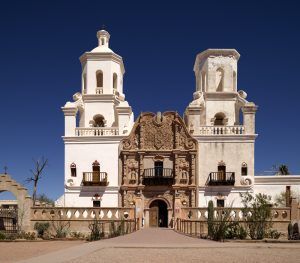
San Xavier del Bac Mission |

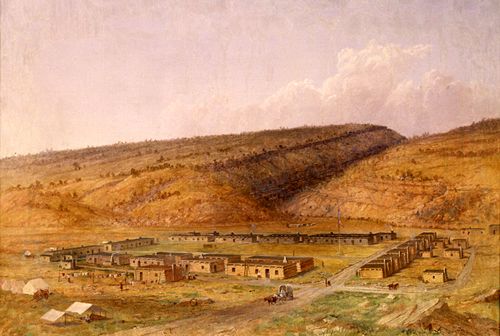
Officers; quarters at Fort Defiance,
Arizona,
Simeon Schwemberger, 1905.
This image available for
photographic prints
and downloads
HERE!
"It has
been my aim throughout present
operations to afford the greatest amount of
protection to life and property interests, and troops have been stationed
accordingly."
--
General George Crook
|
|
Camp Crittenden
(1867-1873) - Named for Colonel
Thomas L. Crittenden, who commanded the 32nd Infantry at the battles of
Shiloh, Stone River, and Chickamauga during the
Civil War, the fort was
established on August 10, 1867. Located at the
head of Davidson Canyon, just west of present-day Sonoita, Arizona, Camp
Crittenden was built adjacent to the site of Fort Buchanan. The purpose of
the fort was to protect settlers in the Babocomar,
Sonoita, and Santa Cruz Valleys, and saw much action during the Apache
Wars especially between the years 1870 and 1871. The fort was closed on June 1, 1873. Very little remains of this post;
mostly crumbling adobe and mounds of earth that were once barracks walls. It is located on private land in Santa Cruz County, Arizona.
Camp Date Creek (1867-1874) - First
established as Camp McPherson in January, 1867, the camp was a temporary
post and its purpose was to guard the road between Prescott and La Paz,
Arizona. Unlike many Arizona forts, Camp McPherson was situated in a an
area of beauty, with meadows and tall grasses along a creek called Date
Creek, because of the abundance of yucca, or wild dates, in the area. The
post was named for Brigadier General James B. McPherson who was killed in
the Battle of Atlanta on July 22, 1864. Its initial service was short
lived as just a few months later, it was moved north some 25 miles and
renamed Camp Skull Valley in March. However, it was returned to its
original located in May, and renamed Camp Date Creek. By 1868, two
companies of the 14th infantry were stationed at the post, but legend has
it, they initially spent more time fixing buildings and prospecting in the
area, than they did fighting Indians. However, that changed, when the
first recorded skirmish that took place in September, 1869, and afterwards
was followed by a number of Indian attacks. The post was moved two more
times along Date Creek during its existence. In 1871, a temporary Indian
Reservation was located near the post.
In 1874, the Secretary of War restored the
lands to the public domain, saying that the post was of no use for
military purposes. The buildings were then used by settlers for the next
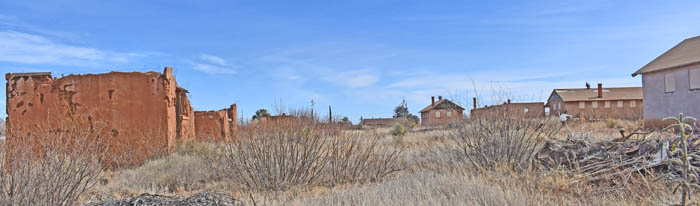
several years. Today a few original building walls still stand and an old
cemetery is located at the site. However, the cemetery graves are civilian
as the soldiers’ remains were moved to the Presidio in San Francisco,
California. The site is located sixty miles southwest of Prescott, Arizona
in Yavapai County, north of US Highway 89 in the Date Creek vicinity.
|
|
|
|
Camp
Hualapai (1869-1873) – First known as Camp Toll Gate, this post
was established in May, 1869, just southeast of Aztec Pass on William H.
Hardy’s toll road between Prescott and Hardyville (which eventually
developed into Bullhead City.)
In 1870, it was
taken over by the military to protect the road from Indian attacks, but
the troops abandoned the camp in 1873. A small settlement that grew up
around the camp became known as Juniper. Today there are just a very few
remnants and a small cemetery, but both are located on private property.
The site is located on Walnut Creek Road north of Prescott, Arizona.
Fort Buchanan
(1856-61) -
Supplementing a number of other military posts established in the
territory acquired from Mexico in 1848, Fort Buchanan (1856-61) was the
first within the bounds of the Gadsden Purchase (1853). First founded as
Camp Moore, but renamed Fort Buchanan in honor of President James
Buchanan, the post protected settlers and stages
from Chiricahua Apaches. A detachment from the post, led by Lieutenant George N. Bascom, was involved in the episode with Cochise at Apache Pass that
precipitated the Apache Wars (1861-86). At the beginning of the
Civil War,
U.S. troops were withdrawn to
New Mexico and to keep it from falling into
Confederate hands, it was destroyed in July, 1861. The following year, General
Carleton's California Volunteers occasionally camped at the site. To aid
in the renewed effort against the Apaches, the post was reactivated as
Camp Crittenden (1868-73) on a hill about one-half mile to the east.
Today, the privately owned sites of Fort Buchanan
and Camp Crittenden are used for grazing. The only remains are scattered
rocks. mounds of earth, and fragmented adobe ruins. Fort Buchanan, Arizona
was located three miles west of present day Sonoita, Arizona on the east
slope of what is now
called "Hog Canyon." Camp Crittenden was established half
a mile east on the flats.
Fort
Goodwin (1864-1871) – One of the first posts in the area, Fort
Goodwin was established in June, 1864 by California Volunteers to provide
protection for settlers in the Gila Valley. Located near a beautiful
spring about two miles south of the Gila River, the post was named for
John N. Goodwin, the first Territorial Governor of Arizona. From the
beginning, the post faired poorly due to unethical contractors, whose
adobe buildings began to crumble in just a few short years. In the spring
of 1866, the California Volunteers were relieved by two companies of the
14th U.S. Infantry and later that year, the post’s designation was changed
from fort to camp.
Another problem that plagued Fort Goodwin
were malaria-carrying mosquitoes that swarmed from a spring about 500
yards south of the post. Though the spring produced good water, it
unfortunately ran through a stagnant swampy area before it reached the
post. Finally, sickness and disease became so prevalent that the post was
abandoned in March, 1871. During the 1880s a sub-agency of the San Carlos
Reservation was located at or near the site.
Today nothing remains of the post, which is
situated on farmland. The only physical marker is a Bureau of Land
Management survey marker which indicates the original site of the fort’s
flagpole.
Continued Next Page
|
|
<< Previous 1
2 Next >> |
|
From the Rocky Mountain General Store
Old
West Exclusive Products -
Legends of America and the
Rocky Mountain
General Store now provide a number of
exclusive products that you won't find anywhere else!
Utilizing our vintage photos,
Old West
words, and original graphics, you'll find selections for
t-shirts, bumper stickers,
Old West prints and calendars, and much more. Click
HERE to see the entire line.
|
| |
|