
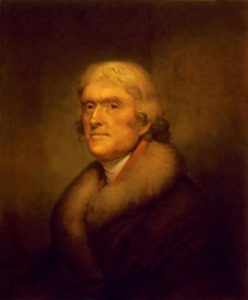
Thomas Jefferson, by Rembrandt Peale, 1805.
The Presidential election of 1800, also known as the Revolution of 1800, signaled to the world that the newly formed United States was a country where the people determined their leaders and, thus, their fate. The vote was a contentious, nonviolent battle that led to the young country’s first and only tie for President of the United States and resulted in a transfer of power without bloodshed or violence, breaking with Europe’s long history of violent takeovers.
The campaign leading up to the election was bitter, full of slander and personal attacks from both sides. It pitted the Federalist Party, led by incumbent John Adams, against the Democratic-Republican Party, led by Adams’ Vice President Thomas Jefferson. It was a rematch of the election four years prior. The election of 1796 resulted in a Federalist President and a Republican Vice President because of how the Constitution allowed the Electoral College to vote.
But the actual tie for President in 1800 wouldn’t be between Jefferson and Adams. It would be between Jefferson and his running mate, Aaron Burr, due to that same flaw in the U.S. Constitution.
Lead up to the Election:
Federalists spread the word that the Republicans would ruin the country with their radical support of the French Revolution. At the same time, the Republicans accused the Federalists of favoring Britain, promoting aristocratic views that were destroying their values through the Alien and Sedition Acts. The Acts were four bills passed by the Federalists in 1798 in the aftermath of the French Revolution:
- The Naturalization Act amendment extended the residency requirement for immigrants to become citizens from 5 to 14 years.
- The Alien Act, which authorized the President to deport immigrants (aliens) considered “dangerous to the peace and safety of the U.S.” (activated with a two-year expiration)
- The Alien Enemies Act, which authorized the President to apprehend and deport resident aliens if their home countries were at war with the United States (remains intact today)
- The Sedition Act made it a crime to publish “false, scandalous, and malicious writing” against the government or certain officials. The Act also expired the day before President Adams’ term ended on March 3, 1801.
These acts would be important in the 1800 election, as the Republicans saw Adams’ foreign policy as too favorable to Britain and opposed new taxes to pay for the Quasi-War, which was an undeclared war fought mostly at sea between the U.S. and the French Republic starting in 1798, and feared that the new army called up for the conflict would oppress the people. They attacked the Alien and Sedition Acts as violations of states’ rights and the Constitution.
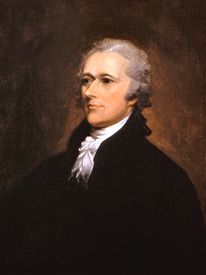
Alexander Hamilton by John Trumbull, 1806
Meanwhile, Adams was also being attacked by “High Federalists” aligned with Alexander Hamilton, who thought Adams to be too moderate for the party. Hamilton even hatched a plan to elect Adams’ running mate, Charles Pinckney, as President. Still, after the Democratic-Republicans obtained and published a 54-page scathing letter against Adams by Hamilton, his efforts were damaged, as well as his and Adams’ political future. Ultimately, it also hurt the Federalist Party as a whole.
The campaign saw both sides seeking any advantage, including changing the selection process of electors in several states. Republican state legislators in Georgia, for instance, replaced the popular vote with selection by the state Legislature. Federalists did the same in Massachusetts and New Hampshire. Meanwhile, Virginia switched from electoral districts to winner-take-all.
At the time, each state chose its election day between April and October. After the long-fought campaign that some thought would rip the country apart, South Carolina gathered the votes. It chose eight Republicans for the Electoral College, breaking a 65-65 national split and giving Jefferson and Burr the winning votes.
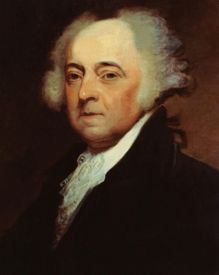
John Adams, by Asher B. Durand.
Flaw in the Constitution Exposed:
The original United States Constitution said that members of the Electoral College could only vote for President. Each elector would vote for two candidates, with the person receiving the most votes becoming President and the second most votes Vice President.
To avoid a tie in votes on the Federalist side, the party arranged for one of their electors to vote for John Jay instead of Vice President Pinckney. The Democratic-Republicans planned to have one elector abstain from casting their second ballot for Burr, but that didn’t happen. Instead, each Republican elector voted for both, giving Jefferson and Burr 73 votes each.
This put the election in the hands of the House of Representatives. Law stipulated that the outgoing House, still controlled by Federalists, would decide, with each state casting one vote. New terms for both the House and President began in early March.
In February of 1801, members of the House balloted as states to determine the winner. An absolute majority vote of the 16 states was required for victory. With many outgoing Federalists unwilling to back Jefferson, most instead voted for Burr, giving Burr six of the states. The seven states controlled by Republicans voted for Jefferson, and Georgia’s sole Federalist also voted for him, giving Jefferson eight votes. But nine votes were needed, and two states remained.
Vermont was a wash. Evenly split, the state representatives cast a blank ballot. This left things to Maryland, which had five Federalist and three Republican representatives. However, they too split their vote between Burr and Jefferson, resulting in another blank ballot.
This went on for seven days that February, with the House casting 35 ballots and Jefferson receiving only eight of the nine states needed each time. Finally, on February 17, Federalist James Bayard of Delaware, along with his party allies in Maryland and Vermont, all cast blank ballots, resulting in both states selecting Jefferson, giving him ten states and the office of President of the United States. The final vote was Jefferson 10, Burr 4, and 2 with no result.
Correcting the Flaw
The Constitution originally stipulated that each elector could cast two votes, but not for two people from the same state. The candidate with the most electoral votes became President, and the second most became Vice President. If there were a tie, the House of Representatives would choose the President. For Vice President, whoever received the second-highest number of Electoral College votes would take office. The election of 1796 exposed the first problem when Federalists scattered their second votes, resulting in Democratic-Republican presidential candidate Thomas Jefferson becoming Vice President. Many were concerned that there could be a situation where a Vice President could impede the President and even try to kill him to become President.
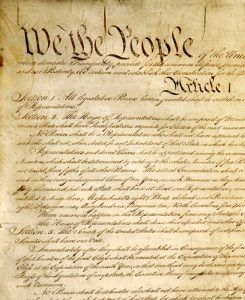
United States Constitution
After the debacles in 1796 and 1800, in December 1803, Congress proposed the Twelfth Amendment (XII) to the U.S. Constitution, requiring each elector to cast separate votes for President and Vice President instead of two votes for President. This measure reduced the chance of an opposing party holding the Vice President’s position. It kept the clause forbidding an elector from voting for both candidates of a presidential ticket if both candidates are from the elector’s state. It also ensured that anyone ineligible to be President could not be Vice President either. The states ratified the Amendment in 1804.
The amendment did not change the composition of the Electoral College, but it did adjust the procedures for ties that go to the House. If no candidate wins a majority of Electoral College votes for President, the House of Representatives chooses the President. The amendment requires the House to choose from the three candidates with the most electoral votes. It also stipulates that, in a tie, the Senate chooses the Vice President. That choice is limited to candidates with the two highest electoral votes. If multiple individuals are tied for second place, the Senate may consider all of them, in addition to the candidate with the highest votes. The amendment also required two-thirds of the Senate to conduct the tie-breaking vote and a majority of the Senate to make a choice.
The amendment further prevents deadlocks by requiring that if the House could not choose a President by March 4 (or the first day of a Presidential term in office), the candidate elected Vice President would act as President. In 1933, the Twentieth Amendment changed the date of the beginning of the Presidential term to January 20, clarified that the Vice President-elect would only act as President if the House had not chosen a President by then, and permitted Congress to direct through legislation who would be acting President if there is neither a President-elect nor Vice President-elect by January 20.
This election system is still in place today in the United States. Therefore, a presidential candidate can still fail to reach the required number of Electoral College votes, sending the decision for President to the House of Representatives and Vice President to the Senate.
One other election since the Twelfth Amendment has had the House of Representatives decide the President of the United States. Although it wasn’t a tie, in the election of 1824 between John Quincy Adams, President John Adams’ son, and Andrew Jackson, neither candidate reached a majority of the electoral vote. It was also the only election where the candidate with the most electoral votes did not become President.
Although neither candidate reached a majority of the Electoral College votes, Andrew Jackson received more votes than Adams. However, the House of Representatives chose Adams in February of 1825. Both candidates had run under the Democratic-Republican Party ticket since the Federalists had dissolved in previous years, heavily damaged by the election of 1800. However, the Republican Party had separated into four groups, each with its own candidate. In later years, the group led by Andrew Jackson would become the Democratic Party. In contrast, groups led by John Quincy Adams and Henry Clay would become the National Republican Party, followed by the Whig Party.

Coloring History by Legends of America. Available at Legends’ General Store.
©Dave Alexander/Legends of America, updated October 2026.
Also See:
Presidents of the United States of America
Presidential Trivia, Fun Facts and Firsts
The United States Constitution
Sources: