
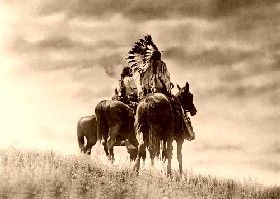
Cheyenne Warriors by Edward S. Curtis.
A nation is not conquered
Until the hearts of its women are
on the ground.
Then it is finished,
No matter how brave its warriors
Or how strong their weapons.
— Cheyenne Proverb
The Cheyenne are a tribe of Algonquian linguistic stock, closely allied with the Arapaho and Gros Ventre and loosely allied with the Lakota Sioux. One of the most prominent Plains tribes, they primarily lived and hunted on hills and prairies along the Missouri and Red Rivers. They call themselves “Tsitsistas,” which translates in several different ways to “people alike,” “our people,” “red talker,” or “people of a different speech.”
Originally, the Cheyenne resided in the Great Lakes area in Minnesota and on the Missouri River. Here, they lived in earth-covered log houses in permanent settlements, farmed, and made pottery. However, in the late 1600s, they began migrating westward, most likely because of competition and conflict with the Ojibwe, Arikara, and Mandan Indians.
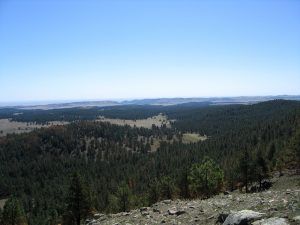
The Black Hills of South Dakota by Kathy Alexander.
As they migrated southwestward, their lifestyle changed to that of nomadic hunters and gatherers. In the 1700s, the Cheyenne acquired horses from the Spanish and became expert buffalo hunters, the life they led when Lewis and Clark encountered them in 1804 in the Black Hills of South Dakota. Pushed farther into the plains by the hostile Sioux, the Cheyenne, in turn, drove the Kiowa tribe further South.
In 1832, the Cheyenne split into two groups: one inhabiting the Platte River near the Black Hills and the other living near the Arkansas River farther South in Colorado. However, bands of the tribe were known to have inhabited every state in the American West at various times.
Those who had moved to the Arkansas River found themselves in conflict with the Kiowa, who, with the Comanche, claimed the territory. Numerous battles took place between them up until 1840, when an alliance was formed with the Kiowa, Apache, and Comanche tribes.
The Fort Laramie Treaty of 1851 established the first Cheyenne territory in northern Colorado, consisting of the present-day sites of Fort Collins, Denver, and Colorado Springs.
Their peace with the Kiowa let them extend their incursions farther south. In 1853, they made their first raid into Mexico with disastrous results, losing all but three of their men in a battle with the Mexicans.
As more and more white settlers pushed West in the 1850s, the Cheyenne, along with their new allies, began to rebel against the pioneers and the U.S. Army. When gold was discovered in Colorado, the 1851 treaty was broken, and the territory that had been ceded to them was taken away. The Pike’s Peak Gold Rush in 1858 brought the tension to a boiling point.
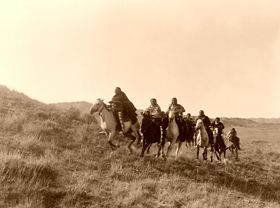
Cheyenne on horses, Edward S. Curtis, 1910.
Indians soon began to attack wagon trains, mining camps, and stagecoach lines, a practice that increased during the Civil War, when the number of soldiers in the area was greatly decreased. Soon, this led to what became known as the Colorado War of 1864-1865. This bloody battle reached its worst point at what is known as the Sand Creek Massacre, which occurred on November 29, 1864.
While the Indians were encamped under the promised protection of Fort Lyon, Chivington led his 700 troops to Sand Creek and positioned them, along with their four howitzers, around the Indian village. Despite the repeated attempts to surrender, the troops slaughtered more than 150 Native American men, women, and children. After the brutal massacre, the defensive battles against the encroaching white settlers and the U.S. Army increased. The Cheyenne people were then forced to move to a reservation in Oklahoma, where another skirmish occurred in the early morning hours of November 27, 1868. After some communication breakdowns, Lieutenant Colonel George Armstrong Custer led the 7th U.S. Cavalry in an attack on a band of peaceful Cheyenne. Known as the Battle of the Washita River, the Indians were legally encamped on reservation land with Chief Black Kettle when more than 100 Cheyenne were killed, mostly women and children. Though Chief Black Kettle had a white flag flying above his teepee, he was killed in the battle.
In the Battle of the Little Bighorn on June 25, 1876, the Cheyenne, along with the Lakota Sioux and a small band of Arapaho, annihilated George Armstrong Custer and his troops near the Little Bighorn River. Known as the greatest Native American victory, 262 soldiers died in the battle, while only an estimated 60 Indian warriors were killed.
Following the Battle of the Little Bighorn, the attempts to force the Cheyenne onto a reservation in Indian Territory intensified. In 1877, almost 1,000 Northern Cheyenne were forced to march to Oklahoma, where they found dire conditions, and many became ill and died from malaria.
Though the Cheyenne from the South grudgingly accepted the Oklahoma reservation, many Northern Cheyenne, unable to adapt to the hot weather, fled back North in 1878, led by Chiefs Dull Knife and Little Wolf. The U.S. Army attempted to round up the “escapees,” killing many of them en route. The band soon split, with one group led by Little Wolf, who safely made it back to Montana. The other group followed Dull Knife and were captured and escorted to Fort Robinson, Nebraska.
Sequestered, the Indians steadfastly refused orders to return to the Oklahoma reservation. In January 1879, Dull Knife and his followers escaped from Fort Robinson. Though more than thirty of the escapees were shot as they ran from the fort, an estimated 50, including Dull Knife, survived to be reunited with the Northern Cheyenne.
An Executive Order in 1884 created a reservation for the Northern Cheyenne in Southeast Montana.
Today, the Cheyenne occupy two reservations, one at Tongue River, Montana, where some 6,500 people reside. The other reservation, in southwestern Oklahoma, is shared with their longtime allies, the Arapaho, and consists of about 11,000 members.

Cheyenne Chief Dull Knife, 1873.
©Kathy Alexander/Legends of America, updated October 2026.
Also See:
Chief Black Kettle – A Peaceful Leader
Dull Knife – Northern Cheyenne Chief