

A.I. Generated image of Ehyophsta based on this article.
In the annals of Plains history, where the names of warriors echo across generations, it’s rare to run into women, but one stands out not only for her courage but for her defiance of convention. Ehyophsta, the Yellow-Haired Woman of the Cheyenne, was born around 1826 in what is now Colorado. Daughter of Chief Stands-in-the-Timber and niece of Bad Faced Bull, she inherited a legacy of leadership and strength. But Ehyophsta did not merely uphold tradition. She reshaped it.
A Warrior Born
Cheyenne society, like many Plains tribes, revered warriors. Men were expected to defend the tribe, hunt, and uphold honor through acts of bravery. Women, though central to cultural and spiritual life, rarely took up arms. Ehyophsta was one of the few who did. Her warrior spirit was not symbolic—it was forged in blood and fire.
She was not a camp follower or a passive witness. She rode into battle, counted coup (a Native American practice in which warriors gain honor and prestige by performing acts of bravery against an enemy), and killed her enemies. Her presence on the battlefield was not just tolerated – it was celebrated. She was known for her skill, her resolve, and her voice, which rose in war songs alongside Buffalo Wallow Woman, a fellow female warrior from the Lakota Sioux. Together, they sang as they rode, their voices cutting through the chaos of combat like arrows through the wind.
The Battle of Beecher Island
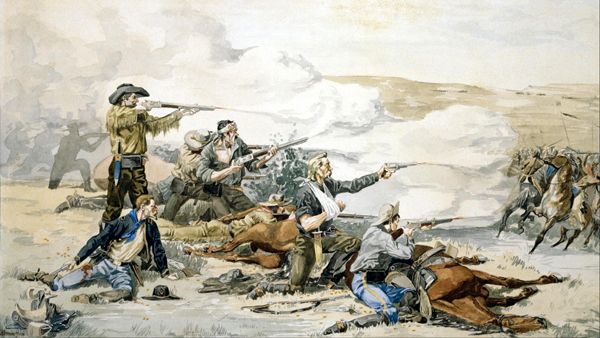
Battle of Beecher’s Island, Colorado by Frederic Remington.
In 1868, Ehyophsta fought in one of the most pivotal clashes between Native forces and the U.S. military: the Battle of Beecher Island. Located near the Arikaree River in northeastern Colorado, the battle pitted a coalition of Cheyenne, Lakota, and Arapaho warriors against Major George A. Forsyth’s scouts. Among the Native warriors was Roman Nose, a legendary Cheyenne fighter whose presence alone could shift the tide of battle.
Ehyophsta rode into this conflict not as an observer, but as a combatant. The battle lasted nine days, with Forsyth’s men entrenched on a sandbar, surrounded and under constant attack. Though Roman Nose was killed, the Native forces inflicted heavy casualties and demonstrated the tactical brilliance and tenacity of Plains warriors. Ehyophsta’s participation in this battle marked her as a fierce defender of her people and a rare female presence in the historical record of warfare.
The Shoshone Campaigns

Shoshone Camp, around 1900.
The year following Beecher Island, Ehyophsta’s husband, Walking Bear, was killed in 1867 by the accidental discharge of his own gun. But grief did not silence her. In 1868 and 1869, she joined Cheyenne warriors in a series of brutal skirmishes against the Shoshone. These were not raids—they were retaliatory campaigns, sparked by theft and threats against Cheyenne families.
One such battle took place near the foot of the Bighorn Mountains in Montana, between Lodge Pole (Clear) Creek and Powder River. The Shoshone had previously raided a small Cheyenne camp of seven lodges, stealing all their horses. Believing the camp was stranded and vulnerable, a large Shoshone war party returned to finish the job. But the Cheyenne had reinforced the camp, swelling to over 200 lodges.
On the eve of battle, a Shoshone scout taunted the Cheyenne: “We have come here for your women and children. If you can keep them, it is good. If not, we shall take them home with us.” A Cheyenne named Gives Birth In A Willow Patch, fluent in Shoshone, replied: “It is good. You have come to a camp of the Cheyenne. No other tribe is with us. After you have killed all the men, you shall take the women and children.”

Cheyenne Warriors by Frank McCarthy.
But the Cheyenne warriors had already begun to surround the Shoshone. When the charge came, the Shoshone fled through the timber and into a ravine, where they built breastworks. Over four days, the Cheyenne killed sixty-two Shoshone warriors. Ehyophsta was in the thick of it.
On the first day, she rode into battle on her father’s horse. In one encounter, she saw a Shoshone grappling with a Cheyenne named Wolf Ear. She dismounted, drew her butcher knife, and stabbed the Shoshone twice. Later, while searching for survivors, she found a wounded man hiding in a crevice. When others hesitated, she stepped forward and said, “If you people will stand aside, I will question him.” She lifted his arm and thrust her knife into his armpit, then took half his scalp.
On the fourth day, Ehyophsta and her daughter joined a scouting party. A dog led them to three Shoshone warriors, who were drying their clothes under a bank. The Cheyenne charged and killed them. These men were thin, their clothing worn, signs of long travel and desperation.
The Shoshone war leader, a medicine man, carried a shield, a walking stick, and a six-shooter. He would emerge from the breastworks, taunting the Cheyenne, who fired volley after volley. However, most Cheyenne weapons were muzzleloaders, which were slow to reload. The Shoshone exposed themselves during these pauses, believing they could escape. Only one man from the Shoshone war party survived.
A Secret Sisterhood

Cheyenne maiden by Richard Throssel, 1907.
Her ceremonial role matched Ehyophsta’s battlefield prowess. She belonged to a secret Cheyenne women’s society, composed of those who had gone to war with their husbands or fought independently. These societies were rare and prestigious, holding meetings closed to outsiders. They were spiritual and communal spaces where women warriors could share experiences, honor the fallen, and preserve traditions.
Her inclusion in such a society speaks volumes. She was not merely tolerated—she was revered. Her voice, her stories, and her rituals helped shape the cultural memory of the Cheyenne.
Ehyophsta lived to the age of 89, passing away in August 1915 on the Tongue River Reservation in Montana. She was one of the last war women of the Cheyenne. Her name, translated as Yellow-Haired Woman, remains popular among Cheyenne girls. It carries with it the legacy of a warrior, a singer, a sister, and a symbol.
Her story challenges assumptions about gender roles in Native societies. While most warriors were men, women like Ehyophsta proved that courage knows no gender. Her life was not an exception—it was a revelation.
The Spirit of Ehyophsta Lives On
In the 20th century, Ehyophsta’s legacy reached beyond tribal boundaries. She was honored in Judy Chicago’s feminist art installation, The Dinner Party, which is featured on the Heritage Floor. This work celebrates women throughout history who made significant contributions to culture, politics, and society. Ehyophsta’s inclusion places her among queens, scientists, and revolutionaries—recognizing her as a warrior in every sense of the word.
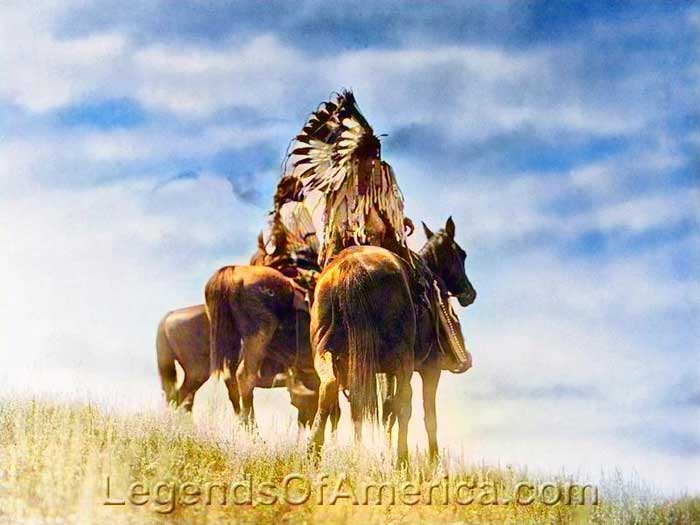
Cheyenne Warriors by Edward S. Curtis, 1905. As the sun sets over the plains and the wind carries the echoes of war songs, one can imagine Ehyophsta riding still—her yellow hair catching the light, her voice rising in defiance, her legacy galloping across the pages of history. She rode into battle not for glory, but for survival. She sang war songs not for ceremony, but for the strength they gave her. She scalped enemies not for vengeance, but for honor. Her story is one of defiance, resilience, and legacy.
©Dave Alexander, Legends of America, October 2025.
Also See:
The Gift of Ehyophsta: A Cheyenne Legend Retold
The Battle of Beecher Island, Colorado
Cheyenne – Warriors of the Great Plains
Sources:
The Cheyenne Indians – Their History and Lifeways, 1926, George Bird Grinnell
Wikipedia