
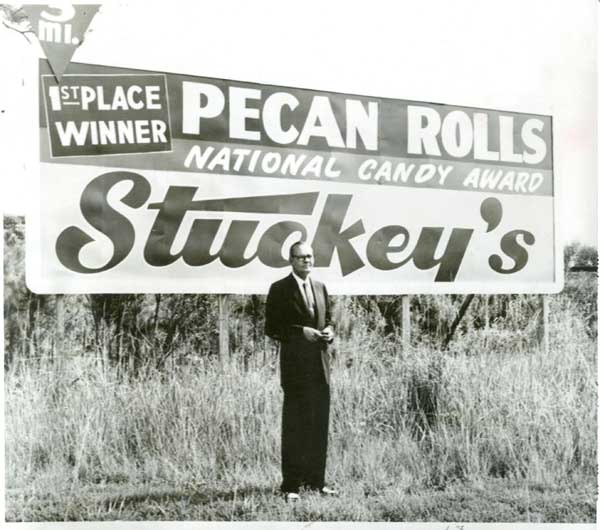
W.S. Stuckey in front of a billboard advertising Pecan Rolls.
When you think of the good old days of Route 66, do you remember your family stopping at Stuckey’s to browse their pecan log rolls, pralines, and peanut brittle?
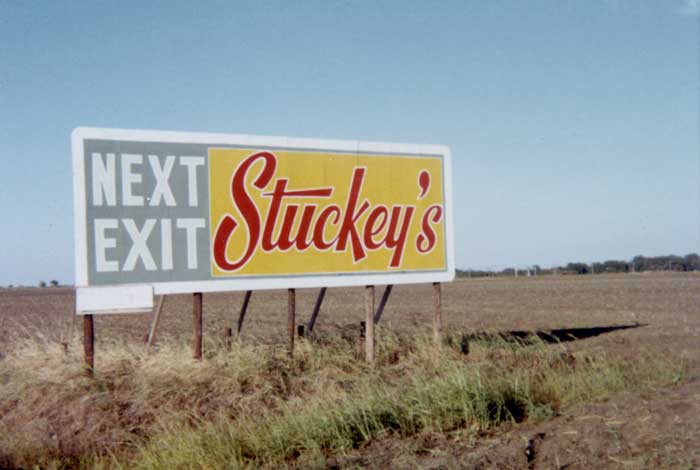
In those long-ago days of Burma-Shave signs and the static of rock and roll on the AM radio, it seemed that the high-pitched roofs of Stuckey’s were everywhere. But what happened? Where are they now? You still see a few of them here and there, but it’s certainly not like it used to be when we were kids.
So… here’s the story.
Like Burma-Shave and many other past icons, Stuckey’s eventually got lost in the corporate jungle, where small things matter less than profits. But that wasn’t always the case, and it isn’t the case again today.
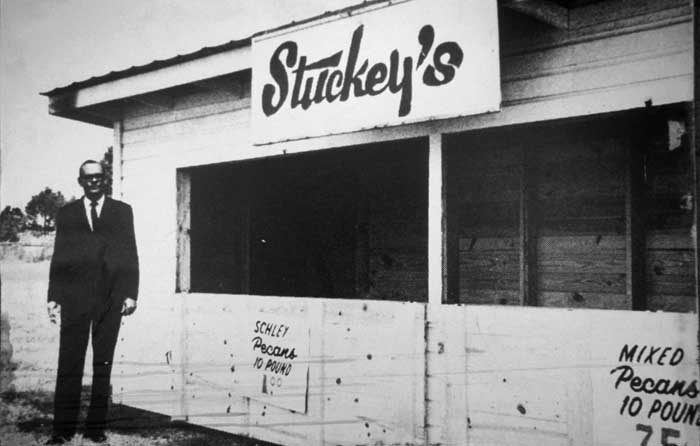
W.S. Stuckey Sr.
Stuckey’s began in the early 1930s when a man named W.S. Stuckey, Sr., started selling pecans. During the Great Depression, Stuckey dropped out of college because of financial constraints and worked on his family’s farm, a job he hated. He was looking for a side hustle to make extra money – and escape a life of cotton farming. A local warehouseman suggested he buy pecans and sell them to the warehouse. In no time, with a $35 loan from his grandmother and a Model A Ford converted into a truck, Stuckey began traveling from house to house buying pecans.
Sometimes he spent all his cash too early in the day, so he waited until the bank closed and started writing checks. He would sell the pecans that night and deposit the checks the next morning, before they had cleared.

Stuckey’s Fine Pecan Candies.
It was an excellent idea for the unemployed Stuckey, who sold about $4,500 worth of pecans in his first year. By 1933, he was doing well enough that a banker lent him $200 to expand his business. Three years later, the bank had extended his credit line to $20,000, and Stuckey’s pecan sales reached $150,000.
In 1937, Stuckey and his wife, Ethel, decided to capitalize on the Winter tourist season by setting up a roadside stand. In addition to selling shelled and unshelled pecans, Ethel made batches of pecan candy that were also sold at the stand. For two years, their sales totaled $2,000 to $3,000. They sold the roadside stand and opened their first retail store in Eastman, Georgia. Before long, two more stores were built in Georgia, and in 1941, a new one was opened in Hilliard, Florida.
When gas and tire rationing began in World War II, Stuckey was forced to close one of his stores, and another fell victim to moonshiners who robbed the store for its sugar and burned it. Only the store in Eastman remained. However, by this time, his pecan treats had become so well known that the couple was commissioned to produce candy for the military.
In 1948, they started large-scale candy production in a warehouse behind the Eastman store. By then, people were traveling again, and they began setting up more stores aggressively. By 1953, the number of stores had reached 29; a little more than a decade later, in 1964, it had increased to over 100. This year, Stuckey’s merged with Pet, Inc., with W.S. Stuckey serving as President of Stuckey’s Inc. However, in 1969, the CEO of PET, Theodore Gamble, died unexpectedly of a heart attack. PET’s new leadership was less supportive of Stuckey’s brand, and W.S. took early retirement in 1970. He died on January 6, 1977, disappointed mainly by the way PET had begun to neglect the roadside chain that bore his name.
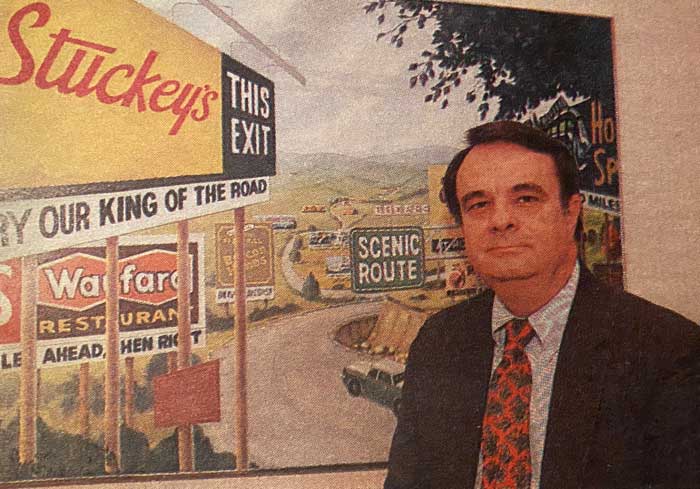
W.S. “Billy” Stuckey, Jr.
After the loss of its visionary founder, along with the Arab oil embargo and reduced road travel, Stuckey’s stores began to falter. In 1979, Pet was acquired in a hostile takeover by IC Industries, and the Stuckey’s brand sadly continued to decline. IC Industries began selling Stuckey’s stores for their real estate value, and those that were not sold were subsequently closed. Within a matter of years, what had taken W.S. Stuckey a lifetime to build was lost mainly.
Of this, Bill Stuckey, Jr. would later say: “Instead of marketing what worked, Pet wanted to look good on Wall Street and let the company-owned stores go to hell to keep the bottom line up.” PET officials retorted that the problem was “a changing world that included McDonald’s, Hardee’s, Shoney’s, and gas stations that sold food and novelties.”
Fortunately, on May 1, 1985, Billy Stuckey, the founder’s son, purchased the remaining assets of Stuckey’s from IC Industries after a year of negotiations. This included the trademark, the franchise system, and the few remaining company-owned stores.
 Stuckey’s fit well within Billy’s business portfolio, as he had successfully run Interstate Dairy Queen Corporation (“IDQC”), a company he founded in 1977, and had the franchise rights to all the famous soft ice cream stores within a half-mile radius of the interstate highway system. He built on this expertise by aligning Stuckey’s locations with his Dairy Queen Stores and launching a Stuckey’s Express franchise program. This store-within-a-store concept complemented existing c-store and travel-stop businesses.
Stuckey’s remained under Billy’s management until 2014, when he sold IDQC to Warren Buffett/Berkshire Hathaway, owner of American Dairy Queen. After that, the company was run by a skeleton crew, with Billy remaining as an advisor. It had not seen a profit for over three years when, in November of 2019, Ethel “Stephanie” Stuckey, Billy’s daughter, purchased the company and became CEO of Stuckey’s Corporation. Since taking over, Stephanie has made the company profitable by developing more retail and online sales channels, creating a line of branded merchandise, and acquiring a pecan-shelling and candy-manufacturing plant.
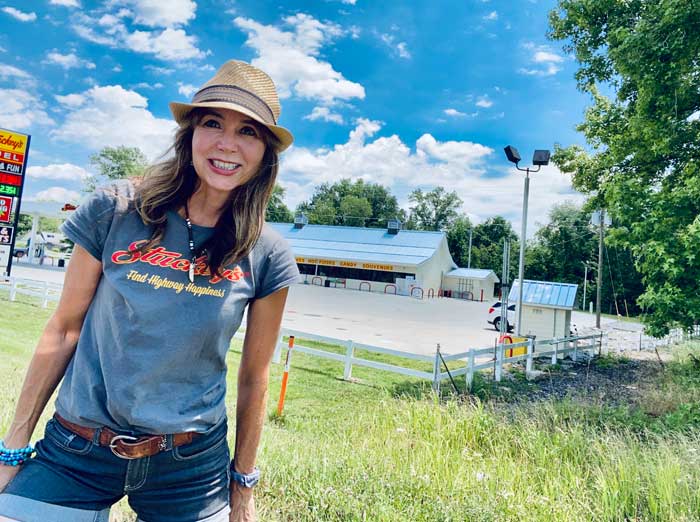
Stephanie Stuckey, CEO of Stuckey’s, in Johnston City, IL, 2021.
Stuckey’s is unique in that, unlike many other nostalgic food brands that made America great and were sold to large corporations, the family has regained ownership of the company and is reviving it.
For more, see Stuckey’s Corporate Website.
©Kathy Alexander/Legends of America, additional information provided by Stephanie Stuckey, updated October 2026.
 Also See:
Nostalgic Flashback Of The 1950s Era
The Old Harvey House Hotels & Cafes
Signs of the Mother Road Photo Gallery
Where are the Burma Shave Signs?
See Sources.