
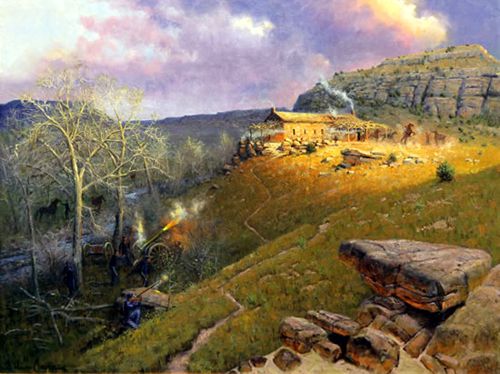
Robber’s Roost, painting by Wayne Cooper.
Known as “Captain” Bill Coe, he worked as a carpenter and stonemason before turning to outlawry. Born Cyrus Coe to a Pennsylvania Baptist preacher in 1842, he served as a Union Army First Lieutenant and is thought to have arrived in the Oklahoma Panhandle around 1864, settling in an area then referred to as “No Man’s Land.” The strip of land, about 35 miles wide and 168 miles long, was not included in any state and therefore lacked law and order. For years, it was a haven for outlaws, and William Coe took advantage of it.
Located strategically on a long, high ridge jutting Southwest from a large mesa near the town of Kenton, Oklahoma, Coe built a “fortress” to protect himself and his gang of some 30 to 50 members, who primarily rustled cattle, horses, sheep, and mules.
His headquarters, made of rock walls some three feet thick, sported portholes for protection rather than windows, as well as a fully stocked bar, living quarters for his men, and several “soiled doves” for their entertainment. His fortress became known as “Robber’s Roost.”
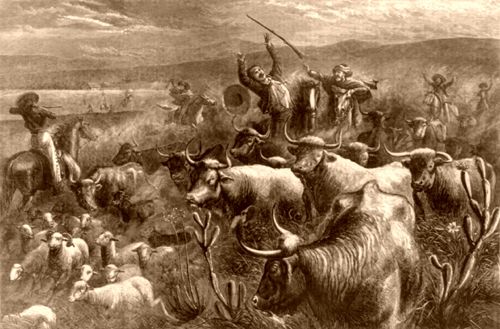
Cattle Raid on the Texas Border, Harper’s Weekly, 1874.
For several years, these men earned their livelihood by raiding ranches and military installations, from Fort Union, New Mexico, to the South, to Taos, New Mexico, to the West, and as far North as Denver, Colorado. They also preyed on freight caravans traveling along the Santa Fe Trail, as well as area ranches. Hiding the stock in a canyon about five miles northwest of their hideout, the rustlers built a fully equipped blacksmith shop with all the tools needed to maintain the herds and change the brands. Once all traces of the previous owners had been removed, the desperado cowboys then relocated the herds to Missouri or Kansas for sale.
Though they had been getting away with their lawlessness for several years, the gang made a major mistake when they raided a large sheep ranch in Las Vegas, New Mexico, in 1867, killing two men before making off with the herd to Pueblo, Colorado. Though wanted before, these murders put Coe and his men on the “wanted list” like never before, and soon, the U.S. Army from Fort Lyon, Colorado, was pursuing them.
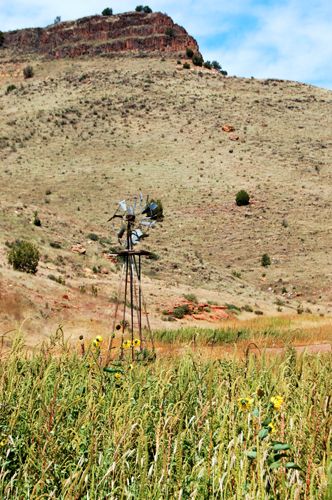
Kenton, Oklahoma area.
The army attacked the Robber’s Roost fortress with a cannon, crumbling the walls and killing and wounding several of the outlaws. Though Coe and others were able to escape, several outlaws who weren’t killed in the battle were hanged on the spot, while others were arrested and taken back to Colorado.
Coe maintained his lawless ways and his freedom for about a year, hiding out in a small (now defunct) settlement of Madison, New Mexico, near Folsom. However, while he was sleeping in a woman’s bunkhouse, her 14-year-old son rode from the ranch and contacted area soldiers, who soon returned and arrested Coe. The fugitive was then taken to Pueblo, Colorado, to await trial, and along the way, allegedly said, “I never figured to be outgeneraled by a woman, a pony, and a boy.”
However, before he could stand trial, vigilantes took matters into their own hands and, on the evening of July 20, 1868, forcibly removed him from the jail. Loading him into a wagon, they moved him to a cottonwood tree on the bank of Fountain Creek and lynched him while he was still handcuffed and shackled. The next day, his body was discovered and buried under the tree from which he had been hanged. Years later, when workers built a new road near Fourth Street in Pueblo, they found the skeletal remains believed to be Coe’s.
Author Carl Robert Coe wrote of his research into the gang.
“Members of the Coe Gang were brought to trial, April 27, 1868, in Pueblo. In the hearings before Judge Moses Hallett, gang member Laura Young was the principal witness against her former comrades. Edward J. Hubbard, a counsel for the defense, and who was to have served as Coe’s personal attorney, claimed conspiracy in Captain Coe’s hanging. He claimed that the army had conspired with local vigilantes to dispatch Coe. To prove his point, he said during the trial that his fee for defending Coe was the captain’s gold watch. It was seen the day after Coe’s death dangling from the waist of an army surgeon.
The Coe Gang trial lasted for six days. Besides Hubbard, Judge John W. Henry of Pueblo also served on the defense team. Prosecuting for the United States were U.S. Attorney G.W. Chamberlain of Denver and District Attorney Wilbur Fiske Stone.
The accused Coe lieutenant, “Tex,” was released for lack of evidence, as were several others. Six gang members, among whom was Charles W. Howard, who kept a stage station on the Platte River route, were found guilty and taken to Denver on May 13, 1868, by a deputy U.S. marshal named Haskell and Capt. Matthew Berry of Fort Lyon.”
Without his leadership, the rest of his gang headed into the unknown and was lost to history.
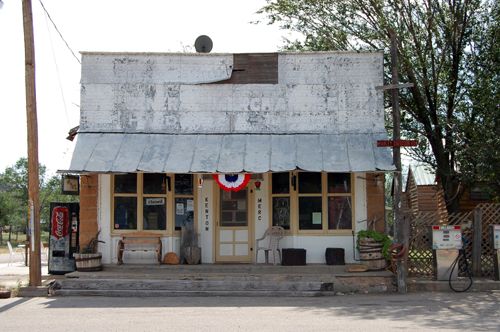
Kenton, Oklahoma Mercantile by Kathy Alexander.
But that is not the end of the tale. After his death, rumors began to abound that much of his illegally earned riches were still hidden in the area of his old hideout near Kenton, Oklahoma. One report alleges that he told his executors that he had buried enough gold to make them all rich. Whether he made the statement or not, it obviously wasn’t persuasive enough to convince his captors.
However, another later report tells of an Indian who had ridden with Coe and his gang, claiming on his deathbed that the outlaws had once stumbled across a rich pack train that Indians had attacked. In addition to all of the debris left scattered in the attack, the outlaws also found some $750,000 of gold and Spanish coins, which they allegedly buried in a place called Flag Springs Arroyo.
Coe’s hideout, though located in Oklahoma, was also just miles from New Mexico and Colorado, so it’s unclear which state Flag Springs is in.
Although it would make sense that if there were a significant stash at this unknown place, one of the other outlaws would have returned for it, the legend of lost treasure persists nonetheless.
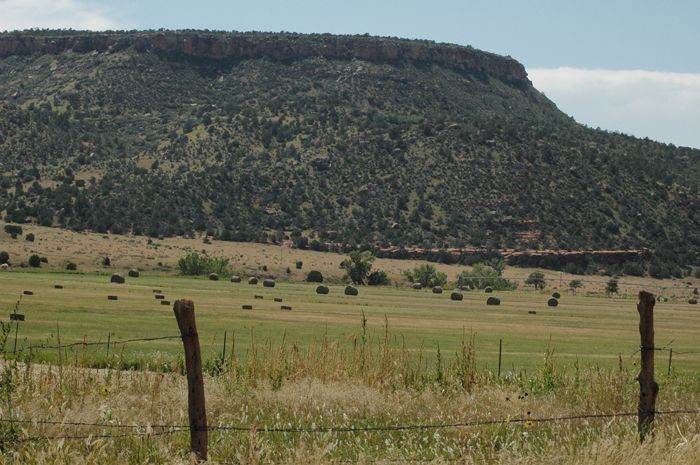
Black Mesa in northwest Oklahoma.
To this day, none of Coe’s gold has been reportedly found, and most searches center on the areas of Robber’s Roost, Black Mesa, Carrizozo Creek Valley, and Blacksmith Canyon. However, this is a large and rugged area, so if the legend is true, it could be hidden for eternity. Robber’s Roost is also located on private property. Only the foundation of the rock fortress that once overlooked the Cimarron and Carrizo Valleys remains. After the cavalry bombarded it, most of the stones were carried away to make farm buildings.
©Kathy Alexander/Legends of America, updated October 2026.
Also See:
Kenton, Oklahoma & No Man’s Land
See Sources.