
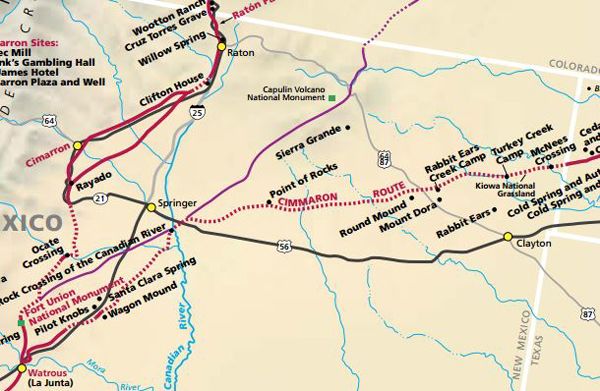
Santa Fe Trail Routes in New Mexico.
Trail Sites:
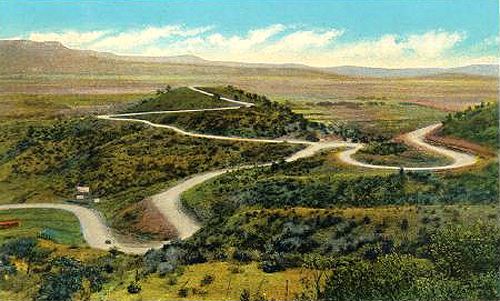
Raton Pass, New Mexico, postcard.
Officially beginning near the Arkansas River Crossing in Dodge City, Kansas, the Mountain Route took caravans along the river westward to Bent’s Fort in Colorado before dropping down into New Mexico. Though the Mountain Route of the Santa Fe Trail presented some problems, especially the crossing of Raton Pass, it had its advantages, including plenty of water and relative safety from Indian attacks. About 100 miles longer than the Cimarron Route, it became the favored route at various times due to drought and hostile Indian raids along the Cimarron Cutoff through the southwest corner of Kansas and the Oklahoma panhandle.
The rugged 3,000-foot elevation gain in just 32 miles, as the trail passed from Bent’s Fort, Colorado, over the Raton Mountains, exerted a physical toll upon men and draft animals alike. Getting over the pass was a five-day ordeal as the teams struggled up a steep 2,000-foot elevation gain. Until that road was somewhat improved in 1863 by Dick Wooton and turned into a toll road, the previous trail was so narrow at times that it had to be propped up by long poles supported by the mountainside below, and was quite dangerous. Many wagons, draft animals, and people were lost during the hazardous journey. Coming down the other side of the steep pass was also difficult.
After surviving this ordeal, the trail continued to the southwest through several villages. It passed several landmarks before reaching Watrous, where the Mountain Route and the Cimarron Route converged. From there, the trail continued onwards to Santa Fe.
©Kathy Alexander/Legends of America, updated April 2026.
Also See:
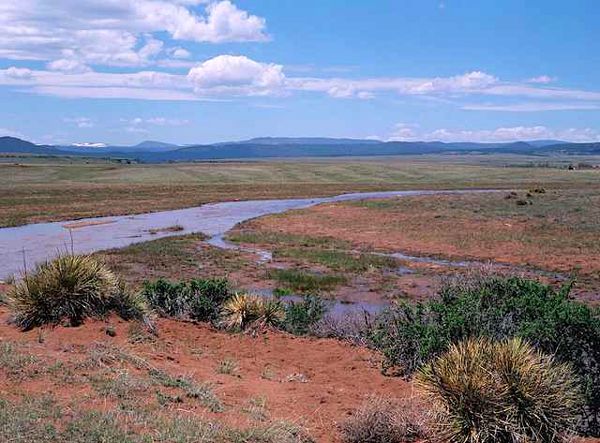
Ocate Creek, New Mexico.
Santa Fe Trail (main page)
Watrous, New Mexico – River Junction on the Santa Fe Trail
Sources:
National Register of Historic Places Nomination
Santa Fe Trail, New Mexico
Santa Fe Trail Research (website no longer active)
Wikipedia
WilliamBecknell.com