

Fort Burgwin Reconstructed Main Fort Building. Photo by John Stanton, 2019, courtesy of Fort Wiki.
Fort Burgwin, also known as Cantonment Burgwin, was a military base located about six miles South of Ranchos de Taos, New Mexico. Though first established in 1852 to protect the Taos Valley from Ute and Jicarilla Apache Indian attacks, the site shows evidence of prehistoric occupation dating as early as 1000 AD.
The Pot Creek Pueblo, one of the largest prehistoric sites in the northern Rio Grande Valley, was situated here. It consisted of about 300 ground-floor rooms and is thought to have been occupied from 1200 to 1350 AD. By the time the first Spanish explorers, led by Lieutenant Hernando de Alvarado of Coronado’s Expedition, arrived in 1540, the pueblo was abandoned.
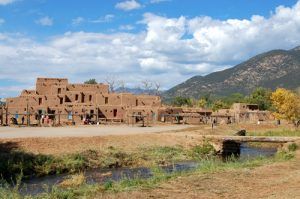
Taos Pueblo, New Mexico.
The nearby town of Taos, about ten miles North, was settled in 1615. The long-established trading networks at Taos Pueblo, its mission, and abundant water, timber, and game soon attracted early Spanish settlers to the area. However, these newcomers also clashed with the Taos Pueblo because of their authoritarian rule and forced religion, which eventually led to the Pueblo Revolt of 1680.
Planned in months of secret meetings centered at the Taos Pueblo, a coordinated attack was made by several Pueblo communities in August 1680, assaulting several Spanish settlements. With more than 8,000 Pueblo warriors, the Indians killed 21 Franciscan friars, more than 400 Spaniards, and drove some 1,000 settlers out of the region. However, Diego de Vargas reconquered New Mexico in 1692. Afterward, an uneasy peace was maintained until 1847, when the local people of Taos once again rebelled.
In 1845, when James K. Polk was elected president, things began to change dramatically for New Mexico. Polk, who embraced the expansionist idea of Manifest Destiny, encouraged pioneers to emigrate into the unoccupied and fertile territories of Texas, New Mexico, Arizona, Oregon, and California. This soon led to disputes with Mexico over the Southwest, ultimately resulting in the Mexican-American War of 1846-1848. During this time, the local Taos people began to regret that little had been done to stop American settlement in New Mexico, and they began to organize against the United States government.
On the morning of January 19, 1847, the insurrectionists began the Taos Revolt in present-day Taos, New Mexico, led by a Hispanic man named Pablo Montoya and a Taos Indian known as Tomasito. In the revolt, several politicians, including newly appointed Governor Charles Bent, were killed. U.S. troops soon retaliated, killing some Indians, destroying the San Geronimo Mission at the Taos Pueblo, and executing 16 Indians for their part in the revolt.
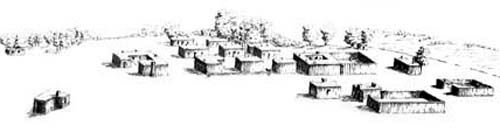
Cantonment Burgwin, New Mexico.
Afterward, the locals settled down, and peace was maintained in New Mexico for the remainder of the Mexican-American War. However, in the meantime, the Ute and Jicarilla Apache were busy making raids on many early settlers in the area. To combat the hostilities, Fort Burgwin, named for Captain John Burgwin, who was killed in the Taos Revolt of 1847, was established on August 16, 1852. The post sat at the confluence of the Rito de la Olla (Pot Creek) and the Little Rio Grande, chosen because it lay along the main wagon road from Santa Fe to Taos and north into Colorado, and because it offered fertile grazing land for livestock.

Fort Burgwin Officers’ Quarters. Photo by John Stanton, 2019. Courtesy Fort Wiki.
Lieutenant Robert Ransom, Jr., first commanded the post and directed the construction of barracks, stables, offices, a mess hall, and storehouses. Built for defense rather than comfort, there was only one gate and no windows in the outer fort wall. The buildings and fortress wall, measuring 120 by 220 feet, were completed in early November. The buildings were built of logs with thick clay roofs surrounded by an almost impregnable, windowless wall. Outside the wall, they later built other buildings, including officers’ quarters, a small dispensary, a guardhouse, and laundresses’ rooms. A private citizen also opened a sutler’s store just across Pot Creek.
The first in a long series of Indian campaigns began in February 1854 when a party of Ute Indians raided the settlement at Culebra North of Taos and stole 30 horses. In retaliation, Army dragoons under Brevet Major Thompson and Lieutenant John W. Davidson soon led troops in pursuit of the Ute. The diligent soldiers, including famed scout and explorer Kit Carson, followed the Indians into the San Luis Valley and the mountains of southern Colorado but were soon forced to turn back because of harsh weather.
The troops’ next significant engagement was at the Battle of Cieneguilla with a Jicarilla Apache on March 30, 1854. The battle, fought near Cieneguilla Creek in the Moreno Valley East of Taos, found the soldiers vulnerable when the Indians caught them by surprise. Fighting in the battle continued for more than three hours, during which 22 soldiers were killed, another 23 wounded, and 45 horses were lost before the troops retreated to Taos. Afterward, the Santa Fe Weekly Gazette reported that the action “was one of the severest battles that ever took place between American troops and Indians.”
The Indians then pursued the troops back to Fort Burgwin, approaching close enough to steal several horses. The livestock was later recovered, and as the troops pursued the Apache, ten were apprehended. However, hundreds of others escaped, and locals feared an imminent attack on Fort Burgwin or even the town of Taos.
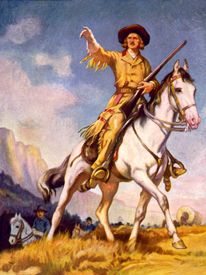
Kit Carson.
Fort Burgwin then became the headquarters for a major retaliatory campaign against the Jicarilla Apache. Additional troops were brought in from Fort Union, and locals were hired as spies and trackers. Under the command of Colonel Philip St. George Cooke, with Kit Carson as their chief guide, the First Dragoons and Second Artillery, totaling about 200 men, began tracking the Indians in April. Pursuing them into a rocky canyon near Agua Caliente, the soldiers and Apache battled until the Indians fled into the mountains, leaving behind several women and children. The Indian camp was then burned, and the soldiers continued the pursuit for a time. However, they soon returned to the fort.
The soldiers continued to pursue the Jicarilla Apache over the next several months. In May, Major William T.H. Brooks, the former commander of Fort Defiance, Arizona, assumed command of the soldiers. However, despite their best efforts, the Apache attacks continued.
However, by 1860, the Indians had mainly been placed on reservations, and there was little need for Fort Burgwin’s continued operations. The troops were then transferred to Fort Union, New Mexico, and Fort Garland, Colorado.
After the fort was abandoned, it quickly deteriorated and for the next century was all but forgotten. However, in the mid-1950s, a businessman and amateur archaeologist named Ralph Rounds acquired the property. He soon enlisted the help of archaeologist Fred Wendorf of the Southern Methodist University’s Department of Anthropology. The pair, with help from students, soon located the remnants of the old log fort, which they excavated and rebuilt.
Today, the reconstructed fort and a 13th-century Ancient Puebloan Pot Creek Pueblo are located on the SMU Campus as part of the college’s Archaeological Field School.
The site is located at 6580 Highway 518 in Ranchos de Taos, New Mexico.