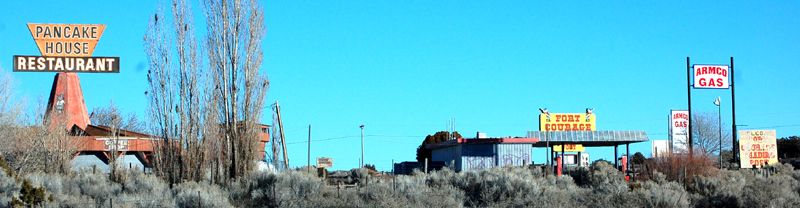
Fort Courage at Houck, Arizona, by Dave Alexander.
Just a short three miles west of Allentown, Arizona, on Route 66, is the small town of Houck. This community of a little more than 1,000 people is called Ma’ii Tó by the Navajo, meaning Coyote Water, the name of a local spring.
Houck was founded by an express rider carrying the mail between Prescott, Arizona, and Fort Wingate, New Mexico. The first route through the area was a wagon road on the south side of the Puerco River that connected Fort Wingate, New Mexico, with Fort Whipple, Arizona. This road became the “Overland Stage Road” and was in regular use by the 1870s. It intersected with the 1858 Beale Wagon Road farther west at Navajo Springs.
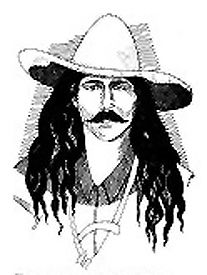
James D. Houck, Sheriff, Sheepman, and Trader.
In 1874, the mail carrier James D. Houck built a trading post on the south side of the Puerco River, where he also had a water tank, so the site was first called Houck’s Tank. The main section of the post was an oblong red sandstone building put together with mud and mortar. He ran sheep in the area in addition to operating the trading post. In 1880, William Walker and William Smith were murdered by Native Americans here. If his nearby neighbors didn’t know, violence appeared to follow Houck as he would make a reputation for himself in years to come.
He continued to run the post intermittently until 1885 when he moved to the Mogollon Mountains. That year, he served as a representative in the Arizona Territorial Legislature. He served as an Apache County Deputy Sheriff under Commodore Perry Owens when the Pleasant Valley War between sheep and cattlemen erupted in 1887. During this conflict, William Graham was gunned down on August 17, 1887. He lived long enough to identify Ed Tewskbury as the shooter. However, Deputy J.D. Houck publicly announced that he had shot and killed the man. The following year, he was involved in the lynching of three alleged cattle rustlers. He eventually went north of Phoenix, where he operated a sheep ranch.
The trading post then went through several hands, operating until 1922. At that time, the highway was moved north of the Puerco River, and when a competitor got a trading license for a new store along the rerouted road, the owner abandoned the post. Cowboys from a neighboring ranch used the buildings for a line camp. Unfortunately, there are no remains today.
The transcontinental railroad was built through the area in 1881, initially crossing from north to south of the Puerco River. A post office was established in Houck in 1884, with J.W. Bennett as the first postmaster. Bennett was the second owner of Houck’s Trading Post. In 1913, the wagon road (Adamana-State Line Highway) was an alternative route of the U.S. Old Trails Highway, which was rerouted to the north side of the Puerco River in about 1920. After the road was rerouted, most businesses moved to the north side of the river. The rerouted Old Trails Highway became part of Route 66 in 1926.
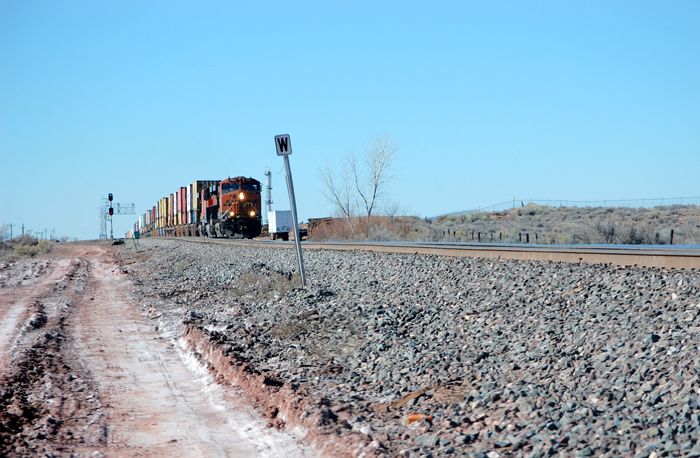
The railroad still runs through this area today, by Kathy Alexander.
Though there had been several other trading posts in the area over the years, the one doing the most business during the Route 66 era was the White Mound Trading Post, established in about 1924. This post was first located north of the Allentown Bridge along the U.S. Old Trails Highway and owned and operated by Joseph Grubbs. At some point, in about 1933, the highway was rerouted farther north, and Grubbs moved the store to the tract now occupied by Fort Courage, a tourist facility. In 1934, the Arizona Navajo Reservation Boundary Act extended the reservation boundary south of the new store, so in 1936, Joseph Grubbs deeded the land to the U.S. government. However, the store continued to operate into the late 1940s and belonged to Al Frick, who also owned the Lupton Trading Post store.
Unlike many other small towns located on Route 66, the passing traffic had little effect on the small town, which never featured more than a trading post, gas, and groceries. The White Mound Trading Post held Houck’s post office from 1924 until 1946. In 1958, U.S. Interstate 40 came through the area, superseding Route 66. The White Mound Trading Post closed two years later.
Then, in the 1960s, a new modern trading post was built at the same site. Called Fort Courage, this place was inspired by the 1960s television show F-Troop that ran from 1965-67. Fort Courage was a replica fort built to resemble the one from the classic show. Over the years, this stop featured a coffee shop, restaurant, gas station, grocery store, gift shop, and trading post, which kept a large selection of authentic Indian jewelry, Navajo rugs, and all types of curios and souvenirs. It also featured motel units, a trailer park, and a campground.
However, by 2010, its old motel units had been turned into apartments, with wrecked vehicles parked in front of them. By 2014, all facets of the “old fort” were closed for good.
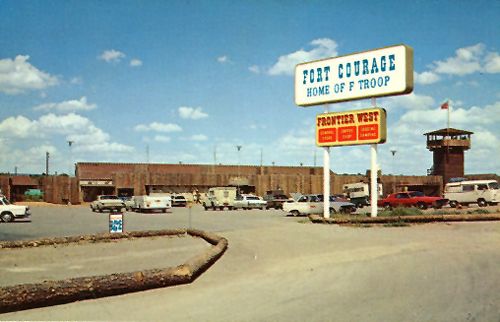
Vintage Fort Courage, Arizona
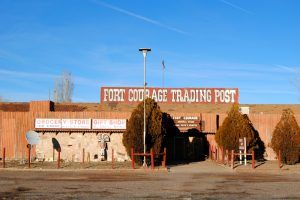
Fort Courage at Houck, Arizona, by Kathy Alexander.
Unfortunately, on May 17, 2020, a fire destroyed a good portion of the old Route 66 attraction, including one of the towers. Fire crews were able to stop the fire from spreading to other structures, and three suspects were arrested for arson.
Today, Fort Courage is only a shell of its former self, with its deteriorating and abandoned buildings to testify to more prosperous times.
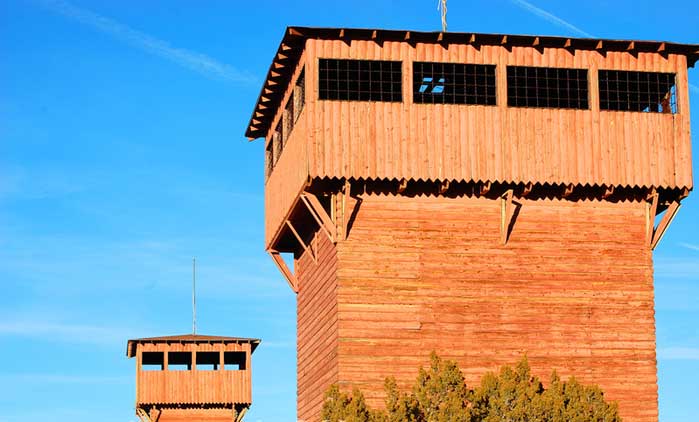
Fort Courage towers on Route 66 in Houck, Arizona. Photo by Dave Alexander, 2015.
Just south of Houck is the old Allentown Bridge, listed on the National Register of Historic Places. Also called the Puerco River Bridge, it was part of the National Old Trails Road in 1923. The single-span wooden timber bridge became part of Route 66 from 1926 to 1931. It is located south of I-40, exit 351, on Indian Route 9402/Allentown Road.
Just past Houck, at the Pine Springs Exit #346, Route 66 travelers can follow an old alignment on the north frontage road. The road crosses a box canyon, passes by the ruins of the Old Querino Canyon Trading Post, and crosses the Querino Canyon Bridge. However, travelers should know that the north frontage road soon turns to dirt and can become impassable during rains.
Querino Canyon Bridge

Querino Canyon Bridge
The Querino Canyon Bridge is picturesquely situated over a beautiful, rugged canyon outside Houck, Arizona. Designed by the Arizona Highway Department, the bridge is a representative example of early highway truss design: 77 feet long, 20 feet wide, and comprised of a concrete-decked steel trestle with three Pratt deck trusses supported by steel piers. Concrete abutments support the bridge from below, and steel lattice guardrails typical of the period line the roadway.
The State built the bridge in 1929 as part of a grand rehabilitation and relocation of Route 66 across northern Arizona. The project included several bridges, drainage construction, and at least 25 miles of roadway. The largest of these multiple efforts, the bridge over Querino Canyon formed an integral link on one of America’s primary arteries.
This section of the highway became a county road after Interstate 40 was constructed in the 1960s. The Querino Canyon Bridge remains intact, carrying local traffic on the Navajo Indian Reservation. It was listed in the National Register of Historic Places in 1988.
The Querino Canyon Bridge crosses Querino Canyon 3.8 miles southwest of Houck, Arizona, as part of Old Highway 66.
As you head through Sanders and Chambers to Navajo, you see signs of the Painted Desert, with its multi-colored sand formations and tremendous views. The Painted Desert covers almost 100,000 acres, stretching from the Petrified Forest to the Grand Canyon. There are times that even the sky above this colorful park glows with the pink and purple hues of the desert.
© Kathy Alexander/Legends of America, updated May 2024.

Digital Download = $1.99
Also See:
Across the Painted Desert on Route 66
Arizona Route 66 Photo Gallery
James D. Houck – Arizona Pioneer & Lawman
Sources:
AtlasObscura
Hinkley, Jim; Route 66 Encyclopedia, Voyageur Press, 2012.
Navajo Times
Richardson, Gladwell; Navajo Trader, University of Arizona Press, 1991.