
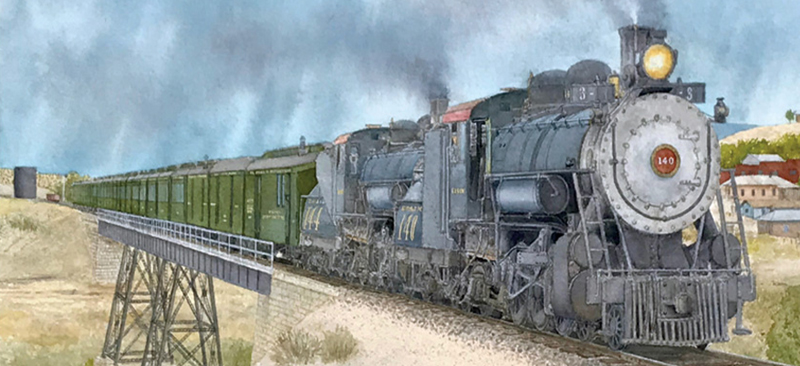
El Paso & Southwestern Railroad.
The El Paso & Southwestern Railroad began in 1888 as the Arizona & South Eastern Railroad, a short line serving copper mines in southern Arizona. Over the next few decades, it grew into a 1,200-mile system that stretched from Tucumcari, New Mexico, southward to El Paso, Texas, and westward to Tucson, Arizona, with several branch lines. The railroad was bought by the Southern Pacific Railroad in 1924 and fully merged into its parent company in 1955.
In the late 1800s and early 1900s, the copper industry experienced significant growth in the United States. The rapid increase in copper production, along with the rise of surrounding towns in southeastern Arizona, highlighted the inadequacy of wagon freight from mainline railheads. There was a clear need for more direct rail connections to the East.
To address this demand, discussions with the Southern Pacific Railroad led to the construction of the El Paso & Southwestern Railroad. This independent railroad, which connected to El Paso, Texas, was entirely financed by the cash reserves of the Copper Queen Consolidated Mining Company. Meanwhile, the El Paso & Northeastern Railroad was building northward from El Paso through the Territory of New Mexico, establishing new towns along its route.
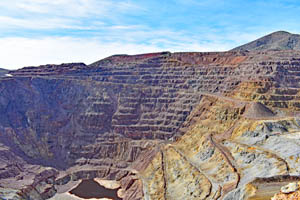
Lavender Pit in Bisbee, Arizona by Kathy Alexander.
James Douglas was a former chemistry professor working for William E. Dodge Jr. and Daniel Willis James, the majority co-owners of the trading firm Phelps, Dodge and Company. Phelps Dodge was interested in entering the copper mining industry and hired Douglas to inspect mining claims in the Southwestern United States. Douglas suggested that the two men invest in the Detroit Copper Mining Company of Arizona, which owned a copper mining claim in Morenci, Arizona, and purchase the Atlanta claim, which adjoined the Copper Queen Mine in Bisbee, Arizona. In 1881, Phelps Dodge followed both recommendations, taking an interest in the Detroit Copper Mining Company and purchasing a controlling interest in the Atlanta mine. After the Copper Queen and Atlanta mines both struck the Atlanta ore body in 1884, Phelps Dodge merged with the Copper Queen to avoid litigation sparked by the “law of the apex”. The company merged its various mining interests into the Copper Queen Consolidated Mining Company in 1885 and appointed James Douglas as president and a part-owner.
With production in the Bisbee area expanding, Douglas formed the Arizona and South Eastern Railroad in 1888. The railroad ran on a short spur of track from Bisbee to Fairbank, Arizona, where it met the mainline of the Atchison, Topeka & Santa Fe Railroad. Shortly thereafter, and unhappy with the Atchison, Topeka & Santa Fe Railroad’s rates, the line was extended to Benson, Arizona, to connect with the Southern Pacific Railroad.
In 1900, Copper Queen Consolidated built a new smelter at the newly built town of Douglas, Arizona, named for James Douglas, to which the railroad was extended again. The line was renamed the El Paso & Southwestern Railroad on June 25, 1901, to reflect its larger scope.
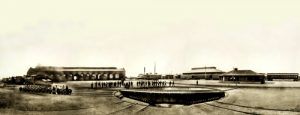
Roundhouse and railroad buildings, Douglas, Arizona, West Coast Art Co, 1909.
James and Dodge had acquired the Moctezuma Copper Company in Sonora, Mexico. In 1902, the El Paso & Southwestern line was extended South from Douglas to the Mexican town of Nacozari de García. The Nacozari Railroad, owned by Moctezuma Copper Co. and used to transport ore to the Moctezuma smelter at Nacozari, was incorporated into the El Paso & Southwestern.
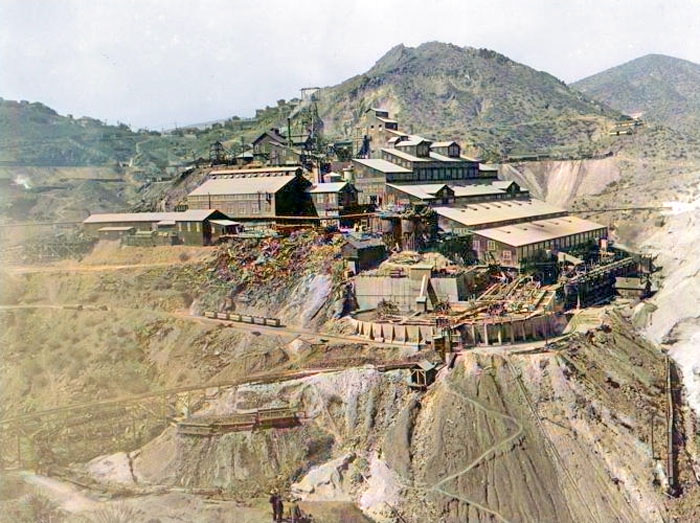
Detroit Copper Company.
Phelps Dodge continued to expand and purchased other mines surrounding their Detroit Copper Company mine near Morenci, Arizona. An eventual subsidiary of the El Paso & Southwestern—the Morenci Southern—was incorporated on June 6, 1902, and its roadbed connected the Morenci mines to the Arizona and New Mexico Railway (a subsidiary of the Arizona Copper Company at Guthrie, Arizona.
The same day, the El Paso & Southwestern Railroad Company of Texas was chartered to operate a railroad between the Texas-New Mexico border and El Paso. The initial capital was $2,000,000, with the business office in El Paso. Members of the first board of directors included William G. Choate, Charles R. Morehead, N.S. Stewart, and Millard Patterson, all of El Paso, and James Douglas, William E. Dodge, and W. Willis James, all of New York City.
In 1903, the terminus of the El Paso & Southwestern was extended from Douglas, Arizona, to El Paso, Texas by building new track and purchasing track from the El Paso and Northeastern Railway, adding over 200 miles of track to the line and extending its reach to Tucumcari, New Mexico.
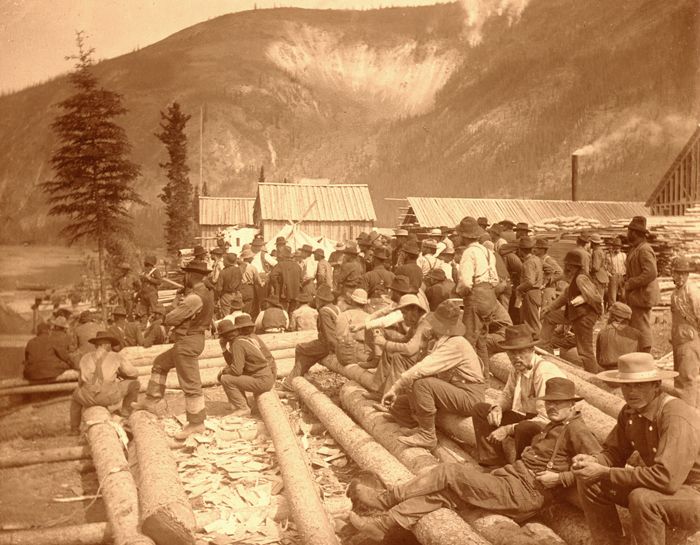
Waiting for the steamer at Dawson City, 1897
The purchase of the Dawson Railway in 1905 extended the railroad to Dawson, New Mexico, where Phelps Dodge had recently acquired coal mines to feed its smelting operations. Near Deming, New Mexico, the new track had to cross the Southern Pacific Railroad line. Aware that the Southern Pacific had only two watchmen on the route, the El Paso & Southwestern stopped all SP trains on either side of the junction and laid its new track across that of the Southern Pacific. In one day, the El Paso & Southwestern ran more than 500 fully laden hopper cars across the new junction to establish a right-of-way. The Southern Pacific sued and won a temporary injunction, but the injunction was never enforced, and the El Paso & Southwestern continued to cross the Southern Pacific’s line.
In 1905, the Southern Pacific Railroad and the El Paso & Southwestern Railroad were joined, and their operations were consolidated as quickly as possible.
After the deaths of William Dodge in 1903 and Willis James in 1907, the various Phelps Dodge railroads, mining companies, real estate firms, and other subsidiaries and divisions were merged into Phelps Dodge and Company.
The Phelps Dodge Mining Company succeeded in the 1900s because copper became increasingly valuable. Copper investments, Arizona’s copper mines, copper production, and the production of other metals were the primary sources of revenue for The Phelps Dodge Mining Company.
In February 1910, James Douglas, head of the Phelps Dodge Corporation, announced his plan to make Tucson the western terminus of the El Paso & Southwestern Railroad. Up until then, Benson was the terminus. Later that year, the company’s board of directors approved Douglas’s plan, making it official. The extension was from Fairbank, Arizona to Tucson, which had beaten out Florence and Phoenix for this honor.
El Paso & Southwestern Railroad.
By October 1911, there were 40 camps for railroad workers between Fairbank and the Vail train station, with another planned within six miles of Tucson. In March 1912, the railroad executives chose a classical design for its new passenger and freight depots, which included a baggage room, ticket office, waiting rooms, operator’s office, and a 30-foot-diameter rotunda. The roof was to be made of red tile, and four Tuscan columns would be by the main entrance. On October 31, 1912, F.L Hunter, manager of the El Paso & Southwestern Railroad purchasing department, drove in the last spike to complete the rail line, a ceremony witnessed by many Tucsonans. This was followed by the first scheduled train arriving on November 20, 1912, with a crowd of 3,000 people gathered around the temporary depot to greet it and celebrate the official arrival of the El Paso & Southwestern Railroad.
In 1915, Phelps Dodge and Company went public as Phelps-Dodge.
The railroad’s expansion continued gradually, and by 1917, the El Paso & Southwestern Railroad operated more than 1,000 miles of track. That year, the railroad was involved in a significant labor dispute. During the Bisbee Deportation, railroad officials collaborated with their counterparts in the Phelps Dodge mining subsidiaries to deport more than 1,300 striking mine workers, their supporters, and even innocent citizen bystanders from the town of Bisbee, more than 200 miles to the town of Hermanas, New Mexico.
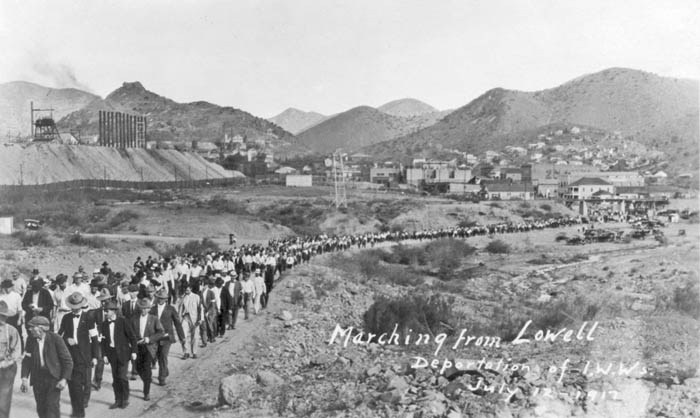
Bisbee Deportation
The worldwide collapse of copper prices after World War I severely affected not only the railroad’s financial fortunes but those of the mining companies it served.
In 1924, the Southern Pacific Railroad leased the entire El Paso & Southwest Railroad from Phelps Dodge, assuming the operation on either October 31 or November 1.
In 1929, the Interstate Commerce Commission authorized abandonment of the Deming Branch.
In November 1937, the railroad purchased the outstanding interest in the El Paso & Northeastern Railroad.
On December 13, 1954, the El Paso & Southwestern Railroad of Texas bought the capital stock of the El Paso Southern Railway Company.
The El Paso & Southwestern Railroad was purchased from Phelps Dodge and merged into the Southern Pacific in 1955; its Texas subsidiary remained until it was merged into the Southern Pacific Company on November 1, 1961.
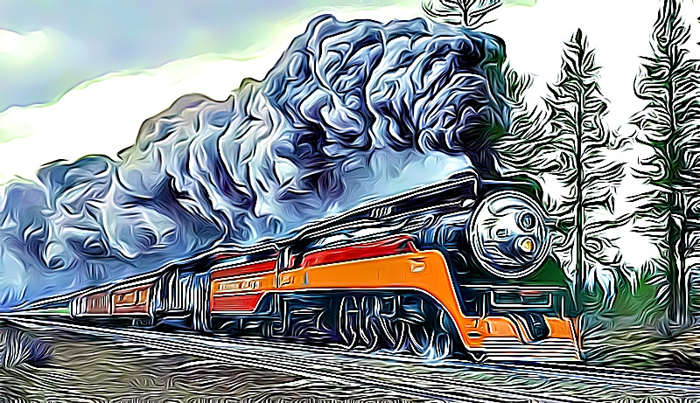
Southern Pacific Railroad.
The Southern Pacific Railroad sold the line from Benson to Douglas to Kyle Railroads, then known as the San Pedro & Southwestern Railway, in 1992.
Today, highways follow most of the route of the El Paso & Southwestern Railroad. Beginning in Tucson, Arizona, State Route 80 largely parallels the railroad grade South to Douglas. State Route 80 then follows the old tracks northeast to Rodeo, New Mexico. There, the tracks diverge from the highway and largely follow Gas Line Road until they intersect New Mexico State Road 9 near Animas, New Mexico. State Road 9 runs next to or on top of the old railroad grade until it reaches El Paso, Texas.
The Arizona & New Mexico spur of the railroad may be traced by following U.S. Route 70 West from Lordsburg to its Junction with U.S. Route 191, then North to Morenci, Arizona. The Mexican spur may begin in Douglas, crossing the international border into Mexico, and following Mexican Federal Highway 14 to Nacozari de García.
The New Mexico & Northeastern parallels or is beneath U.S. Route 54 from El Paso to Santa Rosa. The line then follows Interstate 40 into Tucumcari, New Mexico, and connects to Chicago, Illinois via the Rock Island Railroad. The Dawson line can be followed on U.S. 54 to Logan, New Mexico, then on New Mexico 39 to Abbott. 39 ends, and the tracks continue northwesterly at U.S. Route 412. By turning left onto 412, the driver follows that route into Springer, New Mexico, to join I-25 N. to Maxwell. Take New Mexico State Road 505 (which intersects Interstate 25 at Maxwell, New Mexico to the site of old Colfax, New Mexico. The Dawson Road travels the remainder of the spur from Colfax to the ghost town of Dawson. As of 1905, the El Paso & Southwestern Railroad had a route that connected from Dawson through Roy, Tucumcari, Santa Rosa, Vaughn, Carrizozo, Tularosa, and Alamogordo, New Mexico, to El Paso, Texas, and Douglas, Arizona, with spurs to Deming and Lordsburg. That later all became part of the Southern Pacific.
©Kathy Alexander/Legends of America, updated August 2026.
Also See:
A Century of Railroad Building
Linking the Oceans By Railroad
Railroads & Depot Photo Gallery
Sources:
EPCC Library Services
Texas State Historical Association
Southwestern Southern Historical & Technical Society
Wikipedia