
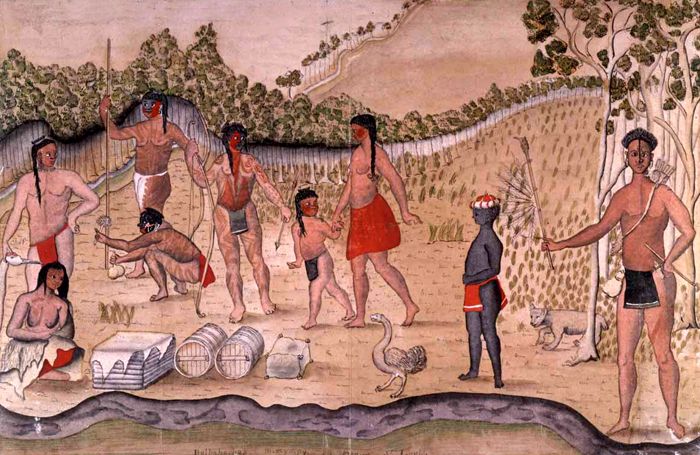
Illinois Indians.
The Cahokia were an Algonquian-speaking tribe of the Illinois Confederacy, usually associated with the Tamaroa tribe. At the time of European contact, the Illinois Indians lived in Illinois, Iowa, Missouri, and Arkansas.
Like all the Confederate Illinois tribes, they were roving until Jesuit priests gathered them and the Tamaroa into a mission settlement around 1698. This mission, first known as Tamaroa but later as Cahokia, was near the present-day site of Cahokia, Illinois, on the East bank of the Mississippi River, nearly opposite the present-day St. Louis, Missouri.
In 1721, the settlement was the second most important town in Illinois. After the Jesuits withdrew, the tribe declined rapidly, chiefly because of the demoralizing influence of a neighboring French garrison, and was nearly extinct by 1800. Five Cahokia chiefs and headmen joined those of other Illinois tribes at the 1818 Treaty of Edwardsville, Illinois, ceding to the United States half of the present state of Illinois. With the other remnant tribes of the Confederacy, they moved westward in about 1820, first to Kansas and then finally to present-day Oklahoma. The Cahokia, along with the Michigamea, were eventually absorbed by the Kaskaskia and, finally, the Peoria. The Cahokia tribe is now considered extinct.
Another earlier tribe, called Cahokians, built one of the largest man-made earthen structures in America and a large city. Referred to today as the Cahokia Mounds State Historic Site, it was inhabited from about A.D. 700 to 1400. Built by ancient peoples known as the Mound Builders, the city’s original population was thought to have been only about 1,000 until about the 11th Century, when it dramatically expanded. At its peak, from 1,100 to 1,200 A.D., the city covered nearly six square miles and boasted a population of as many as 100,000.
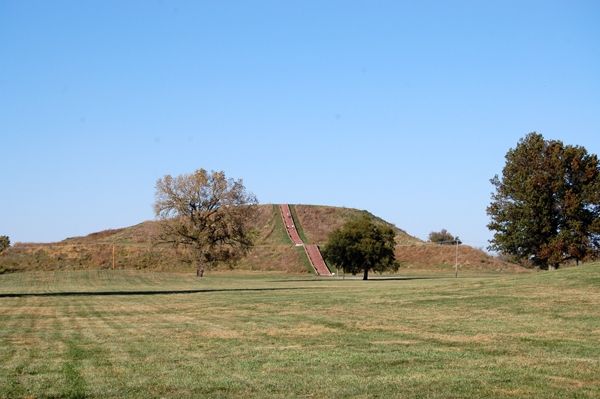
Cahokia – Monks Mound by Kathy Alexander.
©Kathy Alexander/Legends of America, updated September 2026.
Also See:
Illinois Tribe of the Mississippi River Valley
Native American Photo Galleries
See Sources.