
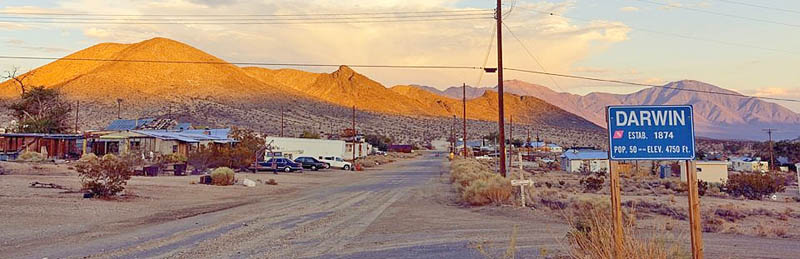
Darwin, California, courtesy of Wikipedia.
Sitting on the western outskirts of Death Valley in Inyo County, California, tiny Darwin, a semi-ghost town today, was once the largest city in the county. The settlement began in early 1860, when a prospecting expedition led by Dr. E. Darwin French set out from Visalia, California, to search for the Lost Gunsight Mine. This place had long been called “Silver Mountain.”
Exploring the rocky, dry landscape Southeast of Owens Lake, French’s party never found the Lost Gunsight Mine or Silver Mountain. Still, they did discover rich silver outcrops, staked several claims, and headed back to Visalia to record them. When they returned, hundreds followed, and soon mines developed, and the rugged mining town of Coso Junction was born.
Around 1870, more gold, silver, and lead deposits were again discovered in the Coso Range, forming the New Coso Mining District in 1874. The settlement of Darwin was soon established and named for early explorer and prospector Dr. Darwin French. Quickly developing into the main commercial center in the area, by the end of 1875, Darwin boasted two smelters, some 20 operating mines, a post office, graded streets, a drug store, a hotel, three restaurants, the ever-present saloons, a newspaper, 200 frame houses, and more than 700 residents. The Defiance Mine was the district’s principal producer, but other profitable mines included the Argus-Sterling, Christmas Gift, Lucky Jim, Custer, Independence, Keystone, Thompson, and Wonder Mines.
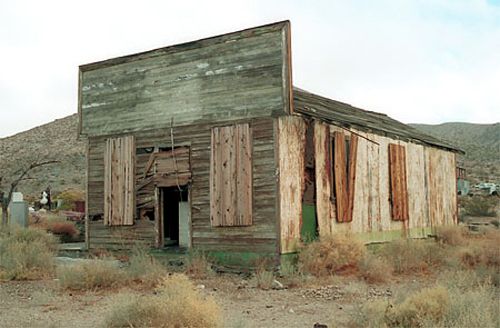
Darwin, California, courtesy of Ghost Town Explorers.
The following year, the town continued to grow, supporting over 1,000 people, and became the largest town in Inyo County. Its Centennial Celebration on July 4, 1876, was the second largest in the county. Though the settlement had taken on an air of permanence, it also gained another reputation—that of a rowdy and violent town. Because of its isolation and distance from the county seat of Independence, gunplay, assaults, and stage robberies were common. Still, the town grew, peaking at about 3,500 in 1877. However, it would not continue. A smallpox epidemic swept the community the following year, and a national economic slowdown hit Darwin hard. Production slowed, and mine owners scaled back wages, creating more violence in the community.
In September 1878, the newspaper office closed, and the publisher, T.S. Harris, packed up the presses and headed North toward the boomtown of Bodie. Many of the miners followed him. However, the following month, the Independence newspaper reported that the town still had 200-300 people, four stores, three restaurants, five saloons, and a drug store. Six months later, on April 30, 1879, a suspected arson fire began in the Darwin Hotel, destroying 14 businesses, including several stores, offices, the hotel, saloons, and the post office.
Though much diminished from its former self, Darwin didn’t completely die. In 1880, some 85 people still called it home. In 1902, however, the post office closed briefly but would later reopen.
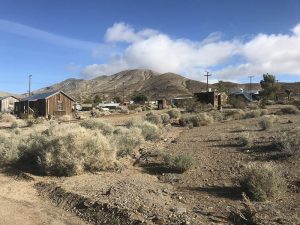
Darwin, California, courtesy of Wikipedia.
In the early 1900s, the mining industry in southern Inyo County was reborn when copper, once left in the dumps as worthless, began to be mined in earnest as its value rose dramatically. In 1907, Senator Tasker L. Oddie of Nevada bought nine claims in the Darwin area, while George Nixon and George Wingfield of Goldfield, Nevada, fame, took over some property. At the same time, the Lucky Jim Mine was shipping lead-silver ore to Salt Lake City smelters in Utah. Another smelter opened in nearby Keeler, and over the next ten years, more mines opened, and older ones were reworked. A new hotel was built, and the town began showing signs of returning to life. Unfortunately, in August 1917, another fire blazed through the town, which destroyed a service garage, a new hotel, a saloon, and three homes. Less than a year later, another fire swept down the other side of Main Street, destroying more homes and businesses.
However, by June 1919, the Darwin District, especially the Lucky Jim and Christmas Gift Mines, was still going strong, driven by the increase in the price of silver. Another significant development occurred on Mt. Ophir, where a company town was built to house the miners needed to work the Wagner & Company Mine.
In 1926, the Eichbaum Toll Road was built through Darwin and into Death Valley, bringing tourist cabins and service businesses. By 1927, the Darwin District’s future seemed assured, for the area contained ores of nearly all metallic minerals—silver, lead, gold, tungsten, and copper. From 1870 to October 1938, production in the area reached about $3 to $5 million, and some estimates put it as high as $7 million by 1945. The mines were shut down during World War II for the war effort.
After the War, in 1945, the Wagner Mine and other operations were purchased by the Anaconda Copper Mining Company. They soon became California’s No. 1 lead mine, producing two-thirds of the state’s lead. It remained in operation until the 1970s. The total value of all lead, silver, and zinc produced was evaluated at $15 million.
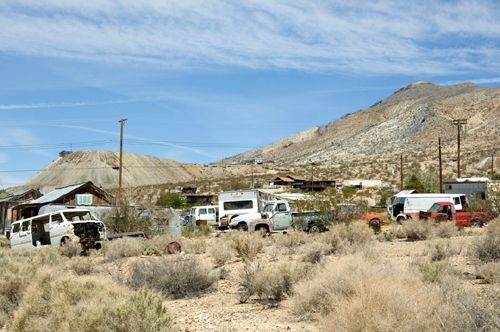
Darwin is filled with rusting junk cars, photo courtesy of the Tight Sainthood blog.
Today, Darwin’s population is estimated at just about 35 people. On the hillside of Mt. Ophir, about a half mile northwest of “downtown,” you can still see the remains of the company camp, including decaying rows of company houses, Quonset huts, and mill buildings. Its downtown area still contains several buildings that once housed businesses but are now closed. Scattered, rusted mining machinery and the remains of the old Defiance smelter, complete with rusted-out hulks of vehicles and trailers, are also visible.
Darwin is located about 24 miles Southeast of Keeler, California.
©Kathy Alexander/Legends of America, updated October 2026.
Also See:
See Sources.