
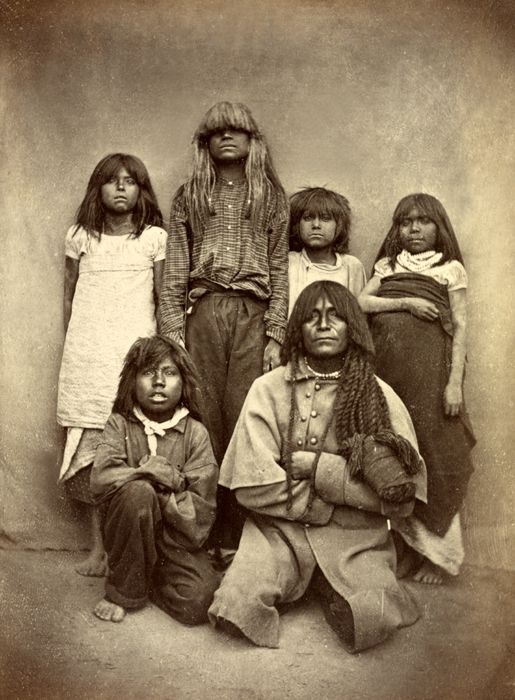
Pima Indians by Carlo Gentile, 1870.
First called the Pima Indians by exploring Spaniards who encountered them in the 1600s, these early Americans called themselves “Akimel O’odham,” meaning the River People. The Piman peoples, who live in the Sonoran Desert region, are descendants of the prehistoric Hohokam Culture.
The Pima lived along the Gila, Salt, Yaqui, and Sonora Rivers in ranchería-style villages, where family groups shared a central ramada and kitchen area. Their homes were oval lodges covered with grass and mud over a superstructure of poles. The O’odham are matrilineal, with daughters and their husbands living with and near the daughter’s mother. Each village had a chief who oversaw cultivation and defense, mainly against Apache raids. The people elected the tribal chief.
They were among the first inhabitants to turn the desert into profitable farmland with miles of irrigation canals for corn, beans, squash, kidney beans, tobacco, and cotton. The prehistoric peoples built an extensive irrigation system to compensate for the arid conditions that remains in use today. They also subsided on hunting and gathering and conducted extensive trading.
Unusual among the Indian tribes, men did the farming and wove cotton on looms, but the women made the clothing from it. They were experts in textiles and produced intricate baskets as well as woven cloth.
Before the arrival of Europeans, the Pima’s primary military rivals were the Apache and Yavapai, who raided their villages for food. In the 17th Century, the Spanish began imposing rule on the Pima, including taxation, which led to a revolt in 1695. However, the revolt was quickly suppressed, and many fled to their northern Pima lands. A more significant revolt in 1751 was also put down.
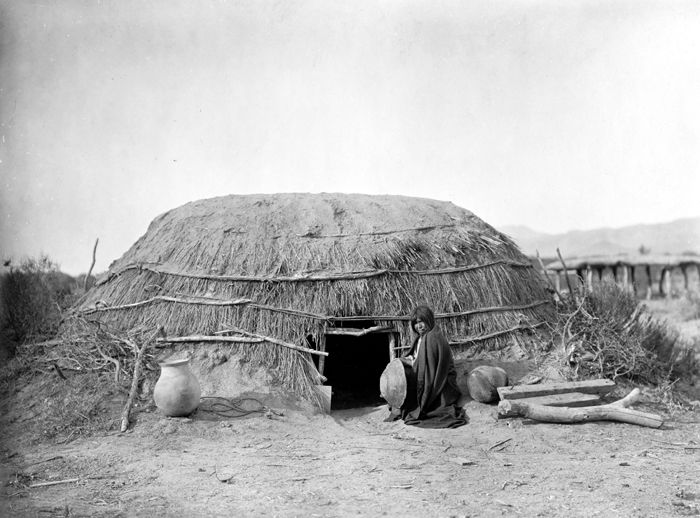
Pima Indian Home, by Edward S. Curtis, 1907.
The United States acquired Pima territory in 1853 with the Gadsden Purchase, which brought an influx of white farmers and pushed most Pima in the region to the Salt River area, where they were settled on a reservation. Today, they live along the Gila and Salt Rivers near Phoenix, Arizona.
©Kathy Alexander/Legends of America, updated September 2026.
Also See:
Native Americans – First Owners of America
Native American Photo Galleries
See Sources.