

Santa Fe Trail Freighters.
On September 9, 1867, Franz (Frank) Huning, an experienced Santa Fe Trail Merchant from Albuquerque, New Mexico, was traveling home after a trip to Dayton, Ohio. His small group, which consisted of seven wagons, a carriage, and an ambulance, was traveling with several drivers, his mother-in-law, and his 16-year-old brother-in-law.
In Junction City, Kansas, they were warned to hold up for a few days as several groups of Plains Indians were on the warpath. Other wagons and freight trains were gathered at the end of the railroad, planning to travel in a large group for protection.
However, Huning was impatient, and the small party soon left alone. The group made its way south to the Santa Fe Trail and began heading Southwest.
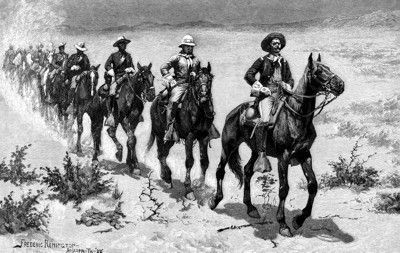
Buffalo Soldiers Riding.
After traveling another 45 miles, they reached the Little Arkansas River Crossing in present-day McPherson County, where Huning found Captain Edward Byrne of the Tenth Cavalry leading a group of Buffalo Soldiers. By this time, the experienced teamster had second thoughts about traveling with such a small party and asked Byrne for a military escort. However, although the troops were stationed there for that purpose, Byrne refused because his soldiers were out on a picnic.
Once again, Huning bravely moved on alone. Wary now, he rode ahead of the freight train, scouting for Indians. However, when his worst fears were realized, the alarm came from the back of the wagons when a teamster began yelling, “Indians, Indians!” Huning, hearing the cry, quickly turned around. While he rode ahead, several Kiowa, Arapaho, and Cheyenne warriors had sneaked up behind the wagons on foot.
Taking refuge behind the third wagon from the front, Huning began blasting the Indians at the back of the train, but he was too late. The warriors stampeded the mules and pulled the four wagons at the back, the carriage, and the ambulance away from the rest of the group.
The other three wagons pulled ahead into a circle as they faced another wave of warriors astride horses and on foot. Oddly, they didn’t attack the group of three wagons. Instead, they turned their attention to the wagons they had already acquired and had moved several hundred yards from the trail.
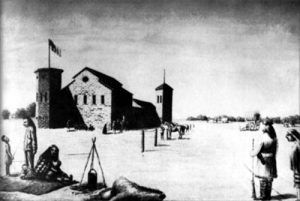
Fort Zarah, Kansas
As Huning heard his mother-in-law’s screams as the Indians ravaged her, he continued to fire upon them until his rifle jammed. As he watched helplessly, the warriors plundered his goods, packed them onto the backs of his mules, and began to set the large items on fire. His mother-in-law’s cries of terror were finally silenced with a pistol shot. Huning then saddled a mule and quickly went to Fort Zarah, some 15 miles away.
Upon his arrival, no soldiers were in camp, but two civilian scouts, Captain Charles Christy and a man named Roma, set out with an ambulance to Plum Buttes. When they arrived, they found the scalped and mutilated body of one of the teamsters under a wagon. They stuffed inside a featherbed the mutilated bodies of Huning’s mother-in-law and brother-in-law, and the prairie was littered with burned wagons and goods.
The scouts then loaded the three bodies into the ambulance and began the return trip to the fort. On their way back, the warriors assailed them again, and they were engaged in a four-mile chase. Fortunately, they held off the Indians until a large group of Fort Zarah soldiers rode in, and the Indians fled.
Huning returned to his family in Albuquerque, New Mexico, where he continued as a successful merchant. He became the first person in the American West to complain, “Where’s the damn cavalry when you need them?” For years afterward, partly burned wagons, barrels, and broken dishes lay scattered in the area. Many historians believe the attack was led by Charley Bent, the mixed-race renegade son of William Bent, and a group of Dog Soldiers.
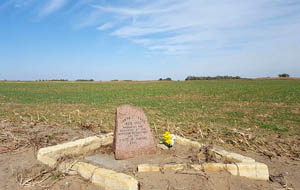
Plum Buttes Massacre Site on the Santa Fe Trail in Rice County, Kansas, by the National Park Service.
We heard from Carolyn Hathaway Kern, the great-granddaughter of John Hathaway, that the Huning wagons were attacked two miles Southeast of Plum Buttes on the East side of the quarter section now known as Ralph’s Ruts. Kern says, “We know this because debris (broken and burned trade goods and wagon parts) was still lying on the prairie in 1878 when John Hathaway (my great-grandfather) filed homestead papers. In 1950, my brother, sister, and I could still find broken bits after a rain.”
At the time of the incident, “Plum Buttes” was the only named/known landmark nearby, so that was the logical name associated with the location of the tragedy. Kern adds that the Ralph Ruts gate to the Santa Fe Trail ruts and massacre site is never locked, allowing visitors to walk the ruts and view the site.
Ralph’s Ruts are located 4 miles West of Chase, Kansas, on Highway 56 and 3/4 mile North on 4th Avenue.
For additional information, contact Carolyn Hathaway Kern at 620-257-8155.
©Kathy Alexander/Legends of America, updated August 2025.
Also See:
Indian Wars, Battles & Massacres
Indian Wars of the Frontier West
Source:
Santa Fe Trail.org
Carolyn Hathaway Kern, current owner of the Hathaway homestead, home of Ralph’s Ruts.