
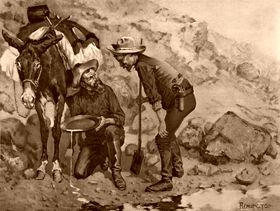
Miners prospecting by Frederic Remington.
Mining Types:
Hardrock Mining – This method requires digging into solid rock to find minerals in their ore form. The simplest form is utilizing picks and shovels, but rock drills and dynamite were also often used. Shafts and tunnels might go straight into the ground or advance horizontally into mountain faces. Shafts and tunnels were often supported by large timbers to prevent cave-ins, but accidents were common in the early days of mining. Deep shafts were generally accompanied by a head frame standing above them to support the hoists. These types of mines almost always eventually flooded as they got closer to the water table, at which time pumps were used to remove the water. In some cases, however, there was so much water that a mine would have to be abandoned.
Placer Mining – Pronounced plăs’ər, this type of mining involves obtaining minerals from placer deposits by washing or dredging. The word placer comes from the Spanish word meaning “sandbank.” It refers to mineral deposits, particularly gold and gemstones, found in alluvial deposits—sand and gravel in modern or ancient stream beds. This is the oldest method of recovering gold from alluvial deposits and is also the easiest, including panning, sluicing, using a rocker, or, if lucky enough, simply picking up what lies on the ground. Placer mining also includes dredging and hydraulic methods. Placer mining takes advantage of gold’s high density, which causes it to sink more rapidly from moving water than the lighter materials it is found in.
Dredging – Today’s most important placer-mining method involves using a floating boat or barge with either a series of buckets to scoop gravel or a suctioning apparatus to vacuum gravel from the bottom of a creek or river. The most common type of dredge used in gold placer mining in the early 1900s was a bucket-ladder dredge, a chain of continuously rotating buckets mounted on a rigid, adjustable frame called the ladder. Sluices also accompany dredges to separate the gold from gravel and debris.
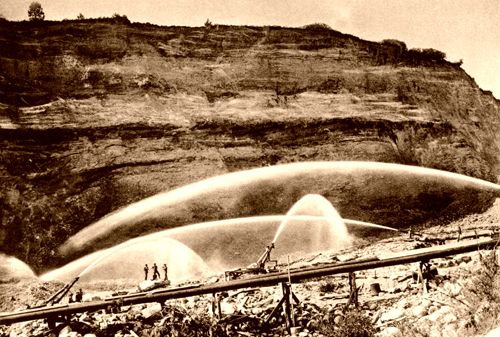
Hydraulic Mining, Twin Springs, ID, Horace C. Myers, 1901
Hydraulic Mining – Another type of placer mining uses high-pressure water sprayed onto an area of rock and gravel, breaking up the rock and dislodging ore and placer deposits. The water/ore mixture is then milled. Due to its destructive forces, this type of mining has been outlawed in most areas.

Gold Panning,
Panning – This is the simplest form of placer mining. The most commonly used technique among 19th-century miners and prospectors was to place a few handfuls of sand and gravel in a large pan, add water, and shake it until the gold particles or other heavy metals settled to the bottom of the pan.
Then, the lighter sand, mud, and gravel were washed over the side of the pan, leaving the gold behind. When gold was found, the miners would move on to equipment such as sluices and rockers to handle a higher volume of sand and gravel. Eventually, these easy-to-find minerals would be worked out, and more advanced technologies would be used to extract the gold, including hydraulic mining and dredging.
Sluicing – A slightly sloping wooden trough called a box sluice, or a ditch cut in hard gravel or rock called a ground sluice, is used as a channel along which a stream of water carries gold-bearing gravel. Riffles placed along the bottom of the sluice cause the water to eddy into small basins, slowing down the current so that gold may settle.
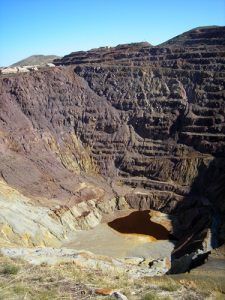
The Lavender Pit Mine in Bisbee, Arizona, by Kathy Alexander.
Open-pit Mining – Also known as open-cast mining, open-cut mining, and strip mining, this type of mining extracts rock and minerals from the earth by their removal from an open pit. The process requires digging large, open holes rather than the small shafts and tunnels used in hard rock mining. Not commonly used in the 19th century, it is a common practice today, especially with copper and coal. Because this type of mining devastates the landscape, regulations generally require companies to restore the environment when the mining is complete.
Mining Claims:
Lode Claims – Deposits subject to lode claims include classic veins or lodes having well-defined boundaries. They also include other rocks bearing valuable minerals and may be broad zones of mineralized rock. Examples include quartz or other veins bearing gold or other metallic minerals and large-volume but low-grade disseminated metallic deposits. The federal statute limits their size to a maximum of 1,500 feet in length along the vein or lode. Their width is a maximum of 600 feet, 300 feet on either side of the centerline of the vein or lode. The end lines of the lode claim must be parallel to qualify for underground extra-lateral rights. Extra lateral rights involve the rights to minerals that extend at a depth beyond the vertical boundaries of the claim.
Placer Claims – Mineral deposits subject to placer claims include those not subject to lode claims. Initially, these included only deposits of unconsolidated materials, such as sand and gravel, containing free gold or other minerals. By Congressional acts and judicial interpretations, many nonmetallic bedded or layered deposits, such as gypsum and high calcium limestone, are also considered placer deposits. The maximum size of a placer claim is 20 acres per locator. An association of two locators may locate 40 acres, and three may locate 60 acres, etc. The maximum area of an association placer claim is 160 acres for eight or more persons. The maximum size of a placer claim for corporations is 20 acres per claim. Corporations may not locate association placer claims unless they are associated with other private individuals or corporations as co-locators.
Mining Sites:
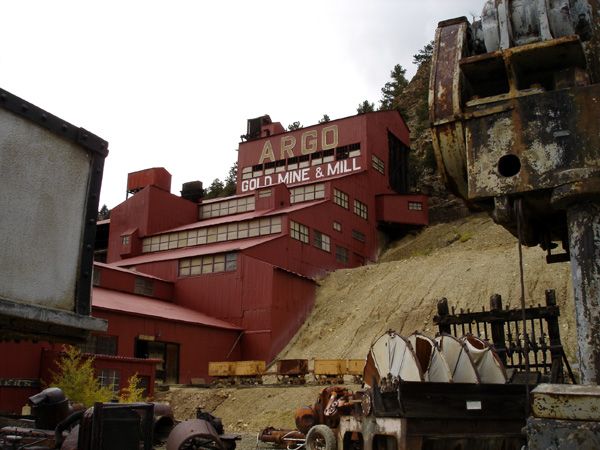
Argo Mill at Idaho Springs, Colorado.
Mill Sites – A mill site must be located on non-mineral land, with its purpose being to either support a lode or placer mining claim operation or support itself independently of any particular claim. A mill site must include the erection of a mill or reduction works and may include other uses reasonably incident to support a mining operation. Descriptions of mill sites are based on metes-and-bounds surveys or legal subdivisions. The maximum size of a mill site is 5 acres.
Tunnel Sites – A tunnel site is where a tunnel is run to develop a vein or lode. It may also be used to discover unknown veins or lodes. To stake a tunnel site, two stakes are placed up to 3,000 feet apart along the proposed tunnel line. Recordation is the same as a lode claim. Some States require additional centerline stakes.
An individual may locate lode claims to cover any or all blind (not known to exist) veins or lodes intersected by the tunnel. The maximum distance within which these lode claims may exist is 1,500 feet on either side of the tunnel centerline. This, in essence, gives the mining claimant the right to prospect an area 3,000 feet wide and 3,000 feet long. Any mining claim located for a blind lode discovered while driving a tunnel relates back in time to the date of the location of the tunnel site.
Federal Lands Open to Mining:
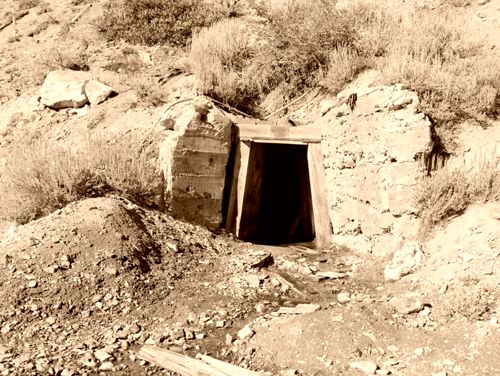
Adit at the Lucky Tiger Mine, Humboldt County, Nevada.
There are federally administered lands in 19 States where you may locate a mining claim or site. These states include Alaska, Arizona, Arkansas, California, Colorado, Florida, Idaho, Louisiana, Mississippi, Montana, Nebraska, Nevada, New Mexico, North Dakota, Oregon, South Dakota, Utah, Washington, and Wyoming.
In these States, the Bureau of Land Management (BLM) manages the surface of public lands, and the Forest Service manages the surface of National Forest System lands. The BLM is responsible for the subsurface on public and National Forest System lands. You may prospect and locate claims and sites on lands open to mineral entry. Claims may not be staked in areas closed to mineral entry by a special act of Congress, regulation, or public land order. These areas are withdrawn from the operation of the mining laws. Before mining on any federal land, prospectors would be well advised to check with the Bureau of Land Management and the state.
Compiled and edited by Kathy Alexander/Legends of America, updated March 2026.
Also See:
Mining on the American Frontier
See Sources.