
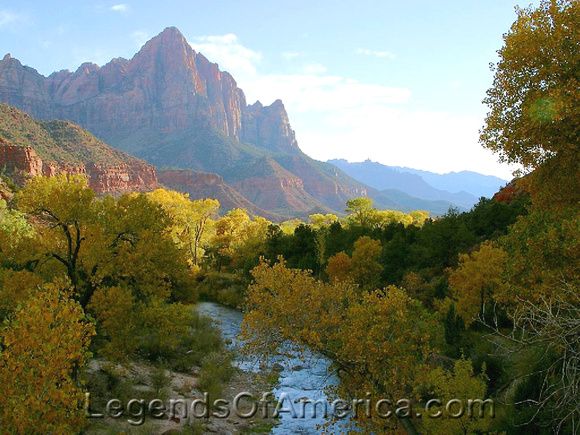
Virgin River through Zion National Park.
Located in southwestern Utah, Zion National Park encompasses 229 square miles of high plateaus, a maze of narrow, deep sandstone canyons, and soaring rock towers and mesas formed by the Virgin River, which is often wild and sometimes raging, over eons. Utah’s oldest national park is also the most visited in the state, with approximately three million visitors annually.
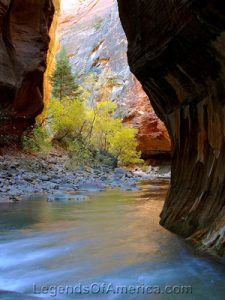
Zion Narrows, Utah.
People had inhabited the park for approximately 12,000 years when they first hunted mammoths, giant sloths, and camels before these animals were overhunted and died out some 8,000 years ago. The nomadic people then turned to hunting smaller animals and gathering wild plants, seeds, and nuts. Approximately 2,000 years ago, the region was inhabited by the Ancient Puebloans, who practiced agriculture. Unlike their eastern counterparts, who constructed monumental structures, such as those in Chaco Canyon, New Mexico, the Ancient Puebloans lived in small, seasonal, multi-room pueblos.
Subsisting on corn, beans, and squash, which they grew using canal irrigation, and on pine nuts and wild plants, they also hunted small game, including deer, turkey, and rabbits. However, about 800 years ago, the Ancient Puebloans moved southeast, probably due to drought and overuse.
For several centuries, the Fremont Indians coexisted in the region. They flourished between 400 A.D. and 1350 A.D., living in semi-subterranean “pit houses” and rock shelters. They, too, were farmers but relied more heavily on hunting and foraging for wild foods. Like the Ancient Puebloans, they also disappeared from the region about 1350 A.D.
Researchers believe that both groups left due to prolonged droughts in the 11th and 12th centuries, catastrophic flooding, and perhaps their inability to compete with the Paiute and Ute Indians, who were more accustomed to desert conditions, who moved into the region around A.D. 1100.
The Ute and Paiute occupied the region exclusively for the next three centuries, living a mobile lifestyle and primarily hunting and collecting wild plants. However, the Southern Paiute also planted corn, sunflowers, and squash fields to supplement their diets.
Euro-Americans’ exploration and settlement began in the late 1700s, first by traders from New Mexico who blazed the Old Spanish Trail, which followed the Virgin River for a portion of its length.
A view from Zion National Park. Photo by Kathy Alexander.
In the next century, American fur trappers and government surveyors added new overland routes across the region, and, beginning in 1847, Mormons began to settle in Utah. By the 1860s, numerous Mormon settlements were established along the upper Virgin River, including Shunesberg, Springdale, Grafton, Adventure, and Paradise. In 1863, Issac Behunin built the first log cabin in Zion Canyon near the Zion Lodge location. Soon, the canyon was dotted with other homesteads.
In 1872, John Wesley Powell explored Zion Canyon as part of western surveys conducted by the U.S. Geological Survey. The early pack trails soon became well-used wagon roads, connecting Santa Fe to the California markets.
During the remainder of the century, the small communities and homesteads struggled to survive. Catastrophic flooding by the river, little arable land, and poor soils made agriculture in the upper Virgin River risky. Some settlements, including Shunesberg and Grafton, were ultimately abandoned in favor of more favorable locations.
By the first decade of the 20th century, the scenic qualities of southern Utah and Zion Canyon, in particular, had been recognized as a potential destination for tourism. In 1909, a presidential Executive Order designated Mukuntuweap National Monument; however, in 1917, when the acting director of the newly created National Park Service visited the canyon, he proposed changing its name to Zion, which was locally unpopular as Mukuntuweap. However, the new monument was virtually inaccessible to visitors because the existing roads were in poor condition and the nearest railhead was 100 miles away.
Established that year, the Utah State Road Commission began construction on a state highway system that would eventually improve access to the southern region. State officials also negotiated with the Union Pacific Railroad to develop rail and automobile links in southern Utah and tourism facilities. By the summer of 1917, touring cars could finally reach Wylie Camp, a tent-camping resort that was the first visitor lodging in Zion Canyon.
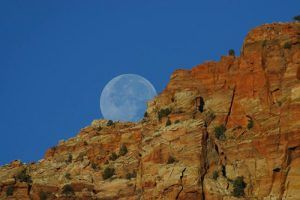
Moon rising over Zion National Park, Utah, by John Sullivan.
In 1919, a Congressional bill designating Zion National Park was signed into law. Visitation to the new national park increased steadily during the 1920s, particularly after the Union Pacific extended a spur rail line to Cedar City. The Utah Parks Company, a subsidiary of the Union Pacific Railroad, acquired the Wylie Camp in Zion and offered 10-day rail-and-bus tours to Zion, Bryce, the Kaibab, and the North Rim of the Grand Canyon. Construction on the Zion Lodge complex, designed in “Rustic Style” by architect Gilbert Stanley Underwood, began in the mid-1920s. In 1930, the newly completed Zion-Mt Carmel highway, including a 5,613-foot tunnel through the sandstone cliffs, allowed motorists to travel through the Zion National Park. This highway was one of the most remarkable engineering feats of modern times, and at the time, the tunnel was the longest of its type in the world. Today, the Zion-Mount Carmel Highway can be traveled year-round; however, access for oversized vehicles requires a special permit and is limited to daytime hours, as traffic through the tunnel must be one-way to accommodate large vehicles.
The park provides two visitor centers, scenic drives, tours, numerous hiking trails, bicycling and horse riding opportunities, and camping in designated campgrounds. Lodging and a restaurant are available at Zion Lodge. National Park Service fees are required for entry to the park, which receives three million visitors each year.
Contact Information:
Zion National Park
Springdale, UT 84767-1099
435-772-3256
Compiled and edited by Kathy Alexander/Legends of America, updated December 2025.
Also See:
National Parks, Monuments & Historic Sites
Nearby: Pipe Spring National Monument (AZ)
Utah Scenic Views Photo Gallery
National Parks, Historic Sites & Monuments Photo Galleries
Source: National Park Service