
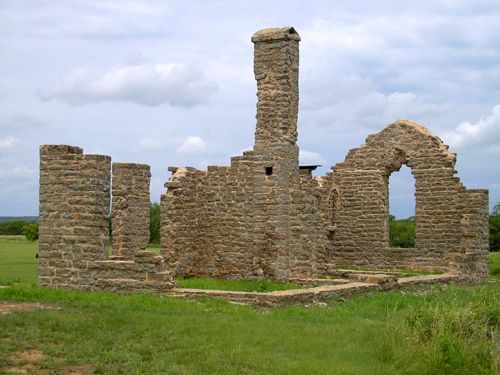
Fort Griffin Administration Building by Kathy Alexander.
The U.S. Cavalry established Fort Griffin in 1867 in northwestern Shackelford County to protect area settlers from Comanche and Kiowa raids.
Though little remains of the old fort and even less of the settlement that formed below the bluff, Fort Griffin was one of the wildest places in the Old West.
Built on the rolling hills between the West Fork of the Trinity River and the Clear Fork of the Brazos River, the area was dangerous as settlers moved into Texas and clashed with Plains Indians who had long called it their exclusive hunting grounds. Though Forts Belknap, Phantom Hill, and Camp Cooper had already been built in the 1840s, they were not enough to protect new settlers. However, the Civil War interrupted further fort building until it ended. Afterward, the government began building forts again, including Fort Griffin and Fort Richardson.
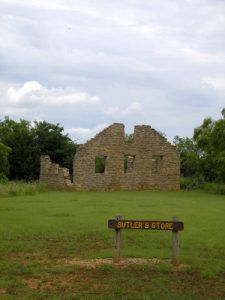
Fort Griffin Sutlers Store by Kathy Alexander.
Work began on Fort Griffin on July 31, 1867, when Lieutenant Colonel Samuel arrived with four companies of the Sixth Cavalry. The outpost, first called Camp Wilson, was built on a hill overlooking the Clear Fork of the Brazos River. Later, the name was changed to Fort Griffin in honor of the late Major General Charles Griffin, Commander of the Texas Army Department, who had initially planned the new fort.
By the time it was finally complete, the fort would accommodate up to six companies of soldiers and included an administration building, a hospital, officers’ quarters in eleven buildings, numerous barracks, a guardhouse, a bakery, a powder magazine, five storehouses, forage houses, four stables, a laundry, and a workshop.
Almost immediately after the fort was completed, a new settlement began at the bottom of the hill, first called “The Bottom,” “The Flat,” or “Hidetown,” before it took on the fort’s name. In addition to the honest pioneers who settled the area for legitimate reasons of ranching, agriculture, and commerce, several ruffians and outlaws flooded in.
When more people continued to arrive, the Indian attacks increased across northern Texas, keeping the soldiers busy in what was called the Red River Campaign. The battles continued until 1874, when the Texas Army defeated the Kiowa and Comanche at Palo Duro Canyon.

John M. Larn.
Meanwhile, the settlement below the hill bustled with buffalo hunters, businessmen, cowboys, outlaws, gamblers, gunfighters, and “painted ladies,” quickly gaining a reputation for lawlessness.
Some of these people would later become well known in the annals of history, including Doc Holliday and Wyatt Earp, who first met in Fort Griffin. Others included Big Nose Kate, a famous lady gambler; Lottie Deno; lawman Pat Garrett; and gunfighter John Wesley Hardin. “Marshaling” the lawless town was outlaw/lawman John M. Larn as sheriff, and his deputy, John Selman, who, in the mid-1870s, were working both sides of the law by controlling the local vigilante group known as the Tin Hat Brigade and rustling cattle. John Larn, however, would be killed by those same vigilantes inside his jail in Fort Griffin. On the other hand, Selman quickly disappeared and, almost two decades later, would kill John Wesley Hardin. During these lawless times, the settlement was so decadent that it was labeled “Babylon on the Brazos.”
In fact, in 1874, the place was so bad that the fort commander placed the town under its control, declared martial law, and forced many undesirable residents to leave. The town remained under the army’s control until Shackelford County was officially formed later in the year. When the fort was built and the town below it sprang up, it was part of Jack County. However, while the town boasted its bawdy ways to the extreme, several law-abiding citizens in the area wanted to form a new county. Early in 1874, they petitioned the Jack County Court to form their county. In September, permission was granted, and the new county was called Shackelford in honor of Dr. Jack Shackelford, a Texas revolutionary hero. Fort Griffin became the temporary county seat on October 12, 1874.
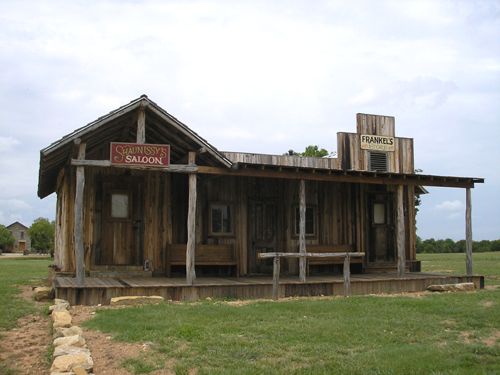
At Shaunissy’s Saloon in Fort Griffin, Wyatt Earp first met Doc Holliday. Today, the saloon has been rebuilt on its original foundation. Photo by Kathy Alexander.
But those law-abiding citizens weren’t satisfied with having Fort Griffin, with its immoral reputation, as their county seat. They quickly gathered and proposed a brand-new town in the center of the county to serve as the permanent county seat. On November 8, 1874, area residents voted to establish the new town of Albany to serve the new county.
Though disappointed at losing its county seat status, Fort Griffin continued to bustle, serving as a major supply source for buffalo hunters from 1874 through 1877 and a stopover for the many cowboys herding cattle up the Western Trail to the Dodge City, Kansas, railheads. Businesses of all kinds sprouted to meet the growing population’s needs, including numerous stores, saloons, and restaurants. A newspaper called the Fort Griffin Echo ran from 1879 to 1882, and the town even had an academy for several years. At its height, Fort Griffin had a permanent population of about 1,000 and an estimated transient population of nearly twice that.
However, by the late 1870s, the buffalo population on the plains was dwindling, reducing the number of buffalo hunters who called Fort Griffin home. Vital to the town’s economy, businesses began to suffer and soon packed up and moved to the new town of Albany.
In 1881, two events would deliver the final blows to Fort Griffin. By this time, the Indians of the area had been pushed westward or placed on reservations, and the fort’s soldiers were no longer needed. After 14 years of guarding the area population, the U.S. flag at the fort was lowered for the last time on May 31.
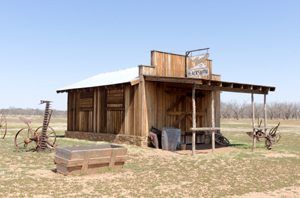
The old blacksmith shop has also been recreated on its original foundation by Carol Highsmith.
That same year, the Texas Central Railroad was pushing through the region, and Fort Griffin was working desperately to entice them through their city. However, the citizens of nearby Albany raised $50,000 to lure them through their town.
The small town survived for several years, gradually shrinking. By the 1940s, the school had been consolidated with Albany’s, and soon after, the post office closed.
Today, only a couple of original buildings are left at the townsite, but several “new” ones have been reconstructed over original foundations. What’s left of this once-thriving town is situated on the Collins Creek Ranch, a wildlife habitat, working ranch, and commercial hunting property. Though privately owned, the owners allow visitors to see what’s left of this once-lawless place.
The fort itself was preserved for years as the Fort Griffin State Historical Park; however, on January 1, 2008, the site was transferred to the Texas Historical Commission. The 506-acre park features the partially restored ruins of old Fort Griffin on the bluff overlooking the old townsite and the Clear Fork of the Brazos River Valley. Several buildings remain, including the mess hall, barracks, administration building, powder magazine, and the restored bakery. Other remnants include a hand-dug well, cistern, numerous foundations, and a rock chimney. The small soldiers’ barracks have been recreated. A portion of the official Texas Longhorn herd resides in the park, which also provides camping, hiking, fishing, and picnicking.

Longhorn cattle at Fort Griffin, Texas by Carol Highsmith.
With the Texas Historical Commission now operating the site, a few changes are underway, including clearing the mesquite trees and cactus from the fort, as these are not historically accurate. This vegetation came up the trail with the longhorns. The Visitor’s Center will also be expanded, and there is hope that archaeological digs might be conducted in the future.
The site is open daily year-round. Fort Griffin is on the Texas Forts Trail on U.S. Highway 283, about 15 miles northeast of Albany, Texas.
Contact Information:
Fort Griffin State Historic Site
1701 North U.S. Highway 283
Albany, Texas 76430
325-762-3592
©Kathy Alexander/Legends of America, updated October 2026.
See our Texas Forts Photo Gallery HERE
Also See:
See Sources.