
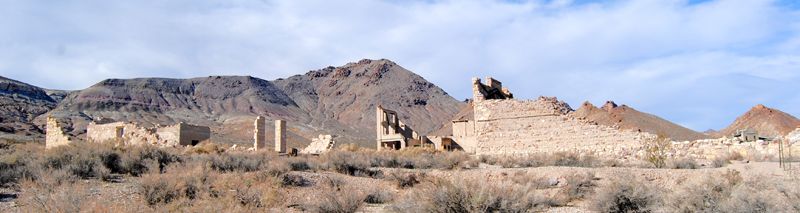
Building Ruins in Rhyolite, Nevada, by Kathy Alexander.
~~
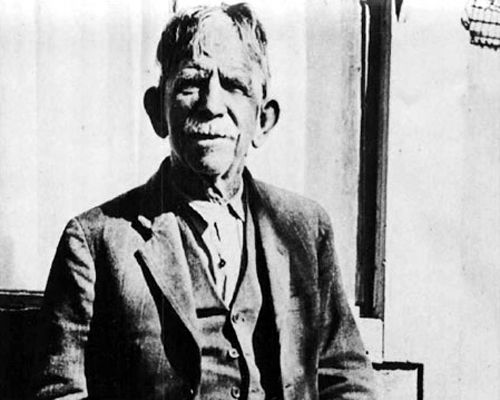
Frank “Shorty” Harris.
Rhyolite, Nevada, began when Frank “Shorty” Harris and Ernest L. Cross discovered gold on August 9, 1904. They called their claim Bullfrog, located a few miles South of where Rhyolite would soon sprout up. When they took samples to nearby Goldfield, they were assessed at $665/ton. Shorty described it as “… the quartz was just full of free gold… it was the original bullfrog rock… this banner is a crackerjack.” Word spread quickly, and the gold rush was on.
Hundreds of men began flooding the area, and several mining camps popped up called Bullfrog, Amargosa, Jumpertown, Leadfield, Gold Center, and dozens more. Shorty Harris would say of the area:
“The district is going to be the banner camp of Nevada. I say so once, and II’llsay it again.”
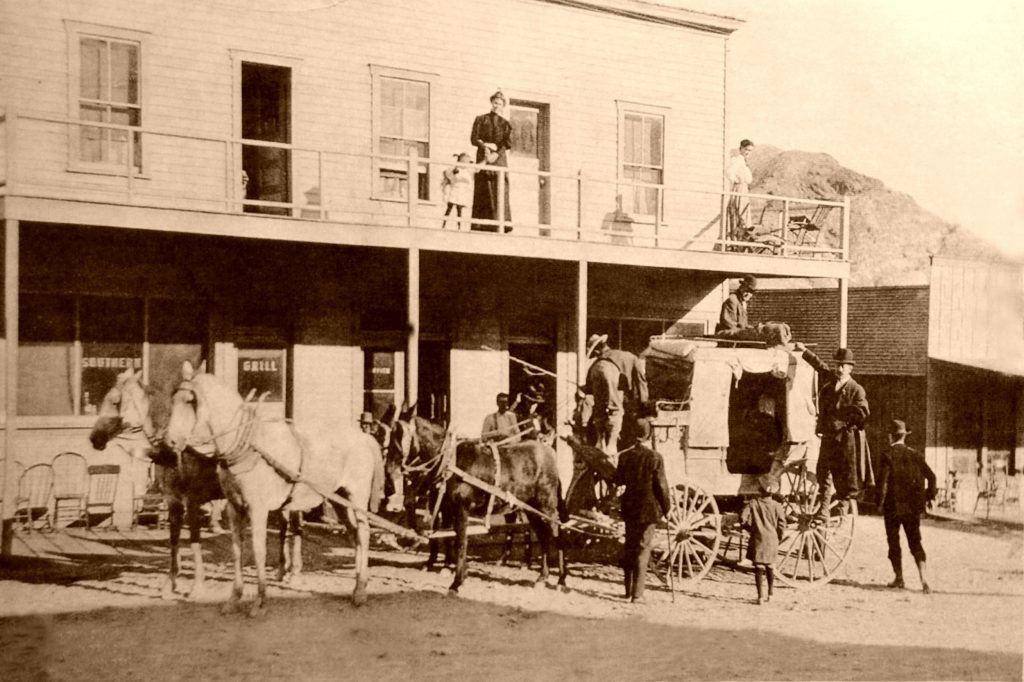
Stagecoach at the Southern Hotel in Rhyolite, Nevada.
Soon, several men named A.G. Cushman, Percy Stanley, C.H. Elliot, and Frank J. Busch began promoting the townsite of Rhyolite, named for the silica-rich ore where most of the gold was found. By November, the town was staked, and lots were offered for sale for $50 each in February 1905. One of the first buildings constructed was the two-story Southern Hotel. Water was a rare commodity in the area and was carted in for $2 to $5 a barrel.
Just months later, in April, H.D. and L.D. Porter crossed Death Valley, bringing along supplies from their store at Randsburg. By that time, the rush to Rhyolite was so great that the Porters had to pay $1,200 for their lot. By constructing a story-and-a-half stone building, they quickly became the district’s leading merchants. In no time, over 2000 claims covered a 30-mile area surrounding the Bullfrog Mining District. The most promising was the Montgomery-Shoshone mine, which prompted everyone to move to the Rhyolite townsite. The town immediately boomed with buildings springing up everywhere, including saloons, restaurants, and boarding houses.
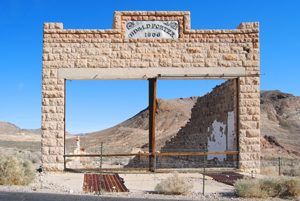
Porter General Store in Rhyolite, Nevada, by Kathy Alexander.
Along with the gold miners, several sharp businessmen also moved into town—making money from the real estate boom and selling speculative stock shares in Rhyolite ventures coast-to-coast. In the end, they would all be worthless.
By spring 1905, three stage lines brought supplies to Rhyolite. The first auto stage—the Tonopah and Goldfield Auto Company — also became active in 1905. By May, Rhyolite boasted some 1,500 people and several buildings of concrete and stone. That same month, Earle R. Clemens published the first issue of the Rhyolite Herald, and the first post office opened in a ten-by-twelve foot tent on Golden Street.
Though a stage line brought mail from Goldfield, the service was initially irregular. The first postmaster was a woman named Anna B. Moore, who was just 18; her husband, Joe, was her assistant. By June, Rhyolite had an efficient water system, so residents no longer had to pay the high cost of having water carted into town.
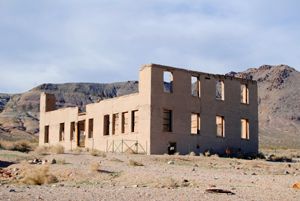
All that’s left of the Rhyolite school by Kathy Alexander.
Like many mining camps, Rhyolite was sometimes prone to violence, with its rugged men and abundant liquor flowing from its many saloons. Though Rhyolite never had a reputation like many mining camps of the Old West in the late 1800s, the settlement suffered its first killing in October 1905 over a dispute in Wandell’s Saloon.
At its first town meeting, residents decided to establish a school, which was completed in 1906 with an enrollment of about 90 children. By May, the school had nearly 250 children.
Hastily built, the schoolhouse was blown down in September 1906 by heavy winds, and school was then held in the county hospital building. In the fall of 1906, the city approved $420,000 for a new school; however, the new concrete structure wouldn’t open until January 1909.
1906 was a busy year for Rhyolite, which by then had abundant water and three water companies. The Countess Morajeski opened the Alaska Glacier Ice Cream Parlor to the delight of the residents. Ernest L. Cross, one of the original prospectors who found gold in the area, sold his share of the Bullfrog claim for $125,000 and bought a ranch near San Diego, California, where he lived until he died in 1958. Shorty Harris would continue prospecting the desert for the rest of his life.
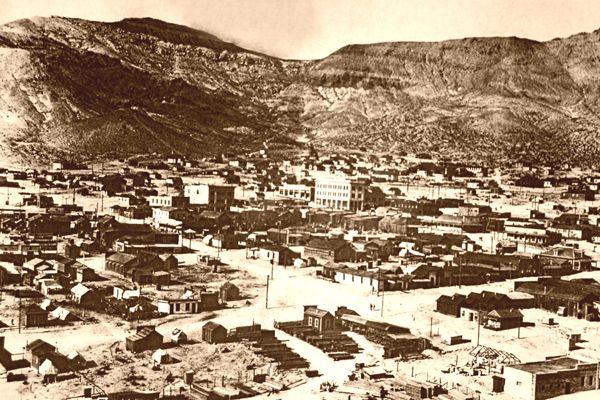
Rhyolite, Nevada and the Bullfrog Hills, 1909.
On May 18, 1906, another killing occurred in Rhyolite when a man named Steve O’Brien stabbed his wife with a miner’s candlestick. When a town deputy sheriff and the judge showed up, the crazed O’Brien stabbed the judge. In retaliation, the deputy shot and killed O’Brien.
Months later, on October 26, 1906, two men named Tom J. Malone and Jack Maher had a dispute over money, and soon Malone lay mortally wounded in the street from Maher’s lethal gun. Malone held on for almost a day but died the next night in the hospital. Maher was arrested and tried, but in the end, he was let go after a self-defense verdict.
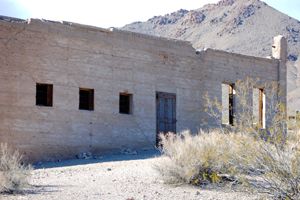
Rhyolite Jail by Dave Alexander.
As in most mining camps, a red-light district did booming business, drawing women from as far away as San Francisco. A protest soon reached the Board of Trade, the town’s only local government at the time. Town authorities decided to segregate the red-light district from the rest of the town, and they drew boundaries. Amargosa Street, between Broadway and Colorado Streets, formed the north and south boundaries, while the alley between Main and Amargosa formed the western boundary. Prostitutes were not allowed to cross the lines, including going to any saloons outside of the prescribed limits; however, they could go as far East as they wanted. The town also had an active social life, including baseball games, dances, whist parties, tennis, a symphony, Sunday school picnics, basketball games, Saturday night variety shows at the opera house, and pool tournaments.
At this time, Rhyolite did not yet have a jail, and the lawmen had to transport the offenders to a jail in Bullfrog. For $15 a day to rent the horse rig, the town began to see the need for building its own jail.
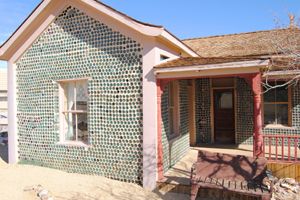
Bottle Building in Rhyolite, Nevada by Kathy Alexander
In 1906, an enterprising miner named Tom T. Kelly built the Bottle House out of 50,000 beer and liquor bottles. This building still stands today, and locals sometimes give tours. Rhyolite also saw the building of two railroads – the Tonopah & Tidewater Railroad and the Las Vegas & Tonopah Railroad. The LV&T sent the first passenger train into Rhyolite on December 14, 1906, arriving through the heart of the residential district. Later, the T&T Railroad would pass through the outskirts of town. At one time, the railroad sidings could accommodate 105 train cars waiting to be unloaded of incoming freight and reloaded with outgoing ore.
By the end of 1906, Rhyolite boasted several hotels, stores, an ice plant, two electric plants, foundries, machine shops, a miner’s union hospital, a stock exchange, and a Board of Trade.
In January 1907, a network of 400 electric streetlight poles was installed in Rhyolite, and the town boasted plumbing and telephone service. Several very impressive buildings were erected, including a three-story bank building and a large mercantile store. In March 1907, the jail was built out of concrete with four steel cells.
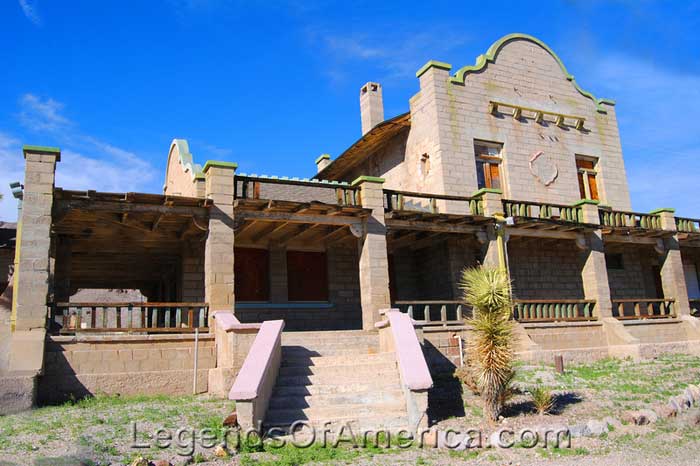
The old depot in the ghost town of Rhyolite, Nevada. Photo by Kathy Weiser-Alexander.
The Las Vegas & Tonopah Railroad depot was built of cut stone hauled from Las Vegas. On June 18, 1907, Rhyolite saw the arrival of yet another passenger train – the Bullfrog & Goldfield. In August, a mill was completed that would handle 300 tons of ore a day at the Montgomery Shoshone Mine. The mine had become nationally known because Bob Montgomery once boasted he could take $10,000 a day in ore from the mine.
By this time Rhyolite had reached a population of about 10,000 and supported 45 saloons, an opera house, a slaughterhouse, two railroad depots, three public swimming pools and dozens of businesses. Over eighty-five mining companies were active in the hills around the city.
However, in the summer of 1907, the American economy was showing signs of weakness, as several businesses and Wall Street brokerages went bankrupt.
In October, the respected Knickerbocker Trust in New York City and the Westinghouse Electric Company both failed, touching off a series of events known as the Panic of 1907. This spelled doom for Rhyolite.
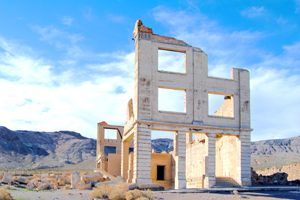
John S. Cook Bank building in Rhyolite, Nevada, by Dave Alexander.
After the initial business collapses, stock market prices plummeted, and depositors made a massive run on the nation’s banks. Because most of Rhyolite’s investors were from the East, they began to withdraw their backing. Smaller mines began to close, but the panic’s devastating effects did not dramatically affect Rhyolite until the spring of 1908.
In January 1908, the John S. Cook Bank building was completed; its ruins are today the most photographed site of all Nevada ghost towns. It also had a large mercantile store and an impressive train station. The post office soon outgrew the tent and moved to a frame building on Broadway. In July 1908, it moved to the 30 x 70 basement of the Cook Bank Building. But it was a little too late for Rhyolite.
After the 1907 Panic, more and more mines began to close, and banks started to fail. At about the same time, the gold started to pan out in the area mines. Soon, the trains were mostly filled with people leaving town.
When gold was discovered at the Pioneer Mine in 1909, several miles away, half of the population moved to Pioneer. At this time, the new two-story brick schoolhouse was completed, with both classrooms and an auditorium; however, it was used only briefly and was never filled. By the end of 1909, the population was well below 1,000, as the town continued to struggle to stay alive, hoping for a new boom that never came.
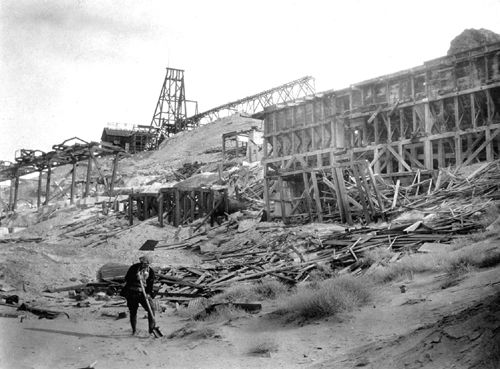
Montgomery-Shoshone Mine near Rhyolite, Nevada
By 1910, production at the Montgomery-Shoshone mill had slowed to $246,661, and only 611 residents remained in the town. On March 14, 1911, the directors voted to close down the Montgomery-Shoshone Mine and Mill. It had grossed almost $2 million and netted about $1.5 million, but it was severely in debt to the tune of about $200,000, mostly because of the mill. Two weeks after the mine shut down, the final issue of the Rhyolite Herald was published, and Clemens left for the coast.
By 1915, the town had only 20 people, and the next year they turned off the power and lights. By 1920, Rhyolite’s population was just 14, and its last resident died in 1924.
Soon, the weeds began to overgrow the town, but people continued to visit to see the old railroad station and the bottle house. Paramount Pictures restored and re-roofed the bottle building in 1925 for a movie set, then gave it to the Beatty Improvement Association for maintenance as a historical site.
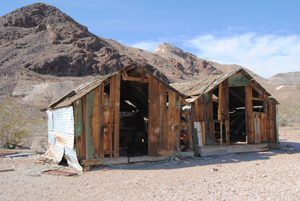
Shacks in Rhyolite, Nevada, by Kathy Alexander.
In 1936, N.C. Westmoreland rescued the depot and converted it into a casino and museum. His sister, H.H. Heisler, maintained it later as a museum and curio shop. Today, it is closed and owned by the Bureau of Land Management. It is one of the few complete buildings left in the town.
Paramount Pictures showed up again and used the deteriorating Cook Bank as a Mexican ruin, further damaging it.
Today, visitors can find several remnants of Rhyolite’s glory days. Some walls of the three-story bank building still stand, as does part of the old jail. The Bottle House and a small stone cabin have been rehabilitated. The ghost town of Rhyolite is on both federal and private land.
At the edge of Rhyolite sits the Goldwell Open Air Museum off the road leading to Death Valley, California. The Museum began in 1984 with the creation and installation of a major sculpture by Belgian artist Albert Szukalski titled”The Last Supper” — a ghostly interpretation of Christ and his disciples sitting against a backdrop of the expansive Amargosa Valley. Over the years, other artists have created various sculptures and displays at the 15-acre outdoor sculpture park.
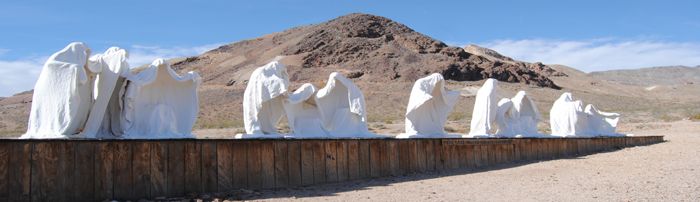
Last Supper sculpture at the Goldwell Museum in Rhyolite, Nevada, by Kathy Alexander.
Rhyolite is located four miles West of the town of Beatty, Nevada, on Highway 374 in Nye County. The East entrance to Death Valley, Rhyolite, offers photographers, explorers, and ghost town enthusiasts a great historical experience.
More Information: Rhyolite, Nevada
©Kathy Alexander/Legends of America, updated September 2026.
See our Rhyolite & Bullfrog Mining District Photo Gallery HERE
Also See:
Frank “Shorty” Harris – Single Blanket Jackass Prospector
See Sources.