
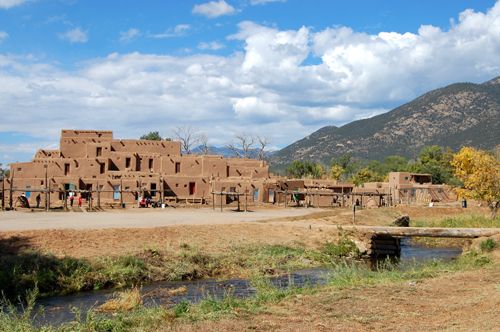
Taos Pueblo, New Mexico, by Kathy Alexander.
Just two miles North of Taos, New Mexico, stands the centuries-old Taos Pueblo, one of the longest continually inhabited communities in the United States. Archaeologists have found evidence that the Taos Valley has been inhabited as far back as 3,000 B.C., and prehistoric ruins dating from 900 A.D. can be seen throughout the area. However, the Taos Pueblo is thought to have been built between 1000 and 1450 A.D. It looks much the same today as it did a millennium ago, linking today’s Native Americans with those early inhabitants.
Built by the Northern Tiwa tribe, the Pueblo is made entirely of adobe—a mixture of earth, straw, and water —poured into forms or sun-dried into bricks to build several-feet-thick walls.
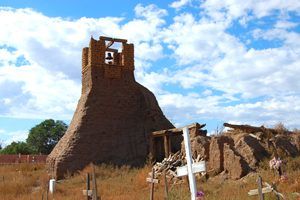
Taos Pueblo Old Mission Church by Kathy Alexander.
The roofs of the buildings, some of which are as many as five stories high, are made of wood poles placed side by side and covered with packed dirt. Large timbers hauled down from the mountain forests surrounding the Pueblo support the rooms and buildings. The exterior has been maintained over the years by repeatedly re-plastering it with thick layers of mud. Though the Pueblo displays both doors and windows today, this has not always been the case. Initially, the buildings had no doors or windows, and people would enter only from the top.
A small stream called Red Willow Creek runs through the center of the community, beginning high in the Sangre de Cristo Range at the tribe’s sacred Blue Lake and flowing quietly through the community before becoming a whitewater river and eventually joining the Rio Grande. The stream has long served as the Pueblo’s primary water source for drinking, cooking, bathing, and religious activities. Because of its swiftness, the river never completely freezes in winter, though it forms a thick layer of ice that can be easily broken to reach the freshwater beneath.
The first Europeans to see the Pueblo were Captain Hernando de Alvarado and a detachment of some 20 soldiers sent by Francisco Vasquez de Coronado to explore what is now northeast New Mexico in 1540. The name “Taos” was borrowed from the Spanish word “təo,” meaning “village.”
Don Juan de Oñate Salazar, an explorer and colonial Governor of New Spain (present-day Mexico), came to Taos in July 1598. In September, he assigned Fray Francisco de Zamora to serve the Taos and Picuris Pueblos. Around 1619, priests built the first Spanish-Franciscan mission, San Geronimo de Taos, with Indian labor.
The Taos Pueblo’s long-established trading networks, mission, and abundant water, timber, and game soon attracted early Spanish settlers to the area. However, these newcomers also clashed with the Taos Pueblo because of their authoritarian rule and forced religion, which eventually led to the Pueblo Revolt of 1680.
Planned in months of secret meetings centered at the Taos Pueblo, a coordinated attack was made by several Pueblo communities in August 1680, assaulting several Spanish settlements. With more than 8,000 Pueblo warriors, the Indians killed 21 Franciscan friars and more than 400 Spaniards and drove some 1,000 settlers out of the region. Unfortunately, the San Geronimo church at the Pueblo was destroyed during the uprising.
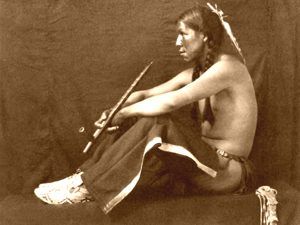
Taos Indian with peace pipe, Karl Moon, 1914.
However, 12 years later, in 1692, Don Diego de Vargas successfully reconquered the region and re-colonized the province. In 1694, De Vargas raided the Taos Pueblo after it refused to provide corn to Santa Fe’s starving settlers. The Taos Pueblo revolted again in 1696, and De Vargas returned a third time to put down the rebellion. In 1706, the San Geronimo Mission was rebuilt.
Finally, Taos and other Rio Grande pueblos settled down and allied with Spain and Mexico when they won their independence in 1821.
The settlement of Taos, which grew up around the Pueblo, soon became an important trading center and, by the early 1800s, was home to several famous mountain men, including Kit Carson, Smith Simpson, and Ceran St. Vrain. But the Pueblo would see conflict again in the Mexican-American War when U.S. General Stephen Kearney and his U.S. troops occupied the province of New Mexico in 1846.
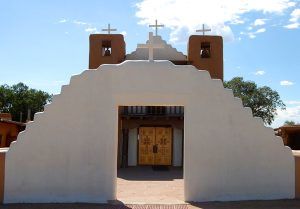
A “new” San Geronimo Mission was built in 1850. The youngest of the Pueblo’s structures, it still serves parishioners today. Photo by Kathy Alexander.
The following year, Taos rebelled against the new wave of invaders and killed the newly appointed Governor Charles Bent in his Taos home. U.S. troops soon retaliated, killing some 150 Indians, destroying the San Geronimo Mission, and, afterward, executing 16 Indians for their part in the revolt. The ruins of the mission can still be seen today to the northwest of the two main pueblo blocks. A new church was built in 1850 within the walls of the original Pueblo.
The Tiwa people and the Taos Pueblo moved forward with the rest of the American West. Still, they maintained many native traditions, cultures, and customs, especially within the Pueblo walls. Though the Pueblo buildings have been updated to include doors and windows, they still look much as they did throughout their long history and do not allow modern utilities such as plumbing and electricity. The Pueblo on the North side of the river, called Hlaauma, is one of the most photographed buildings in the Western Hemisphere and is the largest multi-storied Pueblo structure still standing. The homes in the building usually consist of two rooms, one for living and sleeping and the other for cooking and dining.
About 150 tribe members live within the Pueblo full-time, while some 1,800 more live in other areas of the 99,000-acre Pueblo lands. The village is governed by a Tribal Governor, war Chief, and their staff, who are appointed annually by the Tribal Council, a group of about 30 male tribal elders.
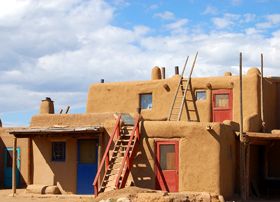
Individual homes at Taos Pueblo display colorful doors, photo by Kathy Alexander.
The Governor and his staff deal with civil and business issues within the village and relations with the non-Indian world. The War Chief and staff protect tribal lands, resources, and wildlife outside the pueblo walls. All adults who live on tribal lands are expected to provide their services for community duties when needed.
The tribe holds its culture and traditions very close to its heart. Its oral traditions and native language are unwritten and unrecorded. Much of its history, rituals, and traditions are considered sacred and, therefore, off-limits to non-tribal members. However, visitors can still marvel at the Pueblo’s architecture and hospitality.
Tourism, native crafts, and food concessions are essential parts of the Pueblo economy, and numerous vendors display pottery, silver jewelry, leatherwork, bread, and more. These shops are open to the public, but unless a door clearly states it is a “shop,” no one should enter any building, as these are private homes.
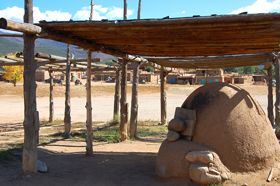
For centuries, drying racks have dried meat, vegetables, and animal hides for clothing. Women still use adobe ovens, called hornos, to bake bread, pastries, wild game, and vegetables. Photo by Kathy Alexander.
One of the Pueblo’s main highlights is the San Geronimo Church, built in 1850. Though it is one of the “youngest” buildings in the village, it provides an excellent example of mission architecture and an interesting look at how the tribe incorporated their values into the Catholic religion. The church, listed as a National Historic Landmark, remains an active church, and visitors should respect requests for “no photography” inside.
The remains of the first San Geronimo Church, destroyed in 1847, are also visible inside the cemetery. However, visitors should not enter the cemetery itself.
One of the summer’s main events is the annual Taos Pueblo Pow Wow, a gathering of spiritual leaders and tribal members that features costumed dancers, singers, and other ceremonies, as well as a wide array of vendors and artists. The tribe also holds other events throughout the year. The tribe also owns and operates the Taos Mountain Casino South of the Pueblo.
Taos Pueblo is open to the public from 8 a.m. to 4:30 p.m. each day, except for special ceremonies and tribal funerals, and for ten weeks during late Winter/early Spring. Admission and camera use fees apply.
The Taos Pueblo requests that the following rules/etiquette be followed when visiting:
- Please report and pay the appropriate fee for each camera carried into the Pueblo area.
- Please respect the “restricted area” signs, which protect residents’ privacy and the sites of native religious practices.
- Do not enter doors that are not clearly marked as curio shops. Each home is privately owned and occupied by a family, not a museum display to be inspected with curiosity.
- Please do not photograph members of the tribe without asking permission first. When permission is granted, it is customary to tip the individual.
- Photography is not allowed in San Geronimo Chapel or anywhere on Feast Days.
- Do not enter the walls surrounding the ruins of the old church and cemetery.
- Do not wade in the river — it is the sole source of drinking water.
- Do not climb onto any structures or ladders.
More Information:
Taos Pueblo
Taos, New Mexico
575-758-1028
©Kathy Alexander/Legends of America, updated October 2026.
See our Taos Photo Gallery HERE
Also See:
Ancient & Modern Pueblos – Oldest Cities in the U.S.
The Tiwa Tribe – Fighting the Spanish
Pueblo Indians – Oldest Culture in the U.S.
Pueblo and Reservation Etiquette
The Mountain Song of Taos – or The Taos Hum
Taos- Art, Architecture & History
See Sources.