
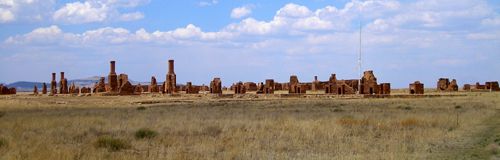
Fort Union, New Mexico, Kathy Alexander
Fort Union was the largest U.S. military post in the region, a bustling center of frontier defense in the Southwest for four decades, and a base for military and civilian ventures that molded its destiny. Astride the southern end of the Mountain Branch of the Santa Fe Trail near the point where it merged with the southern terminus of the Cimarron Cutoff, the post was one of the most important of a string established in New Mexico and southern Arizona in the area acquired from Mexico in the Mexican-American War (1846-48).
The fort’s mission was broad. It protected the Santa Fe Trail, on which it was a resting place and refitting point and a stopping point for Independence, Missouri–Santa Fe mail coaches; was the major Army supply depot in the Southwest; served as a transportation center for civilian wagon freighters carrying military supplies; and provided a base for campaigns that penetrated the homeland of the Apache, Ute, Navajo, Kiowa, and Comanche. Also, in a phase of history extraneous to this volume, the fort played a decisive role in repelling the Confederate invasion of New Mexico from Texas in 1862; it was the prime staging area and logistical base and supported the force of Colorado Volunteers that won a victory over the southerners at the Battle of Glorieta Pass, New Mexico, in March 1862.
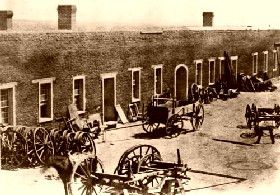
Fort Union, New Mexico
Three different Fort Unions existed over the years. The first, a shabby collection of log buildings, was erected in 1851, only five years after the U.S. conquest of New Mexico, on the west bank of Coyote Creek. The second post, begun in 1861 in preparation for the Confederate thrust from the South, was located across the creek from the first. A massive star-shaped earthwork fort, it had ditches, parapets, and bombproofs. Work continued intermittently until June 1862, when the need for fortification had passed. The last fort, a large complex of adobe structures in the Territorial architectural style, began in 1863 and was finished in 1869. It was situated in the same area as the star fort, except for the arsenal, which was built on the site of the first fort. The garrison’s most dramatic duty, particularly during Indian uprisings, was furnishing escorts and other protection for the Santa Fe Trail.
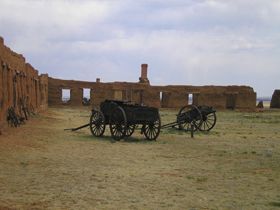
Fort Union, New Mexico wagons by Kathy Alexander.
Dragoons and Mounted Riflemen focused on the Cimarron Cutoff, which extended northeastward to the Cimarron Crossing of the Arkansas River. Traveling over it was risky, for it passed through Kiowa and Comanche country, but it had the advantage of being shorter than the Mountain Branch. The Civil War years were the most critical time on the trail because of the Confederate threat of invasion and attacks on trail caravans, the critical need to assure a continuous flow of provisions to Union forces in New Mexico, and the mounting Indian menace occasioned partly by the withdrawal of Regular troops and their replacement by Volunteers. Nevertheless, the fort kept the trail open, employing escorts, temporary posts, and full-scale offensive campaigns. The trail supported the fort’s mission as a supply depot. Over it, until the Santa Fe Railway arrived in the region in 1879, surged long tandem freight wagons, pulled by 12-yoke teams, carrying military supplies to the fort for distribution to posts all over the Southwest.
The heavy concentration of New Mexico and Arizona troops was scattered at far-flung posts. The land was not rich enough to feed this army, and almost all provisions had to be hauled over the Santa Fe Trail from Fort Leavenworth, Kansas. The need for a depot in eastern New Mexico to receive and distribute supplies and ordnance was clear.
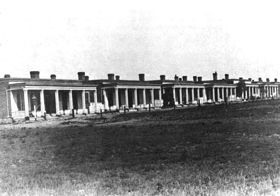
Fort Union Officer’s Quarters, 1870s.
The freight wagon traffic grew so heavy that Fort Union became a freight destination rivaling, if not exceeding, Santa Fe in importance. Civilian companies performed virtually all military freighting on the trail under contract. They unloaded the freight at Fort Union, repacked it, and assigned it as needed to other posts. When wagons or entire trains contained shipments for one fort only, they often continued directly to their destination.
Large-scale military freighting, dominated by Russell, Majors, and Waddell, continued until 1866 when the railroad moved west into Kansas. After that, each railhead town served briefly as the port of embarkation for freight wagons. After the rails reached Denver in 1870, wagons continued moving supplies over the trail’s Mountain Branch between Pueblo and Fort Union. The Santa Fe Railway crossed the Mora Valley in 1879 and ended the era of military freighting on the trail.
Protecting the Santa Fe Trail and supporting troops in the region were indirectly tied to the Indian wars, but the fort was also directly involved. When the U.S. acquired the Southwest in the Mexican War, it also inherited the Indian problems that had plagued its people since the earliest times. The nomadic tribes of New Mexico had long fought the Spaniards and Mexicans. They fought the Americans, who were overrunning their lands, killing off their game, or passing over transcontinental trails on their way to the California goldfields.
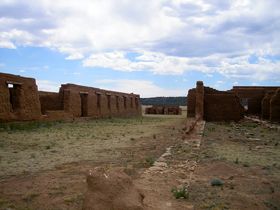
Fort Union, New Mexico, by Kathy Alexander.
From 1851 until 1875, in significant offensives or patrol-type actions, sometimes meeting the enemy and sometimes not, Fort Union troops were usually in the field, skirmishing with Indians. Notable campaigns in which the garrison took part before the Civil War included those against the Jicarilla Apache in 1854; the Utes in 1855 in southern Colorado, then part of New Mexico Territory; and, in 1860, the Kiowa and Comanche menacing the eastern borders of New Mexico. The Indians were especially troublesome during the Civil War when General James H. Carleton, head of the California Column of Volunteers, directed Army operations in New Mexico. The tribes seized the opportunity offered by the Confederate attack on New Mexico to step up their raiding. New Mexico and California Volunteers under Colonel Kit Carson, an experienced Indian fighter, conducted three significant campaigns: against the Mescalero Apache (1862-63), Navajo (1863-64), and Kiowa and Comanche (1864-65).
Fort Union Regulars, who replaced the Volunteers after the Civil War, and troops from other New Mexico posts took part in the final wars against the southern Plains tribes: General Sheridan’s 1868-69 campaign and the Red River War of 1874-75. These campaigns ended the fort’s participation in the Indian wars. In 1879, the arrival of the Atchison, Topeka & Santa Fe Railroad essentially ended its usefulness as a supply depot, but it was not abandoned until 1891.
Rising sharply and starkly from the plains, the history-shrouded adobe ruins of Fort Union, stabilized to arrest erosion, are reminders of a vanished frontier. Sprawling north, nearly half a mile from the visitor center, are a few chimneys and the outlines of melted walls of corrals, stables, a hospital, barracks, officers’ quarters, and large warehouses that made up Fort Union in the years 1863-91. Adjacent to this post was the massive star fort (1861-62). Ruins of the arsenal from the 1863-91 complex lie across the valley to the west, on the same site as the original log fort (1851-62), most traces of which have long since disappeared. Exceptional trail ruts of the Santa Fe Trail are readily identifiable in the vicinity and may be followed for miles. A museum and a visitor center interpret the fort’s history, and a self-guiding tour leads through the remains.
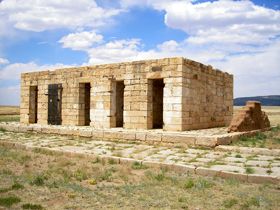
Fort Union, New Mexico Prison.
Fort Union is eight miles north of Watrous, New Mexico, on NM Highway 161.
Contact Information:
Fort Union National Monument
P.O. Box 127
Watrous, New Mexico 87753
505-425-8025
Compiled and edited by Kathy Alexander/Legends of America, updated September 2026.
Also See:
Forts Across the American West
The Death Waltz – A Fort Union Legend
Forts of New Mexico Photo Gallery
Source: National Park Service