LEGENDS OF AMERICA

A Travel Site for the Nostalgic & Historic Minded


  Search


Legends Home

Site Map

What's New!!


Recommend this site


American History

Ghost Towns

Ghostly Legends

Historic People

Native Americans

The Old West

Photo Galleries

Roadside Attractions

Rocky Mtn Store

Route 66

Travel Destinations

Treasure Tales

Legends Blog

Free E-Newsletter


Facebook Fanpage


Twittering


Legends of America's Exclusive Custom Products


Contact Us


Please report broken links, missing pictures, or other problems online by clicking HERE or send us an email.  Thanks!


North Dakota Forts of the Old West


Old West Wanted Posters


<< Previous 1 2 3 Next >> 


Fort Berthold, North DakotaFort Berthold (1845-1870) - This site was not built as a military fort, but rather, a fur trading post, that was first called Fort James when it was established in 1845 by James Kipp. It was situated on the south side of the Missouri River, near its confluence with the Knife River in present day McLean County. Just a year later, the fort was acquired by Pierre Chouteau, Jr. and Company and was renamed for Chouteau’s brother-in-law and partner, Bartholomew Berthold, of St. Louis, Missouri.

Some years later, another “fort” was built on the north side of the Missouri River called Fort Atkinson and operated by Chouteau’s competitors. In 1860, the Chouteau acquired the business his rival across the river and two years later, merged the two, moving his equipment and supplies to the Fort Atkinson location and transferring the original name, as well.  The old “fort” was abandoned and later burned down by the Sioux.

When problems with the Indians erupted the following year, a request was made for military assistance. In 1864, a small garrison of soldiers was placed at the fort, the first time that military troops were ever quartered at Fort Berthold. In 1865, log buildings for the troops were erected outside of the stockade.

A small village called “Like-A-Fishhook,” developed around the fort primarily made up of Mandan, Arikara and Hidatsa Indians. Over the years, more white settlers moved into the region and the village changed significantly, with a mixed community of settlers, Indians, and military troops, who often used the fort as a base for campaigns against Dakota Indians. In 1870, the Fort Berthold Reservation was established for the Mandan, Arikara, and Hidatsa tribes, which forced the Indians from the village. By the late 1880s, the village and the fort was abandoned.

Archaeological excavations were made at the site in the early 1950s. Today; however, the original site is under the waters Lake Sakakawea.


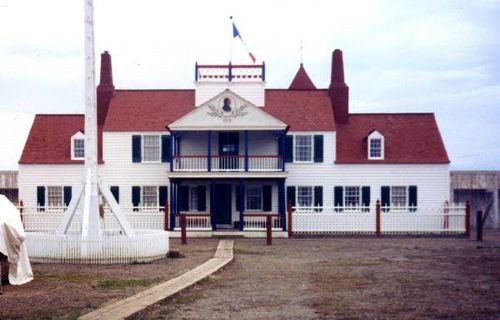
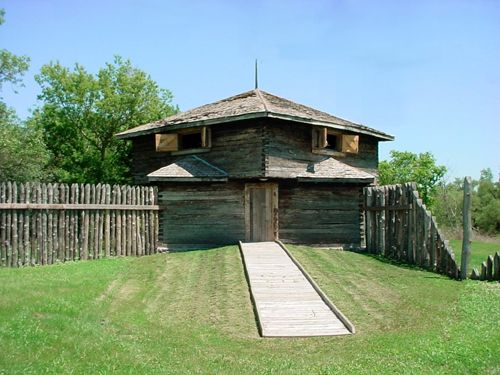
Fort Buford (1866-1895) - Under the command of Bevet Lieutenant Colonel William G. Rankin, Fort Buford began to built in June, 1866 and was named for the late Major General John Buford, a Gettysburg hero.  From the very beginning, the fort was under attack, with Indians wounding one soldier the second night, and attempting to drive off their cattle on the third day.  Raids continued throughout the summer and fall, but the soldiers persisted and by the end of November the fort included log and adobe buildings surrounded by a 360-foot-square stockade. Though established to protect the overland and river routes used by immigrants moving westward, the soldiers remained busy protecting themselves, as well. The unhappy Sioux attacked a work party at the sawmill in December, 1866 and continued to raid throughout the winter.


Fort Buford, North Dakota

Fort Buford today, courtesy Fort Buford State Historic Site.

As a result, the number of troops at the fort was increased by four additional companies in the spring of 1867, which required the post to expand. The stockade was partially torn down and expanded, enlarging it to 999 feet by 600 feet. The buildings; however, didn’t fare very well, as the handmade adobe bricks deteriorated quickly. The deterioration, coupled with the constant Indian attacks required the soldiers rebuild again just three years later. Expansion again occurred in 1871-72, designed to house six companies of soldiers.

In the meantime, the Northern Pacific Railway resumed survey activities west of the Missouri River and the Yellowstone expeditions of 1871-1873 were occurring, violating the Treaty of 1868 with the Sioux. Further angered, the attacks by the Sioux increased, especially after the Black Hills expedition of 1874, which brought thousands of prospectors flooding into Sioux lands.  

As the attacks continued, more and more troops were brought into the area and Fort Buford became key in the supply of troops for the military campaigns. By the end of 1875, the situation had deteriorated to the point that the government decided to force the Indians onto their respective reservations. This action began the Sioux Wars of 1876-1879 that included the defeat of Custer at the Battle of Little Bighorn and Sitting Bull's flight into Canada. Forced to return, Chief Sitting Bull surrendered on July 20, 1881 at Fort Buford.

After the Indian Wars were over, the fort lost its importance and began to deteriorate. On October 1, 1895, it was abandoned.


Today, the Fort Buford State Historic Site, run by the North Dakota State Historical Society, preserves remnants of the once vital fort.  Three original buildings continue to stand including the

Original features still existing on the site include a stone powder magazine, the post cemetery site, and a large officers' quarters building which now houses a museum.  Southwest of the museum is the fort cemetery; however, the soldiers’ remains were moved to the national cemetery at the Little Bighorn Battlefield National Monument in Montana after Fort Buford was abandoned. Today, reconstructed wooden headboards mark the graves where soldiers were once interred. Some headstones still mark the spots were civilians were buried.


The museum is open daily during the summer months and by appointment only the rest of the year.  


Fort Buford State Historic Site

15349 39th Lane NW

Williston, North Dakota 58801

701-572-9034


Continued Next Page

<< Previous 1 2 3 Next >> 

From the Rocky Mountain General Store


National ParksNational Park Postcards - Take a virtual tour through dozens of the United State's National Parks by taking a look at the many postcards we've collected along the way. Each one of these is unique and, in most cases, we have only one available, so don't wait. To see them all, click HERE!


National Park Postcards  National Park Postcards  National Park Postcards  National Park Postcards  National Park Postcards


                                                              Copyright © 2003-2009, www.Legends of America.com