
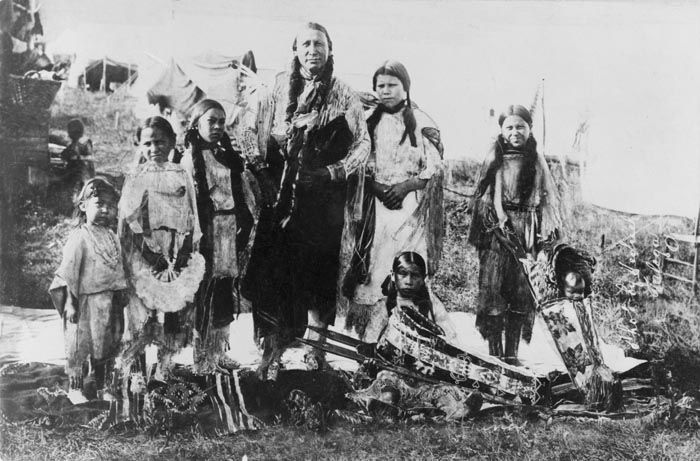
Kiowa Indians by J. V. Dedrick, 1908.
Originating in the northern basin of the Missouri River, the Kiowa migrated south to the Black Hills around 1650 and lived there peacefully with the Crow Indians. At that time, they were organized into 10 independent bands and numbered an estimated 3,000.
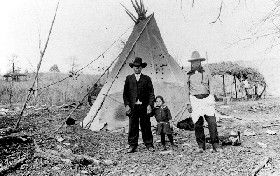
Kiowa Teepee in Oklahoma in 1937, courtesy Marquette University Libraries.
Pushed southward by the invading Cheyenne, Arapaho, and Sioux, who were being pushed out of their lands in the Great Lake regions by the Ojibwe tribes, the Kiowa moved down the Platte River basin headwaters of the Arkansas, Cimarron, Canadian, and Red Rivers.
They fought with the Comanche, who had already occupied the land. The Spanish in Santa Fe mediated a peace treaty between the Kiowa and Comanche in 1807, and the two groups made an alliance and agreed to share the area.
An additional group, the Plains Apache (a.k.a. Kiowa-Apache), was also affiliated with the Kiowa. The people hunted, traveled, and made war together. The two tribes soon began to raid settlements in Texas and New Mexico, providing horses and mules to trade with the northern Plains Tribes.
The Kiowa lived a typical Plains Indian lifestyle. Primarily nomadic, they survived on buffalo meat and gathered vegetables, lived in teepees, and depended on their horses for hunting and military uses. The historic Kiowa also ranged through Southwest Colorado and Southwest Kansas.
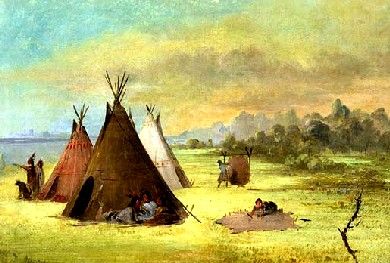
Painting of Kiowa camp, courtesy of the Smithsonian American Art Museum
After 1840, the Kiowa joined forces with their former enemies, the Cheyenne, Comanche, and Apache, to fight and raid the Eastern natives, then moved into the Indian Territory. The United States military intervened, and in the Treaty of Medicine Lodge of 1867, the Kiowa agreed to settle on a reservation in southwestern Oklahoma.
Because the reservation restricted them to the area between the Washita and Red Rivers, they never really confined their activities to the reservation, and in 1874, resumed warfare with the white settlers in the vicinity. Primarily living in Palo Duro Canyon, near Amarillo, Texas, the renegade bands were defeated when large numbers of their horses were taken and destroyed, and several of their leaders were captured.
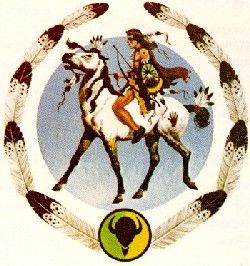
Kiowa Emblem.
On August 6, 1901, the Kiowa land in Oklahoma was opened for white settlement, effectively dissolving the contiguous reservation. While each Kiowa head of household was allotted 80 acres, the only land remaining in Kiowa tribal ownership today consists of scattered parcels of grassland leased to white settlers for grazing before the reservation opened for settlement.
Today, more than 12,000 Kiowa live in Oklahoma and other areas of the Southwestern United States. The Kiowa Indian Council governs the tribe.
More information:
Kiowa Tribe of Oklahoma
100 Kiowa Way
Carnegie, Oklahoma 73015
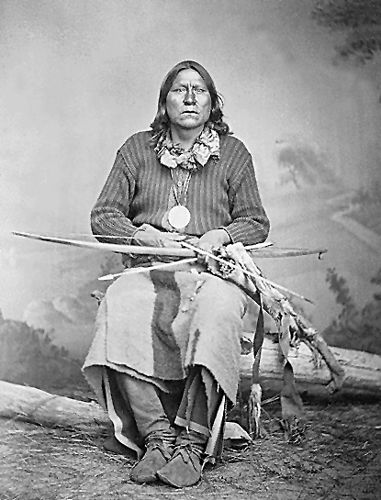
Chief Satanta of the Kiowa tribe.
©Kathy Alexander/Legends of America, updated September 2026.
Also See:
Native American Photo Galleries
See Sources.