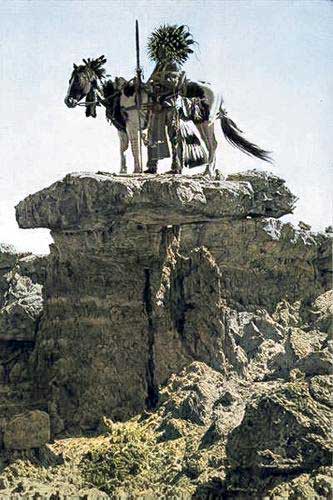
Cheyenne Dog Soldier
By W.S. Campbell in 1921.
The incredible warriors were “armed to the teeth with revolvers and bows… proud, haughty, defiant as should become those who are to grant favors, not beg them.”
— An Ohio reporter covering the negotiations at Medicine Lodge, Kansas, on October 27, 1867.
Of all the typical Plains tribes, the Cheyenne were most distinguished for warlike qualities. Few in number, they overcame or held in check most who opposed them, and when the westward movement of European civilization began, they made more trouble than all the rest combined. In short, they were preeminently warriors among peoples whose trade was war.
As in other Plains tribes, the warriors of the Cheyenne were organized into societies or orders. These societies were fraternal, military, and semi-religious organizations with special privileges, duties, and dress, usually tracing their origin to some mythical culture hero or medicine man. Each society had its own songs and secret rituals and exacted specific observances and standards of its members.
Of these organizations, none played such a part in the history of the Plains as the “Dog Soldiers” of the Cheyenne.
The best version of the story of its origin is that recorded by George A. Dorsey in The Cheyenne Ceremonial Organization, 1905:
“The Dog-Man (Dog Soldier) Society was organized after the organization of the other societies, by a young man without influence, but who was chosen by the great Prophet. One morning, the young man went through the entire camp and to the center of the camp circle, announcing that he was about to form a society. No one was anxious to join him, so he was alone all that day. The other medicine men had had no difficulty in establishing their societies. Still, when his turn came to organize, others ridiculed him, for he was not a medicine man and had no influence to lead others.
That evening, he was sad, and he sat in the midst of the whole camp. He prayed to the Great Prophet and the Great Medicine Man to assist him. At sunset, he began to sing a sacred song. While he sang, the people noticed that now and then the large and small dogs throughout the camp whined, howled, and grew restless. The people in their lodges fell asleep. The man sang from sunset to midnight; then he began to wail. Everyone slept in their lodges and did not hear him. Again, he sang; then he walked out to the opening of the camp circle, singing as he went. At the opening of the camp circle, he ceased singing and went out. All the dogs of the whole camp followed him, both male and female, some carrying their puppies in their mouths. He sang four times before reaching his destination at daybreak. As the sun rose, he and all the dogs arrived at a river bottom which was partly timbered and level.
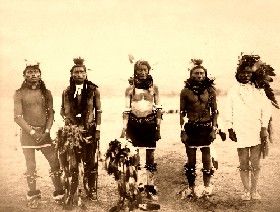
Cheyenne Dancers by John Graybill, 1890.
The man sat down by a tree that leaned toward the North. Immediately, the dogs ran from him and arranged themselves in a semi-circle about him, like the shape of the camp-circle they had left; then they lay down to rest. As the dogs lay down, by some mysterious power, a lodge sprang up over the man in the center of the circle. The lodge included the leaning tree by which the man sat; three other saplings stood there, trimmed at the base, with the boughs left at the top. The lodge was made of buffalo skins. As soon as the lodge appeared, all the dogs rushed towards it. As they entered the lodge, they turned into human beings, dressed like members of the Dog-Men Society. The Dog Men began to sing, and the man listened very attentively, learning several songs from them, their ceremony, and their dancing forms.
The camp circle and the center lodge looked like a real camp circle for three long days. The Dog Men blessed the man and promised that he should be successful in all of his undertakings and that his people, his society, and his band would become the greatest of all if he carried out their instructions.”
Later, the Cheyenne discovered the camp. But “as they came into view of the wonderful camp, the Dog lodge instantly disappeared, and the Dog-Men were transformed into dogs. By this time, the medicine men and warriors were very sorry they had refused to join this man’s society. The next day, on the Great Prophet’s instructions, he again asked the warriors to join his society, and many hundreds of men joined. He directed the society to imitate the Dog Man in dress and to sing the way the Dog-Men sang. This is why the other warrior societies call the warriors of this society ‘Dog-Men Warriors’.” So much for the fabulous origin of the organization.
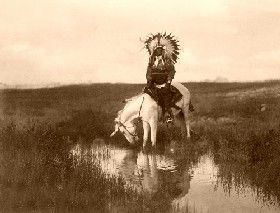
Cheyenne Indian at the Valley of the Rosebud, by Edward S. Curtis.
The society’s uniform consisted of a bonnet covered with upright feathers of birds of prey and a whistle suspended from a thong around the neck. It was made of the wing bone of an eagle, leggings, a breechclout, and moccasins. The belt was made of four skunk skins. The Dog Soldiers carried a bow and arrows, and a rattle shaped like a snake was used to accompany their songs. They had one chief and seven assistants, four of whom were battle leaders chosen for their extraordinary courage. These four wore, in addition to the usual uniform, a long sash which passed over the right shoulder and hung to the ground under the left arm, decorated with porcupine quills and eagle feathers. Of these four men, the two bravest had their leggings fringed with human hair.
The society has a secret ritual that lasts four days and uses a series of 400 songs in its ceremonies and dances. It was often called upon to perform police duties in a large camp and enjoyed certain privileges in the tribe, such as the right to kill any fat dog whenever a feast was in order.
The warrior society’s power in policing the camp was great, and its punishments severe for those who violated camp regulations. Not infrequently, they whipped delinquents with quirts, beat them with clubs, or killed their ponies. For minor offenses, they might cut up a man’s robe, break his lodge poles, or slash his tipi cover. They oversaw the tribal buffalo hunt and ensured the rules governing it were followed and that all men had an equal chance to kill meat. They prevented any individual from hunting until the camp’s needs were met.
About 1830, all the men of the Masiskota Cheyenne band joined the Dog Soldiers. The society then comprised about half the men in the tribe and was the most distinct, meaningful, and aggressive of all the Cheyenne warrior societies.
Though much has been written regarding Cheyenne battles, probably the most authentic accounts are those given by George Bird Grinnell in The Fighting Cheyennes (1916, and all who discuss the exploits of the Dog Soldiers must necessarily be indebted to him. Do not suppose that the following brief account attempts to cover the exploits of the members of this organization. I wish only to enumerate the principal engagements in which the Dog Soldiers figured as an organization.
By 1840, the Dog Soldiers were so nervous and influential that the Cheyenne chiefs left it to them to decide whether peace should be made with the Kiowa, Comanche, and Apache, following the very disastrous drawn battle with these tribes in 1838. The peace the Dog Soldiers made has never been broken. The disastrous fight with. The Pawnee in 1852 was a great misfortune to the Cheyenne, and in the following year, those who had lost relatives brought presents to the Dog Soldiers, urging them to avenge the dead. Accordingly, the Dog Soldiers led a campaign against the Pawnee, but, finding them reinforced by a number of Pottawatomie, equipped with firearms, were forced to withdraw.
The Dog Soldiers were thoroughly conservative and inclined to follow the advice of their tribal culture hero, who had warned the people that intercourse with white men would be to their disadvantage. Accordingly, in 1860, they refused to sign the treaty submitted by the Commissioner of Indian Affairs at Bent’s Fort on the upper Arkansas River, saying that they would never settle on a reservation. Members of the organization were active in raiding along the Platte River, following the disgraceful Sand Creek Massacre perpetrated by Colorado volunteers upon friendly and defenseless Indians.
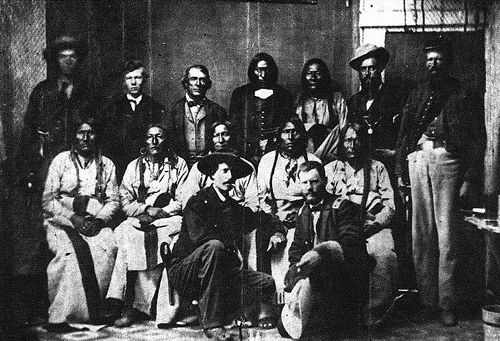
Camp Weld Meeting
In 1865, the Dog Soldiers played a significant role in the alliance between the Southern Cheyenne, Northern Cheyenne, and Ogallala Sioux, whose primary objective was to raid the emigrant road near the Platte Bridge. There, a stockade had been erected, known as Camp Dodge. This war party is estimated to have numbered three thousand men.
The Dog Soldiers assumed police duties during this expedition. They succeeded in preventing the troops from discovering the presence of the Indians until decoys had lured them out of the fort. The success of the Indian strategy on this occasion has been credited to their most famous leader, Roman Nose. In 1865, another attempt was made to hold a council and make a treaty with the Cheyenne, Arapahoe, Kiowa, Comanche, and Apache. The Commission met the tribes on the Arkansas River, and reservations were set aside in the region to the south. This treaty was accepted as binding by most of the Cheyenne, but the Dog Soldiers would have nothing to do with it, though two attempts were made to induce them to leave lands which they had never ceded to the government.
At this time, the Dog Soldiers were friendly, but General Winfield Hancock’s tactlessness soon drove them to hostility. He apparently knew nothing of Indians and insisted upon dealing only with Roman Nose, who, though a very prominent warrior, was not a chief at all. When General Hancock attacked, the Cheyenne succeeded in getting away with their usual ease, leaving their village to be burned, and the only Indians killed were six friendly ones, who had come up to the Dog Soldiers’ camp on a visit. During four months of active campaigning, General Hancock, with a force of fourteen hundred men, consisting of cavalry, artillery, and infantry, succeeded in killing only two hostile Indians.
After the failure of General George Custer’s summer campaign on the Republican and Smoky Hill Rivers, the Cheyenne were induced to come in for the Medicine Lodge Treaty, but as Fort Reno, Fort Phil Kearny, and Fort Smith had been built along the Powder River road to Montana, through the last remaining hunting grounds of the tribe, the treaty came to nothing, for the Indians could not sit quietly by while their livelihood, the buffalo, was being destroyed.
The Beecher Island fight in 1868 has been widely celebrated for its spectacular features and the prominence of the leaders on both sides. Here, the Dog Soldiers formed the bulk of the Indian fighting force. Roman Nose, the most famous of the Northern Cheyenne and a prominent Dog Soldier, led a charge and was killed by one of the scouts hidden in the grass. The story of his death, as the late George Bent of Colony, Oklahoma, narrated it to me, has elements of tragic interest. It seems Roman Nose depended on his war bonnet for protection, and that its protective power depended on his observance of certain taboos. One was that he should never eat food an iron fork had touched. Shortly before the battle, Roman Nose had eaten food served at a feast and had afterward learned that the food had been prepared with such a fork. He did not desire to enter the battle, believing that he would be killed because the protective power of his war bonnet had been destroyed. However, when he saw his warriors failing before the rifles of the white scouts, he mounted his horse and led the charge, where he fell. Of the six Cheyenne killed in this fight, five were Dog Soldiers.
After their defeat by the buffalo hunters at Adobe Walls, Texas, in 1874 and the capture of the Southern Cheyenne village by Colonel R. S. McKenzie in 1875, White Horse, with the Dog Soldiers, came in and surrendered at Darlington, Oklahoma.
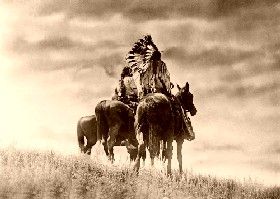
Cheyenne Warriors by Edward S. Curtis
No doubt members of the Dog Soldiers’ Society were present at the Custer battle, and perhaps at the capture of Dull Knife’s village, but with this surrender at Darlington, the military life of the organization may be said to have ended.
However, trouble returned when the government moved the Northern Cheyenne to the then Indian Territory to put the whole tribe on one reservation. The Oklahoma climate did not suit the Cheyenne from Montana. They died in large numbers. Medical supplies and rations were scarce, and within a year after their removal, the Northern Cheyenne were so dissatisfied that many resolved to fight their way back to the North. The story of this wonderful retreat is well known and deserves a place beside that of philosopher Xenophon or the equally great retreat of Chief Joseph. Tangle Hair, head chief of the Dog Soldiers, was among those who fled to the North, but the expedition’s real leader was Little Wolf. The Indians reached their destination and stayed there about a year before General Nelson Miles persuaded them to surrender.
Tangle Hair and a number of the Dog Soldiers had split off from the main party and followed Dull Knife. These Indians were imprisoned in Fort Robinson, and on their refusing to return to the south, were starved by the officer in charge for eight days. At the end of that time, they broke out of their prison and tried to escape over the moonlit snow. In this fight, more than a third of the Indians, men, women, and children, were killed, among them Tangle Hair, Chief of the Dog Soldiers. Before the outbreak, he had been told he and his family might leave the prison, but he, like the other Dog Soldiers, refused to consider it. He was killed attempting to stand off the soldiers while the women and children made their escape.
This summary of the exploits of the Cheyenne Dog Soldiers will perhaps give some idea of the vital part this organization played in the many victories and hard-fought battles of the most warlike of the Plains tribes. Only a much more detailed narration could give any proper idea of the splendid courage—often in the face of overwhelming odds—displayed by members of this organization, times without number, in battle, whether against United States troops, Mexicans, or other Indian tribes. But this brief enumeration of the principal engagements of the Dog Soldiers may help explain how the United States government, in its campaigns against the Cheyenne, spent a million dollars and lost twenty-four lives for every Cheyenne killed.
W.S. Campbell, 1921. Compiled and edited by Kathy Alexander/Legends of America, updated October 2026.
This tale, written by W.S. Campbell, appeared in the Chronicles of Oklahoma, Volume 1, No. 1, January 1921. The text here, however, is not verbatim, as it has been edited for clarity and ease for the modern reader.
Also See:
Cheyenne – Warriors of the Great Plains
Dull Knife – Northern Cheyenne Chief
Little Wolf – Courageous Leader of the Cheyenne