

Creek Chief Menawa by Thomas L. McKenney
The Muscogee (Creek) tribe comprised several distinct groups that inhabited Georgia and Alabama during the Colonial Period. Their confederacy, which formed the largest division of the Muscogean family, included other Muscogean tribes, such as the Catawba, Iroquois, and Shawnee, as well as the Cherokee. Together, they were sufficiently numerous and powerful to resist attacks from the northern tribes. They were named by the English because of the numerous streams in their territory.
It is believed that Creek culture began as a means of defending against larger, conquering Indian tribes in the region. One of the Five Civilized Tribes, the Creek Confederacy, was formed with other Muscogean-speaking tribes, including the Alabama, Hitchiti, and Coushatta. The Creek Confederacy was in constant flux, its numbers and land possessions ever-changing as small bands joined and withdrew from the alliance. Society was organized in matrilineal, exogamous clans, each bearing the name of its totem animal.
The economy was centered on agriculture, with corn, beans, squash, pumpkins, melons, and sweet potatoes grown. When war erupted in 1813 between the United States and the Red Stick faction of the Creek Nation, a series of raids were launched against the white settlements. These raids culminated in the sacking of Fort Mims, Alabama, in which 400 settlers were killed. General Andrew Jackson defeated the Red Sticks at Horseshoe Bend and exacted a disastrous cession of 23 million acres of land from the Creek tribe.
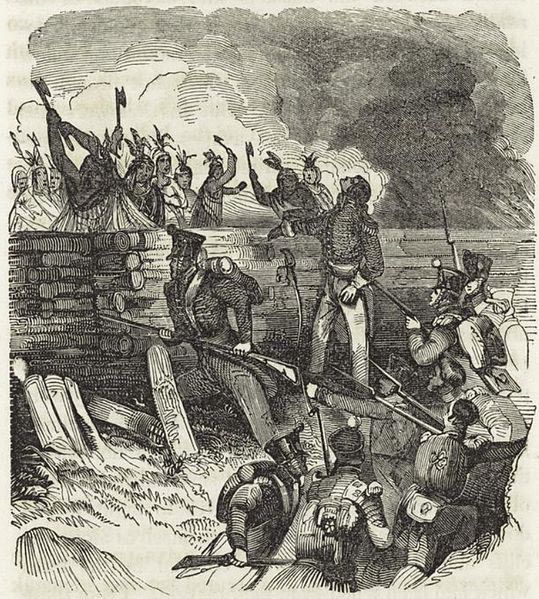
Battle of Horseshoe Bend, Alabama.
When Jackson became president, he forcibly removed the Creek to Oklahoma. Today, the Creek Confederation is headquartered in Okmulgee, Oklahoma, but a few surviving bands remain in Alabama, Georgia, and Florida.
Nothing certain can be said of their previous condition or of the time when the confederacy was established. Still, it appears from the narratives of the Spanish explorer Hernando de Soto’s expedition that leagues among several of these towns existed in 1540, over which head chiefs presided.
Between 1836 and 1840, the people of the Creek Confederacy occupied about 50 towns, in which six distinct languages were spoken: Muscogee, Hitchiti, Koasati, Yuchi, Natchez, and Shawnee. The first three were of Muscogean stock.
About half of the Confederacy spoke the Muscogee language, which thus constituted the ruling language and gave the Confederacy its name. The meaning of the word is unknown. Although an attempt has been made to connect it with the Algonquian language family, the evidence favors a southern origin. The people speaking the cognate Hitchiti and Koasati were contemptuously designated as “Stincards” by the dominant Muscogee. The Koasati seem to have included the ancient Alibamu of central Alabama. At the same time, the Hitchiti, on the lower Chattahoochee River, appears to have been a remnant of the ancient people of southeastern Georgia and claimed to have been of more ancient occupancy than the Muscogee. Geographically, the towns were grouped as Upper Creek, on the Coosa and Tallapoosa Rivers in Alabama, and Lower Creek, on the middle or lower Chattahoochee River, on the Alabama-Georgia border.
While the Seminole were still a small tribe confined to the far northern part of Florida, they were frequently referred to as the Lower Creeks. To the Cherokee, the Upper Creeks were known as Ani-Kusa use, from their ancient town of Kusa (Coosa), while the Lower Creeks were called Ani-Kawita, from their principal town Kawita (Coweta). The earlier Seminole emigrants were chiefly from the Lower Creek towns.
The history of the Creek begins with the appearance of De Soto’s army in their country in 1540. Spanish conquistador Tristan de Luna came in contact with part of the group in 1559, but the only important fact that can be drawn from the record is the deplorable condition into which the people of the sections penetrated by the Spaniards had been brought by their visit. Another Spanish explorer, Juan del Pardo, passed through their country in 1567, but Juan de la Vandera, the chronicler of his expedition, has left little more than a list of unidentifiable names.
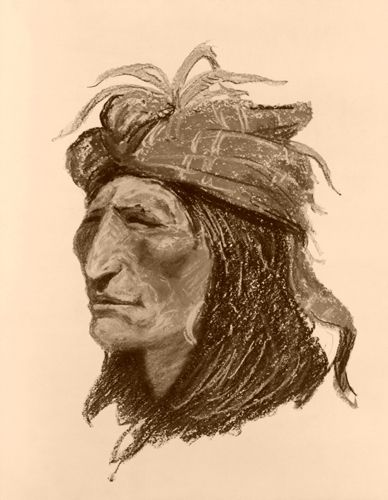
Creek Warrior by Frederic Remington, 1906
The Creek came prominently into history as allies of the English in the Apalachee Wars of 1703-08, and from that period, continued almost uniformly as treaty allies of the South Carolina and Georgia colonies while hostile to the Spaniards of Florida. The only serious Creek revolt against the Americans occurred in 1813-14, during the well-known Creek War, in which General Andrew Jackson played a prominent role. This ended in the defeat of the Indians and the submission of Weatherford, their leader, followed by the cession of the greater part of their lands to the United States. The extended and bloody Seminole War in Florida, from 1835-1843, secured permanent peace with the southern tribes.
The removal of the larger part of the Creek and Seminole people and their black slaves to the lands assigned to them in Indian Territory took place between 1836 and 1840.
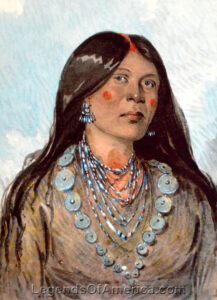
Creek Woman Tchow-ee-put-o-kaw, by George Catlin, 1834.
The Creek woman was short in stature but well-formed, while the warrior was generally larger than the Europeans, often above six feet in height, said to have been erect in his carriage, and graceful in every movement. They were described as proud, haughty, arrogant, brave, and valiant in war. As a people, they were more than usually devoted to decoration and ornament; they were fond of music, and ballplay was their most important game. Marriage outside the clan was the rule; adultery by the wife was punished by the relatives of the husband, and the descent was in the female line.
In government, it was a general rule that where one or more clans occupied a town, they constituted a tribe under an elected chief, or miko, who was advised by the town council in all important matters. In contrast, the council appointed the “great warrior” or tustenuggi-hlako. They usually buried their dead in a square pit under the bed where the deceased lay in his house.
Certain towns were consecrated to peace ceremonies and were known as “white towns,” while others set apart for war ceremonies were designated as “red towns.” They had several orders of chiefly rank. Their great religious ceremony was the annual puskita, of which the lighting of the new fire and the drinking of the black drink were important accompaniments.
Early statistics on the Creek population are based solely on estimates. In the last quarter of the 18th century, the Creek population may have been about 20,000, occupying 40 to 60 towns. Estimates made after the removal to Indian Territory placed the population between 15,000 and 20,000.

Muskogee Creek leader Opothle Yoholo.
After being forcibly removed to Indian Territory, most Lower Muscogee people located farms along the Arkansas and Verdigris Rivers. The Upper Muscogee re-established their farms and towns on the Canadian River and its northern branches.
The Civil War was disastrous for the Muscogee people, even though most of the tribe desired neutrality. The first three battles of the war in Indian Territory occurred when Confederate forces attacked a large neutral band led by Opothle Yahola. Eventually, hundreds of Muscogee men fought on both the Union and Confederate sides. After the war ended, the 1866 Reconstruction Treaty required the cession of approximately half of the Muscogee land—some 3.2 million acres.
In 1867, the Muscogee people adopted a written constitution that established a Principal Chief and a Second Chief, a judicial branch, and two legislative chambers: a House of Kings (similar to the Senate) and a House of Warriors (similar to the House of Representatives). Each tribal town determined representation in both houses of this Legislative assembly. A new capital was established in Okmulgee the same year. In 1878, the tribal government constructed a Council House of native stone. Today, it serves as the Council House Museum in the center of the modern city of Okmulgee.
This “constitutional” period lasted for the remainder of the 19th century. However, in the late 1800s, the Dawes Commission began negotiating with the Muscogee Nation for land allotments, and in 1898, Congress passed the Curtis Act, which required the dismantling of the National governments of the Five Civilized Tribes.
In 1904, the “Creeks by blood” living in the Creek Nation numbered 9,905, while Creek freedmen aggregated 5,473. The number of acres in their reserve in 1885 was 3,215,395.
In the early 20th century, the process of allotting lands to individual citizens was completed, but the dismantling of the Muscogee government was never fully executed, as the nation continued to maintain a Principal Chief.

Council House Museum, Okmulgee, Oklahoma
Long after partially dismantling the nation’s government, the tribe drafted and adopted a new constitution in the 1970s. They also revitalized the National Council and began challenging the earlier demands of the Federal Government in the Supreme Court, which affirmed the Nation’s sovereign rights to maintain its own court system and levy taxes.
Today, the Muscogee tribe is a federally recognized Indian Nation, with its capital in Okmulgee, Oklahoma.
There are also federally recognized Creek tribes in Alabama. Other bands in Alabama and Georgia are recognized by the state, but their requests for federal recognition have been denied. Other Muscogee living in Florida and Texas have not been recognized by either the state or federal governments.
More Information:
Muscogee (Creek) Nation
P.O. Box 580
Okmulgee, Oklahoma 74447
918-756-8700
©Kathy Alexander/Legends of America, updated January 2026.
Also See:
Indian Territory (Oklahoma main page)
Sources:
Encyclopedia of Oklahoma
National Park Service
University of Oklahoma
Wikipedia