
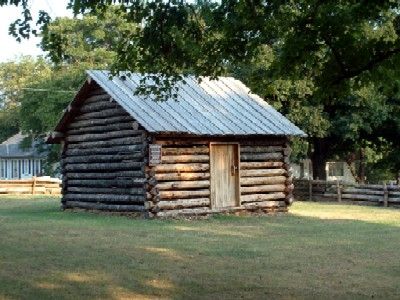
Fort Blair, Baxter Springs, Kansas.
During the Civil War, Baxter Springs was situated on the old military road that ran from Fort Smith, Arkansas, through Fort Scott, Kansas, and southwest to Fort Gibson in Indian Territory. Initially, the site was primarily a rest stop for wagon trains supplying the troops and for military personnel assigned to protect them from hostile Indians along the way. However, when the Civil War began, the region soon found itself under attack from Confederate regular and guerrilla forces.
In the Spring of 1862, a field camp, initially known as Camp Baxter Springs, was established by Colonel Charles Doubleday’s 2nd Ohio Brigade and Colonel William Weer’s 2nd Kansas Brigade to accommodate approximately 6,000 troops.
Several more field camps would be established along the route, including Camp Little Five Mile, built by Colonel John Ritchie’s Indian Home Guards in June 1862, which was located to the southeast across the Spring River. Two more field camps were built near here in the summer of 1863, including Camp Joe Hooker and Camp Ben Butler, both constructed by Colonel James Williams’ 1st Kansas Colored Troops.
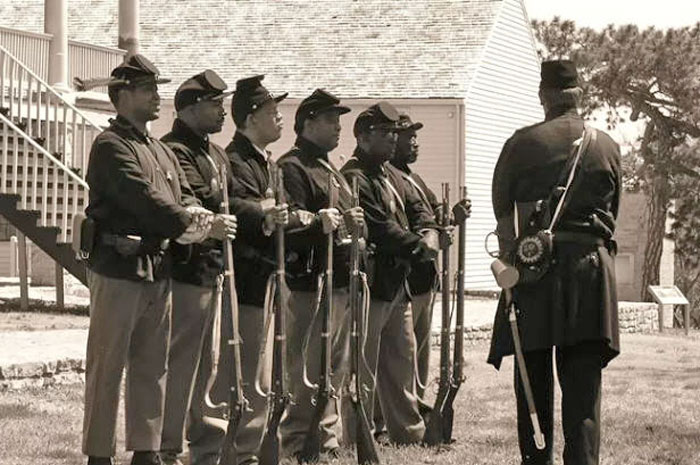
Colored Infantry re-enactors in Kansas.
In the beginning, life at the camp was easy and at times very dull, leading one soldier to write in June 1862, “Here we camp, with nothing to do but eat, drink, swim, sleep, and read — the latter only when we are fortunate enough to procure newspapers or books.”
In July 1863, the decision was made to build a permanent post, and Colonel Charles Blair sent Lieutenant John Crites, along with companies C and D of the 3rd Wisconsin Cavalry, to construct it on August 17. Though the post was officially called Fort Blair, it was more commonly known as Fort Baxter. When complete, it consisted of a blockhouse and a few cabins surrounded by breastworks made of logs, rocks, and dirt.
Crites was soon reinforced by a detachment of the Second Kansas Colored Infantry under the command of Lieutenant R. E. Cook, and early in October, further reinforcements were added under Lieutenant James B. Pond of the Third Wisconsin Cavalry, which provided a 12-pound howitzer.
Baxter Springs Massacre (October 6, 1863)
Though the post’s activities had been slow, things would change in October 1863.
On October 4, 1863, Lieutenant James B. Pond arrived from Fort Scott to command the post, which was then manned by about 155 men. Setting up camp about 200 yards west of the fort, Pond decided that the fort needed to be enlarged, and the following day, he ordered the west wall of the fort to be removed so it could be moved.
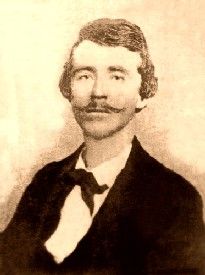
William Quantrill
The next morning, a foraging party of sixty men and all the wagons was sent out of the fort, leaving Pond with about 90 men. Pond had no way of knowing that William Quantrill and about 400 guerrillas, who had decided to winter in Texas, were making their way south.
After capturing and killing two Union teamsters on the Texas Road who had recently left Fort Blair, Quantrill decided to attack the post. Though short-staffed, Lieutenant Pond manned the howitzer and fought them off when the guerrillas began to attack, though they suffered several casualties. Quantrill’s men moved on but would quickly find another opportunity to do battle.
Meanwhile, on the very same day that Pond had arrived at Fort Blair – October 4, General James G. Blunt left Fort Scott with an escort of 100 men of the Third Wisconsin and Fourteenth Kansas Cavalry, headed to Fort Smith, Arkansas. By noon of October 6, they were nearing Fort Blair when they spied a body of mounted men advancing from the trees along the Spring River. Dressed in Federal uniforms, Blunt thought they were Pond’s men out on drill and sent his Chief of Scouts, Captain Tough, forward to meet them. However, Tough quickly returned with information that the men were not Union soldiers but rebels, and that a battle was taking place at Fort Blair.
The men who were spied were Quantrill’s guerrillas, who quickly began attacking Blunt’s troops. Though Blunt tried to organize a battle line, they were powerfully outnumbered, and the Union troops scattered in disorder. One officer broke through Quantrill’s men and reached Fort Blair to tell Pond about the turn of events, but it was to no avail. General Blunt and about 15 of his men escaped and eventually made their way back to Fort Scott.
Wiley Britton, in his book, Civil War on the Border, described the carnage this way: “In many instances where the soldiers were closely pursued, they were told that if they would surrender they would be treated as prisoners of war; but in every case the moment they surrendered and were disarmed, they were shot down sometimes even with their own arms in the hands of the bandits.”
Immediately after destroying Blunt’s force, the guerrillas plundered the supply wagons, finding weapons, food, and whiskey. Though two of Quantrill’s leaders, George Todd and William “Bloody Bill” Anderson, wanted to attack Fort Blair again, Quantrill was more concerned about carrying away his wounded men. No further attack was made, and the guerrillas then continued their southward march.
It was a Confederate victory, with 85 of Blunt’s men killed or dying from their wounds and another eight wounded. Six of Pond’s men were killed, and ten were wounded. The guerrilla casualties were probably twenty to thirty killed and at least three wounded.
All of the casualties were buried near the fort. Blunt was temporarily dismissed from his command after the massacre but was later reinstated. In 1885, Congress appropriated $5,000 for a national cemetery about a mile west of Baxter Springs, where many of the bodies were re-interred.
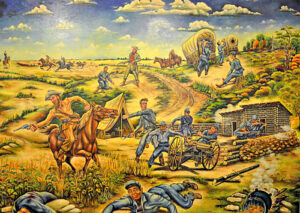
Baxter Springs Massacre by Edmund Victor Ness.
When the Civil War was over, the fort was abandoned, but the town of Baxter Springs grew up around it, becoming an outlet for the Texas cattle trade and one of the wildest cow towns in the West.
Today, the story of Fort Blair and more regional history can be found at the Baxter Springs Heritage Center & Museum, located at 740 East Avenue. The 20,000-square-foot facility also interprets the area’s Native American, mining, and Route 66 history. A self-guided Civil War tour can also be taken, highlighting 12 points of interest related to the attack. Maps and brochures may be picked up at the museum or the Chamber of Commerce.
©Kathy Alexander/Legends of America, updated June 2026.
Also See:
Baxter Springs – 1st Kansas Cowtown
William Quantrill – Leader of the Missouri Border War
See Sources.