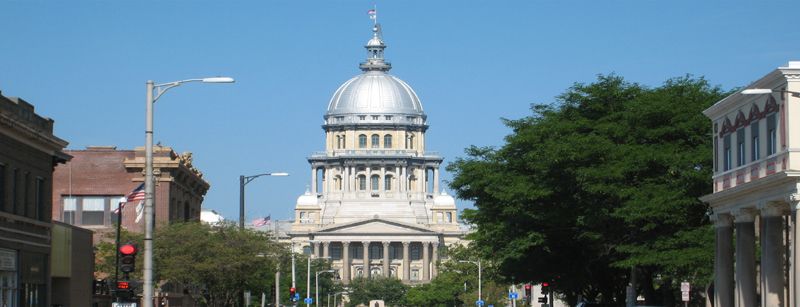
Springfield, Illinois Capitol Building.
Springfield, Illinois, is the state capital, the county seat of Sangamon County, a Route 66 city, and once home to Abraham Lincoln.
The pioneer settlement of Springfield began when John Kelly, his wife Mary, their five children, and John’s brother, Elisha, arrived in the area in the spring of 1819. The following year, they built the first cabin at the northwest corner of Second and Jefferson Streets. Other pioneers from North Carolina, Virginia, and Kentucky followed, taking advantage of the area’s fertile soil and trading opportunities.
In 1821, Zachariah Peter, William Drennan, and Rivers Cormack drove a stake into the ground on the prairie near John Kelly’s field, and a town was officially born. They first named it Calhoun after Senator John C. Calhoun of South Carolina. A trail traveling past John Kelly’s cabin brought supplies to the settlement from the Illinois River and soon became the first street, called Jefferson. That same year, Elijah Iles opened the first store on Jefferson Street, buying goods from St. Louis, Missouri, and having them brought to the settlement. Calhoun was then designated as the county seat of Sangamon County.
The school was first taught in a log building during the Winter of 1821-22. Like most pioneer settlements, taverns soon sprang up; the first was opened by Elijah Slater in 1822, where travelers were provided food, drink, and a place to stay. Two more taverns quickly followed. In 1830, the Methodists built the first church in the burgeoning community, and the Presbyterians opened a new brick church just one month later.
In 1832, Senator John C. Calhoun, for whom the settlement was named, fell from public favor, and the town’s name was changed to Springfield. The town was officially incorporated on April 2, 1832, and by 1835, Springfield had grown enough that the Board of Trustees saw the need for law enforcement, and a constable was appointed.
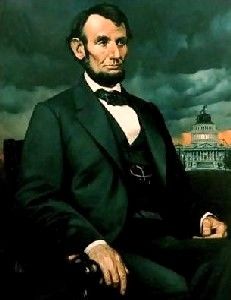
Abe Lincoln.
In 1837, the state capital moved from Vandalia to Springfield, mainly because of the political maneuvering of a young politician named Abraham Lincoln. On April 15, 1837, Lincoln moved from nearby New Salem to Springfield and began practicing law with John T. Stuart, a prominent Springfield attorney.
Before moving to Springfield, Lincoln tried his hand at several endeavors, including clerking at Denton Offutt’s store in New Salem, becoming a postmaster, a surveyor, and a law student, before running for the state Legislature in a losing campaign. In 1834, he was elected to the Legislature on his second try. During this term, he helped secure the placement of the State Capital in Springfield.
During his time in Springfield, Lincoln had three different law partners, the last of whom eventually became his biographer. He spent many days riding the Eighth Judicial Circuit and practicing in county courthouses all around central Illinois. His legal practice gave Lincoln the status and visibility that helped his political success.
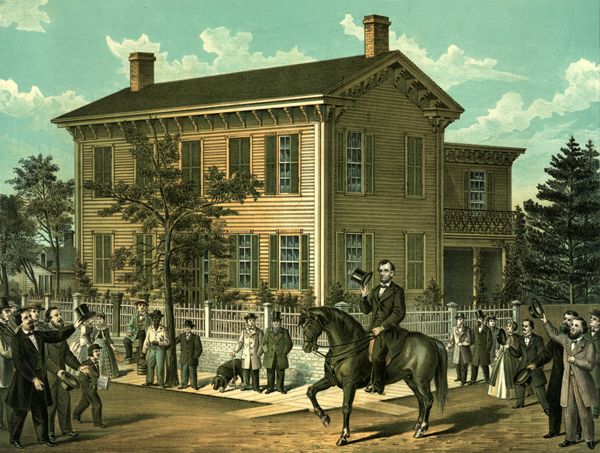
Abraham Lincoln is at his home in Springfield, Illinois, by Rees Print & Litho. Co.
In 1840, Lincoln met a Kentucky belle named Mary Todd, and after a stormy, sporadic courtship, the couple married in 1842 at the hands of the Reverend Charles Dresser. Their first son, Robert Todd Lincoln, was born on August 1, 1843. The following spring, Lincoln bought the Reverend Dresser’s home on the corner of Eighth and Jackson streets for $1,200 cash and a small lot worth $300. The Lincolns occupied this brown frame house for the next 17 years. This home still stands in Springfield today at 413 S. 8th Street and is part of a National Historic Site that includes several other structures within the four-block area. All the homes have been restored to their appearance during the time Lincoln lived in the neighborhood.
While practicing his profitable law career, Lincoln remained active in politics, and on November 6, 1860, he was elected president.
On February 11, 1861, Lincoln stood on a train station platform and, in a voice filled with emotion, shared his parting words for Springfield, Illinois. To the large crowd that gathered, he said:
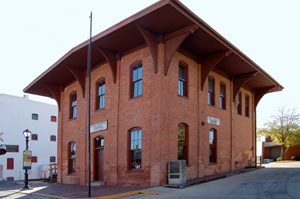
Lincoln Depot in Springfield, Illinois by Kathy Alexander.
“My friends – No one, not in my situation, can appreciate my feeling of sadness at this parting. To this place and the kindness of these people, I owe everything. Here, I have lived a quarter of a century and have passed from a young to an old man. Here my children have been born, and one is buried… To His care I am commending you, as I hope in your prayers you will commend me, I bid you an affectionate farewell.”
He left Springfield that day and would never return during his lifetime.
Though the Civil War took many men from Springfield in the fight for the Union, it also boosted Springfield’s economy with numerous new industries and businesses. With its status as the state capital, the town continued to grow.
When Route 66 came through Springfield, the town responded by opening even more businesses targeted to the many travelers on the new highway. Gas stations, cafes, and motels sprang up overnight.
When the Route 66 signs came down in January 1977, many of these longtime businesses died the inevitable death of being bypassed by the superhighway. However, many of these old icons still stand in this proud city, and Springfield honors its rich history, including the Mother Road. The city today is home to about 114,700 people.

The Cozy Drive-In on Route 66 in Springfield, Illinois by Kathy Alexander.
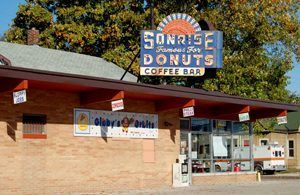
Sonrise Donuts on Route 66 in Springfield, Illinois by Kathy Alexander.
Springfield has several museums and historic sites, including Abraham Lincoln’s longtime home, burial site, and presidential library.
Downtown, the historic district offers many examples of preserved nineteenth-century architecture, where you can walk the same streets Abraham Lincoln did. Check out the Old State Capitol Building, where Lincoln delivered his famous “House Divided” speech. The Old State Capitol Historic Site was the center of Illinois government from 1839 to 1876 and is considered one of the most important 19th-century public buildings in the United States. After his assassination, President Lincoln’s body lay in state in the second-floor House of Representatives. The Old State Capitol Building is located at 2nd and Capitol Streets. The present-day Capitol building and governor’s mansion are also in this area.
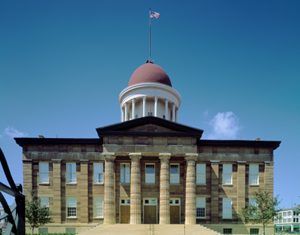
The old Capitol building in the downtown historic district of Springfield, Illinois, by Carol Highsmith.
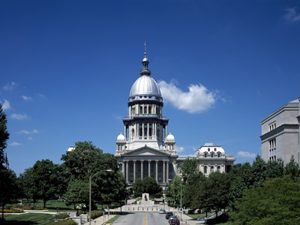
Current Illinois Capitol in Springfield, Illinois by Carol Highsmith.
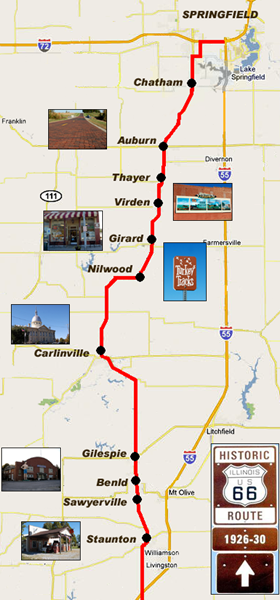
South Springfield Old Alignment Map. Click for an enlarged version.
As you continue your travels southward along Route 66 out of Springfield, you will have to choose between two alignments that are still intact today.
The pre-1930s two-lane alignment meanders through Chatham and Auburn—where you can see a piece of brick alignment—before moving on to Thayer, Virden, Girard, Nilwood, Carlinville, Gillespie, Benld, Sawyerville, and Staunton. South of Staunton, the road rejoins the later alignment.
The newer alignment (1930-1977) begins as a four-lane road in Springfield, closely following I-55, and will take you to Glenarm, Divernon, Farmersville, Litchfield, Mt. Olive, and Livingston.
If you travel to the older alignment (pre-1930), you will see Route 66 Drive-in at 1700 Recreation Drive, which shows movies nightly.
As you travel down the Mother Road, you’ll pass over Lake Springfield. A manmade lake in the 1930s covers parts of the original two-lane alignment of Route 66. When the water level is low, you can still glimpse the old road. You might want to plan your trip to Springfield the last week in September when the enthusiastic Route 66 city holds the Route 66 Mother Road Festival every year. Join thousands of others to relive the good old days, see dozens of vintage automobiles, and celebrate the rock-and-roll era.
Or, as an alternative, travel through the city in late August, when Springfield hosts the Illinois State Fair. Regardless of when you visit this historic city, plan on taking your time, as there is much to see.
Route 66 Postcard Color Book, available at Legends General Store.
©Kathy Alexander/Legends of America, updated October 2026.
Also See:
Ghosts of Historic Springfield
See Sources.