Madison Street, Pontiac, Illinois, in the early 1900s..
One of Route 66’s Red Carpet Corridor Communities, Pontiac has much to offer for the Route 66 Roadie and the history buff.
Before the coming of white men, the plains around Pontiac were home to Illinois, Potawatomi, and Kickapoo Indians. A few traders of European descent traveled through the territories before the arrival of the first settlers in about 1829. An act of the Illinois Congress established Livingston County in February of 1837. Within no time, a commission met and selected a site owned by three early Pontiac settlers.
The three settlers, Henry Weed, Lucius W. Young, and Seth M. Young, laid out a townsite and agreed to contribute $3,000 toward the erection of public buildings and to donate land for a public square, a jail, and a pen for stray domestic animals. They also promised to build a bridge across the Vermilion River. The town was named for the Ottawa Indian Chief, Pontiac. Though Pontiac had waged war on white settlers invading Ottawa for some 60 years, he was much admired by both whites and Native Americans alike.
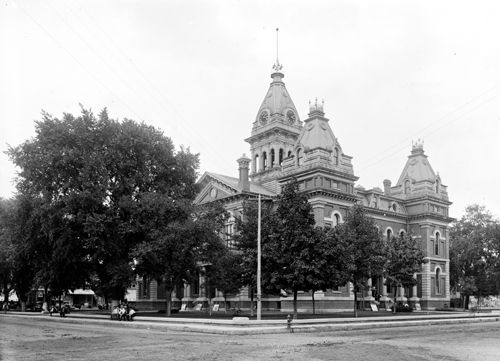
Pontiac, IL courthouse, turn of the century, Detroit Publishing Co.
Once Livingston County was organized, a two-story frame courthouse was completed in Pontiac in 1842 and located on the public square. It continued to serve the county until a new building was built in 1856. Unfortunately, a fire destroyed the second courthouse, but a third was completed in 1875 and still stands today, listed on the National Register of Historic Places.
Having some of the richest farmland in the nation, Pontiac thrived with an agricultural economy, growing wheat, corn, and other staple crops. Later, it developed several manufacturing facilities, bringing further prosperity to the town. These included shoe and boot manufacturers and the Allen Candy Company with its famous “Lotta Bar.” The advertising slogan for this confection was “A Lotta Bar for 5 cents.”
Early on, Pontiac developed a rich cultural heritage, beginning with the Folks Opera House that featured several artists who traveled the circuit from Chicago, Illinois, to St. Louis, Missouri.
The community grew steadily, but prospered even more when Route 66 barreled through in 1926. The community quickly provided services and amenities to the many travelers on the historic road.
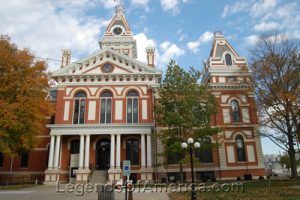
Historic Livingston County Courthouse. Photo by Kathy Alexander.
Today, this city of some 12,000 people offers several historic points of interest, including the Livingston County Courthouse (1875), the Jones House (1850s), and the Old City Hall Shoppes, listed on the National Register of Historic Places.
While in Pontiac, stop by the Route 66 Association Museum and Hall of Fame, which features artifacts, photos, and literature capturing years of adventure along the old route. The museum was built inside a refurbished firehouse, which is also listed on the National Register of Historic Places. It’s also home to the late Bob Waldmire’s bus and van. Waldmire was a noted Route 66 Artist and Icon who died in late 2009. Also, here are the Old City Hall Shoppes and the Livingston County War Museum. It is located at 110 W. Howard Street.
Also, look at the gun-shaped Illinois State Police District 6 Headquarters. The building was constructed in the shape of a pistol and served as the base for state troopers who patrolled roads from Dwight to McLean. In 2003, it was vacated when a new state police headquarters was built nearby. It was inducted into the Route 66 Hall of Fame in 2000 and listed on the National Register of Historic Places in 2007. It is located at 15551 Old U.S. 66 on the south side of town.
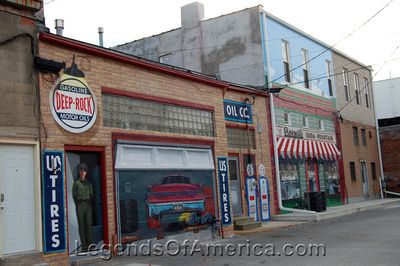
Murals in downtown Pontiac. Photo by Kathy Alexander.
The old Log Cabin Inn is still open for business in Pontiac. This is a classic old restaurant that got its start back in 1926 and has been entwined with Route 66 ever since. It used to face the early alignment of Route 66; however, when Route 66’s old alignment was moved to the other side of the building, it was jacked up and turned around. Later, a newer building was constructed right next door. The old building now serves as a residence. It is located at the intersection of Pontiac Road, once two-lane Route 66, and the newer four-lane Route 66 on the north edge of town at 18700 Old Route 66.
Another interesting stop is the International Walldog Mural & Sign Art Museum, dedicated to preserving and appreciating outdoor wall advertising signs painted in the days before electronic mass media. These painters called themselves “Walldogs.” It is located at 217 N. Mill Street.
Pontiac’s downtown district includes several shopping and dining opportunities. While in downtown, check out the murals of cars and trucks painted by local artists.
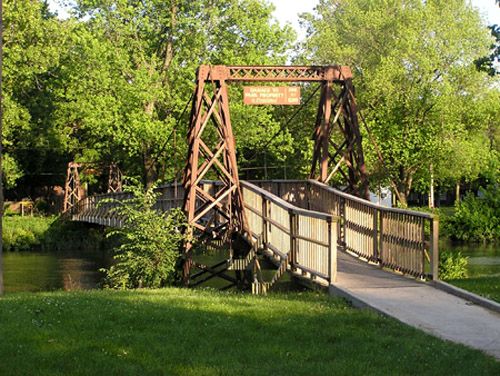
Swinging bridge courtesy Pontiac, Illinois Tourism Bureau.
One of the town’s spectacular features is its three swinging bridges over the Vermillion River. One bridge connects Riverview Drive and Play Park. It was built in July 1898 by the Joliet Bridge Company, with an iron structure measuring 190 feet long and four feet wide, supported by cables suspended from masonry piers. The current bridge is a wooden structure. The second connected the Play Park and Chautauqua Park and was built in 1926. The third connects the south side of Play Park and Riverside-Humiston Park.
A city of about 12,000 people today, Pontiac has been recognized by the National Main Street program with numerous Governor’s Hometown awards and by Time Magazine as one of the best small towns in the country.
In this area, several old alignments and sections of the road can be seen but are no longer traveled. Closed bridges and overgrown asphalt abound in the area.
Pontiac is located about 92 miles southwest of Chicago.
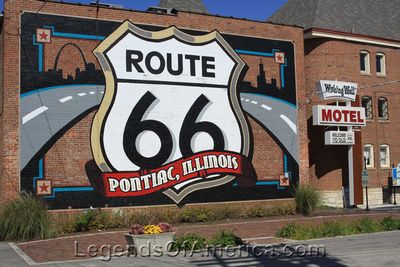
Route 66 Mural in Pontiac. Photo by Kathy Alexander.
More Information:
Pontiac, Illinois Tourism Bureau
115 W. Howard Street
Pontiac, Illinois 61764
815-844-3396
© Kathy Alexander/Legends of America, updated November 2025.
Also See:
See Sources.