
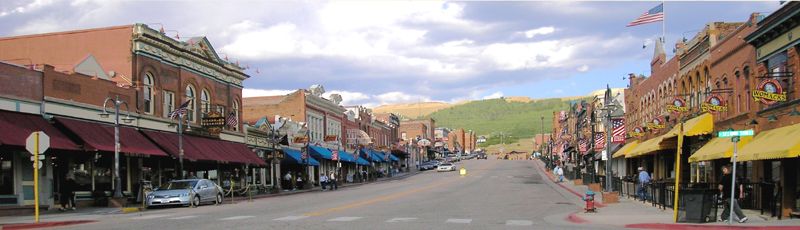
Cripple Creek, Colorado by Kathy Alexander.
“Today the fame of The Cripple Creek Gold Camp ranks with London, Paris and other money centers of the world, for, while the great money centers may handle and control more of the world’s assets, Cripple Creek actually adds more new money to the treasury of the world than any other place. Nearly $2,000,000 are added every month to the world’s wealth by the product from the hills within The District of Cripple Creek.”
— Cripple Creek Times, 1904
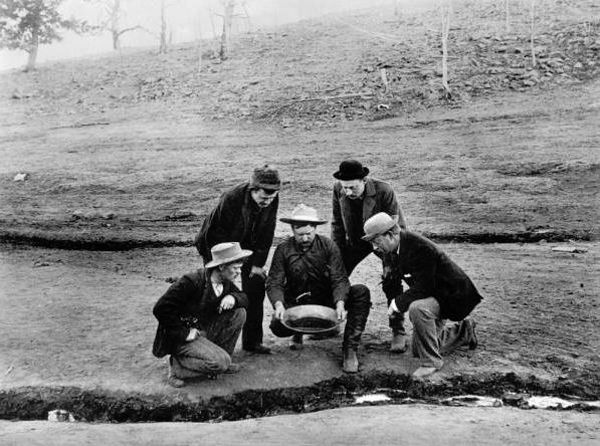
Gold panning at Cripple Creek, Colorado
The first discovery of gold in the Pikes Peak region was made in 1874 when a man named T.H. Lowe picked up some rich ore in a meadow near the present site of Cripple Creek. Excited, he quickly organized a prospecting party to search the nearby gulches. Though they found a little gold, there was not enough to warrant mining, and they soon departed.
It would be another ten years before any gold was heard of again. In the spring of 1884, word spread that a man named Chicken Bill was taking nuggets out of the ground by the handful. Three thousand men quickly swarmed the area to find absolutely nothing. Soon, it was discovered that the nuggets produced by Chicken Bill were from a salted mine, and the disappointed miners quickly left in search of more profitable opportunities.
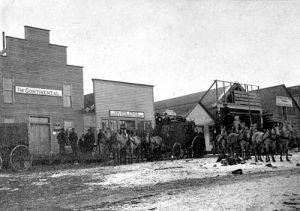
Cripple Creek, Colorado, 1890.
In December 1890, a man named Bob Womack really did discover gold, but miners were slow to respond, remembering the hoax of six years prior. By the summer of 1891, Womack struck a very rich vein and hurried to Colorado Springs to celebrate. In a drunken stupor, the foolish man sold his mine for $500 cash. Word then spread, and men began to stake claims all over a six-square-mile area surrounding what would soon be the Cripple Creek Gold Camp.
Tents and cabins began to spring up, and a mining district was organized in the fall of 1891. The creek, which flowed through the camp, had already been named by area cowboys because so many cattle were lamed while crossing the rocky stream. The camp took its name from the creek. The land where the many claims were being staked was owned by Denver real estate men Horance Bennett and Julius Myers, and they soon platted 80 acres for a townsite, selling lots to the many miners and their families flooding the area. At first, the two men wanted to call the new town Fremont, but the post office officials rejected the name as there was already one by that name in Colorado. Soon, they settled with the name of the creek. By the time the town was officially incorporated in 1892, there were already over 5,000 Gold Camp residents.
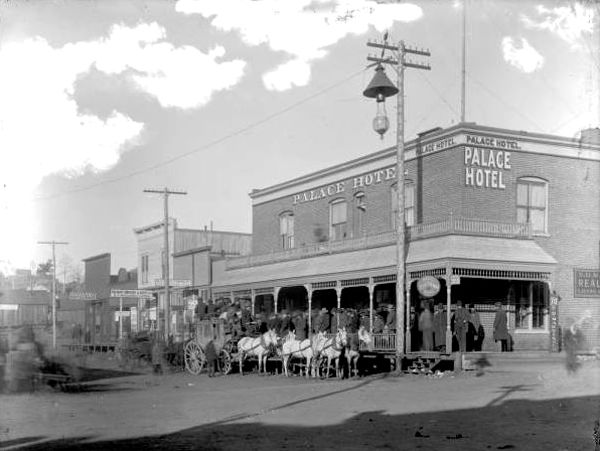
Stagecoach at the Palace Hotel in Cripple Creek, Colorado about 1894.
In 1892, most of the gold was found from placer mining, enough to sustain the burgeoning camp. Two stage lines began to carry people to Cripple Creek from Divide and Canon City. In the winter of 1892, stockbrokers began to arrive in Cripple Creek, selling mining stocks to the excited people of the area and around the nation.
In 1893, two major mines in the district were discovered and developed. The same year, the nation changed to the gold standard, and thousands of silver miners were thrown out of work, flocking to Cripple Creek.
The deeper the mines were developed, the richer the veins became. Some of these deep-developed mines were three to six miles away, and soon, the camp of Victor sprang up, with many of the miners moving closer to work. However, by this time, Cripple Creek was well enough established that it had little impact on the growing community.
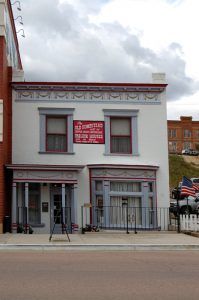
The Homestead Museum in Cripple Creek, Colorado was once a popular brothel by Kathy Alexander.
Like most booming gold camps, Cripple Creek wasted no time establishing dozens of businesses, including a number of saloons and brothels. At first, the houses of “ill-repute” were located near the many saloons along Bennett Avenue, the main street of the settlement. However, to keep the peace between the business establishment and the “ladies,” Marshal Wilson moved the “girls” and their establishments one block south to Myers Avenue, which soon became known as the Red Light District.
Myers Avenue was known as one of the liveliest streets in the Old West. The phrase “There’ll be a Hot Time in the Old Town Tonight” was coined on this street filled with parlor houses, “cribs,” dance halls, and false-front saloons. Businesses on the “Row” never closed, operating twenty-four hours a day, providing entertainment to the many free-spending miners.
Pearl de Vere, the most famous madam of Cripple Creek arrived in the Boom Camp in 1893. Soon, she would build the most opulent Gentlemen’s Parlor in the American West. Humorously called the “Old Homestead,” Pearl’s going rate was $250 a night, at a time when $3 a day was considered a good wage for a miner. When she died several years later, her funeral was the biggest that Cripple Creek had ever seen.
By 1894 two railroads were racing to the city – the Midland Terminal from Divide and the Cripple Creek railroad from Canon City. The Cripple Creek railroad finished first arriving with its first steam engine into the camp on July 2, 1894, to a grand celebration of Cripple Creek’s citizens.
The Midland Terminal arrived in Cripple Creek in December 1895, traveling up the Ute Pass from Colorado Springs. The railroad continued to service Cripple Creek for over half a century.
By 1896, the city boasted a population of 10,000 residents and on January 21, 1896, the Cripple Creek Stock Exchange was opened. The National Hotel, the largest and tallest structure, was completed in February 1896, complete with Turkish baths, an elevator, and its electric light plant. It contained 150 rooms, 40 suites, and a restaurant with fine cuisine.
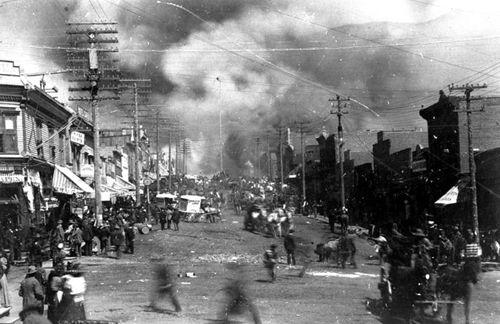
Cripple Creek, Colorado fire, 1896.
On April 25, 1896, a fire wiped out nearly half of the city. Started in one of the many brothels, a dancehall girl named Jennie Larue got into an argument with her lover, and while quarreling, accidentally upset a gasoline stove. The wooden frame buildings of the camp quickly ignited and spread from one building to the next. Buildings in the fire’s path were blown up in an effort to stop the approaching flames. The fire departments of Victor, Florence, Colorado Springs, and Denver dashed to the city’s aid, but there was little that could be done.
Four days later, half of the city lay in smoldering ruins, and a second fire alarm went off. This fire began in the Portland Hotel on Myers Avenue and was believed to have been deliberately set because other fires were discovered simultaneously in other parts of the city. In this second fire, eight blocks of buildings were consumed, six lives were lost, and nearly 4,000 residents were left homeless. When it was all said and done, fewer than ten buildings were left to mark the site of the city. The firebugs who were suspected of setting the second fire were lynched and Cripple Creek began to rebuild. Within just a few months, modern businesses built of brick or stone rose on the foundations of the former camp.
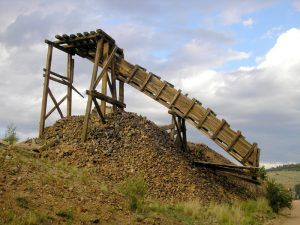
Mining remnants in Cripple Creek, Colorado by Kathy Alexander.
Having survived the fire, the city continued to prosper, and in October 1897, the Butte Opera House was remodeled, bringing culture to the city.
By 1898, the mines were yielding greater amounts of valuable ore, and production jumped to some 16 million dollars. By 1899, gold production had reached 21 million dollars, and Cripple Creek was named the County Seat. By this time, there were as many people on the streets at 3:00 a.m. as at 3:00 p.m., and the camp supported 75 saloons, 25 restaurants, four department stores, a business college, 40 stockbrokers, and 72 lawyers.
By 1900, gold production had reached some 23 million, and over 500 mines were operating in the area. The Cripple Creek Times reported that the Mining District had grown to 55,000 citizens. Of those residents, Cripple Creek boasted 35,000.
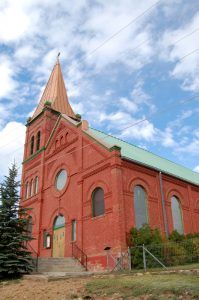
A church in Cripple Creek, Colorado by Kathy Alexander.
Victor, on the south end of the District, had a population of 5,000. Eleven other towns with populations of a few hundred to over 2,000 were scattered around the District.
On Sunday morning, hundreds of people crowded Cripple Creek’s 16 churches. The Teller County School System was one of the best in the country. At the time 3,849 students were enrolled in the District’s 19 schools, and 118 teachers were employed in Cripple Creek and Victor.
Soon, however, the gold would begin to play out. By 1920, there were only about 40 mines operating, and production had been reduced to four million dollars. The 1930s saw a brief revival of mining, but this, too, waned. By 1945, fewer than 20 mines were operating, with only about one million dollars in gold produced each year.
Determined not to become a ghost town, the citizens of Cripple Creek began promoting its rich history to potential tourists. In the 1940s, the Imperial Hotel began showing melodramas in the Gold Bar Room Theatre. In 1953, the Cripple Creek District Museum opened in the old Midland Terminal depot. In 1967, the Cripple Creek Narrow Gauge railroad began operation.
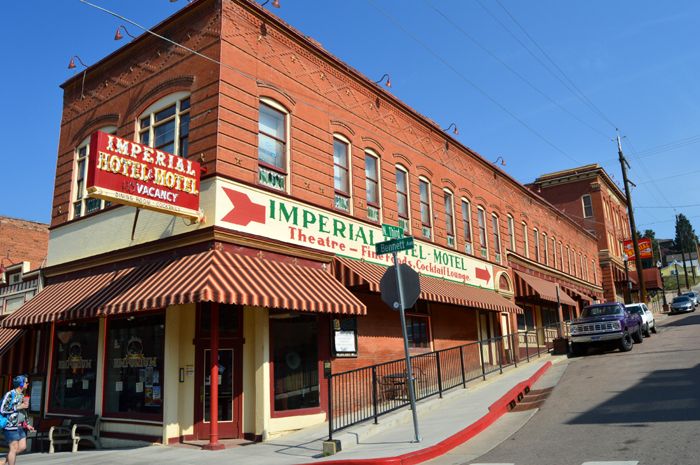
Imperial Hotel in Cripple Creek, Colorado by Kathy Alexander.
However, by the 1980s tourism began to drop in Cripple Creek and other historic towns of Colorado. As a result, Colorado passed a law to authorize limited stakes gambling in Cripple Creek, Central City, and Blackhawk, saving these old towns from total extinction.
Today Cripple Creek offers a wide array of events and attractions for the vacationing visitor including summer celebrations, art shows, fall aspen tours, rodeos, symphony performances, and craft shows. Old mine shafts, headframes, and cabins still dot the landscape in the high country behind Pikes Peak, where driving tours and hiking in the area abound. The most significant event in Cripple Creek event is Donkey Derby Days, always held the last full weekend of June. Nearby Victor holds Gold Rush Days every year, during the third weekend of July.
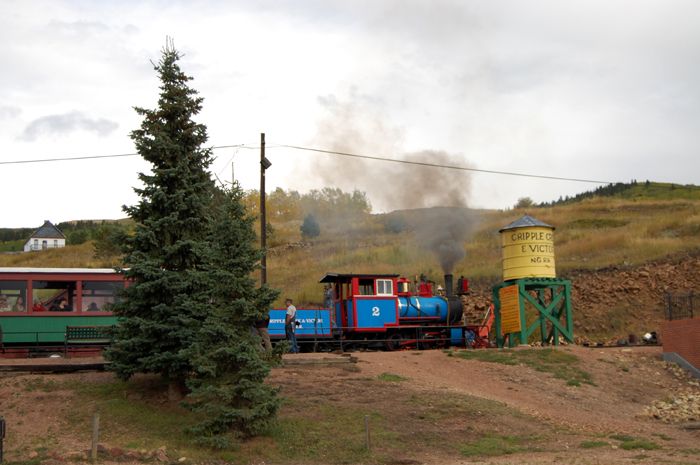
Cripple Creek-Victor Railroad by Kathy Alexander.
Though still labeled a “ghost town” because it’s not nearly as large as it once was and has lost its former mining status, it remains the county seat of Teller County. It is home to almost 1,200 people. The Cripple Creek Historic District, which received National Historic Landmark status in 1961, includes part or all of the city and surrounding area. Cripple Creek is 48 miles from Colorado Springs via U.S. Highway 24 and Colorado Highway 67. Shuttle services are available from Colorado Springs and Pueblo as well as local shuttles servicing Cripple Creek and Victor.
©Kathy Alexander/Legends of America, updated May 2025.
Also See:
Teller County Courthouse in Cripple Creek, Colorado by Kathy Alexander.
Cripple Creek Photo Print Gallery
Ghosts of the Cripple Creek Mining District
Pearl de Vere – Soiled Dove of Cripple Creek
See Sources.