
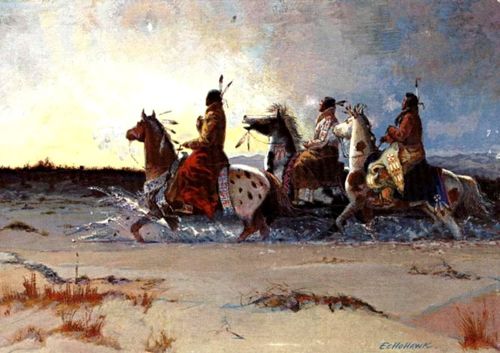
Comanche Painting by Brummett Echohawk.
The Comanche are a Native American nation of the Great Plains whose historic territory ranged from present-day north-central Texas, eastern New Mexico, southeastern Colorado, southwestern Kansas, western Oklahoma, and northern Chihuahua, Mexico.
Dating back to the early 1500s, the Comanche were originally part of the Eastern Shoshone, who lived near the upper reaches of the Platte River in eastern Wyoming. However, when Europeans entered the scene and the tribe obtained horses, they broke away from the Shoshone, forming an estimated 10,000-member group.
Moving south, they first migrated to the central plains before continuing southward to an area that extended from the Arkansas River to central Texas. As they continued to migrate, the Comanche population increased dramatically due to the abundance of buffalo, an influx of Shoshone members, and the kidnapping of women and children from rival tribes and Mexican settlements.

Comanche Hunting Buffalo by George Catlin
Long known as war-like and aggressive, some estimates state that up to 20,000 people were kidnapped. Unfortunately, the Comanche Indians did not treat their captives well, considering them little more than slaves and commodities. From the moment of their capture until their death or release, they were both physically and mentally abused.
Though the tribe was large, they never formed a single tribal unit but were divided into eight to twelve independent groups. Sharing the same language and culture, they sometimes fought between bands and at other times were at peace, cooperating.
Although the name Comanche is well known, its origin is uncertain. There are two accounts of its origin, the most accepted being a Spanish corruption of the name the Ute called them—Kohmahts, meaning “those who are against us.” The second account is that it was a derivative of the Spanish word amino ancho, meaning “wide trail.” They were also called Paducah by early French and American explorers, but the tribe’s preferred name has always been Numunuh, meaning “The People.” The Comanche speak a Uto-Aztecan language that is almost identical to the Shoshone language from which they originated.

Three mounted Comanche warriors, 1892.
The horse was a key element in Comanche culture, who are thought to have been the first of the Plains Indians to have horses. In the beginning, they were primarily a hunter-gatherer nomadic society. Still, with horses, they became more daring and aggressive and were soon considered the best buffalo hunters on the plains. The horse trade quickly became a large part of their culture, with breeding, stealing, and trading horses with other Plains Indians, allowing them also to become more productive buffalo hunters.
Warfare was a major part of Comanche life, with conflicts often bringing them into battles with the Apache and other tribal groups. Those they stole from often found it simpler and safer to buy back the stolen commodities rather than fight for them. During the 1800s, they began stealing cattle from Texas settlers and reselling them in New Mexico. During this period, they fought the Mexicans and white settlers, and many of the other Plains tribes.

Comanche Camp, by William S. Soule, 1873.
In an attempt to stop the raids upon the Apache, the Spanish offered help; however, it was to no avail, and the Apache were finally forced out of the Southern Plains by the mid-1800s. Now dominating the Texas Panhandle area, including western Oklahoma and northeastern New Mexico, the Comanche were so well-heeled at their horsemanship that they began to supply horses to French and American traders.
Many historians debate whether the Comanche deserve their ferocious reputation, arguing that they fought only to reclaim the land they believed was theirs. Continuing to protect their territory, the formidable Comanche aggressively attacked the many settlers passing through on their way to the California Gold Rush. Some were killed, but most often, their horses and cattle were stolen.
The fierce Comanche continued to maintain their independence and even increase their territory until new diseases, including smallpox and cholera, began to take their toll. By the 1870s, these illnesses had reduced the population to about 7,000 people.
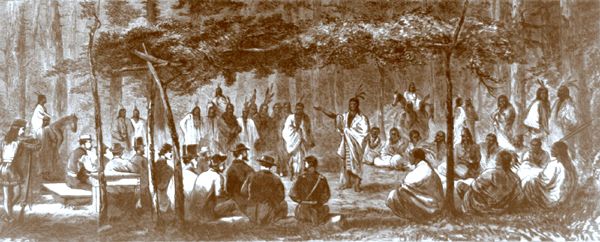
Medicine Lodge, Kansas Treaty Council
In the 1860s, efforts began to move the Comanche to a reservation in Indian Territory (Oklahoma). In the Treaty of Medicine Lodge of 1867, the government offered them churches, schools, and annuities in return for a vast tract of land totaling over 60,000 square miles. They also promised to stop the buffalo hunters, who were decimating the great herds of the Plains, on the condition that the Comanche, along with the Apache, Kiowa, Cheyenne, and Arapaho, relocate.
Obviously, the government failed on its promise to prevent the buffalo hunters from slaughtering the herds, which soon provoked the Comanche Chief White Eagle to attack a group of hunters in the Texas Panhandle in 1874. Known as the Second Battle of Adobe Walls, the attack was a disaster for the Comanche, and the army soon drove those who were remaining onto a reservation.
In 1892, the government negotiated the Jerome Agreement with the Comanche, Kiowa, and Apache, further reducing their reservation land to 480,000 acres and allotting 160 acres to each person.
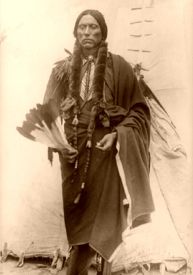
Quanah Parker, Comanche Indian Chief.
Today, the Comanche Nation claims approximately 10,000 members, about half of whom live in Oklahoma, and the rest are scattered throughout Texas, California, and New Mexico. Lawton, Oklahoma, is the site of the annual pow-wow, where Comanche from across the United States gather to celebrate their heritage and culture.
©Kathy Alexanderer/Legends of America, updated December 2025.
Also See:
Shoshone – Continuing the Traditions of their Ancestors
Adobe Walls – Buffalo and Battles
Comancheros of the Llano Estacado
Native American Photo Print Galleries
See Sources.