
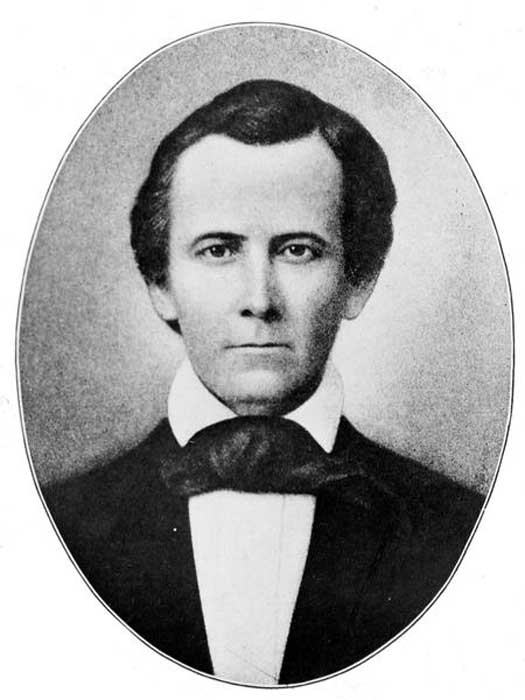
Illinois Governor Thomas Ford.
By Roger Myers
The adventure and excitement of the American West lured many young men from comfortable lives in the “civilized” East. The sons of the deceased former Illinois Governor Thomas Ford, Thomas H. Ford and his older brother by three years, George Sewell Ford, were no exception. Most of those seeking their fortunes in the West went on to lead successful and productive lives; the Ford boys did not.
The first brother to suffer the consequences of frontier justice was Tom. The only extensively detailed account of the events, corroborated by contemporary newspaper reports, is George D. Freeman’s Midnight and Noonday. [1] An inaccurate, reputation-saving version was published in the Peoria National Democrat three years after the fact, and again in the July 1910 issue of the Journal of the Illinois State Historical Society.
Thomas H. Moore, alias Thomas Ford Moore, alias Tom Smith, was born in 1847, the youngest (illegitimate?) son of former Illinois governor Thomas Ford. Upon the death of both his parents in 1850, [2] stove merchant Thomas C. Moore adopted him. [3] On June 1, 1864, Thomas Ford Moore enlisted in Company F of the 139th Illinois Infantry, mustering out on October 15, 1864. He then joined an artillery regiment serving to the end of the war. Upon his separation from the military, he went home to Peoria, Illinois, where he obtained a job writing for the Peoria Transcript. [4] In recounting the circumstances of Ford’s time in the west, his hometown newspaper, the Peoria National Democrat, was involved. It published an extensively sweetened version for consumption by its Illinois readers:
In the fall of ‘71, he became dissatisfied with Peoria, and Mr. Moore, his adopted father, having lost much of his former property, Tom resolved to seek a new field of endeavor and turn to some substantial account the many talents with which he was endowed.
Accordingly, he set out for Kansas, in which State an elder brother [George] of his had been settled for some time. This brother was in the vicinity of Wichita, and there Tom found him. Together they roamed over the prairies until the summer of ‘72, sometimes hunting, sometimes engaged in the nomadic avocation of cattle driving. [5]
The Democrat went on to recount that Tom was lynched for a crime he did not commit by vigilantes from Sumner County. The paper reported that a completely innocent Tom was accused of horse theft and seized by “three ruffianly-looking men,” who were soon joined by three others. Protesting his innocence, he told the men he could prove an alibi if given sufficient time. Being denied this, he asked the men to search him and find papers “which would show that they had mistaken his identity.” Again, the vigilantes refused, and he was hanged from a nearby tree after a prolonged struggle. After he was hanged, the men searched the body and found the papers proving his innocence. The names of the men were discovered, but the “cowardly villains” were not prosecuted, an injustice that demanded further action by the Kansas authorities. The Sumner County Press refuted the National Democrats’ account, citing firsthand knowledge of the event. U.S. Deputy Marshal George D. Freeman recounted in detail the theft, pursuit, and subsequent capture of Tom Smith and his accomplice, John Dalton, in his book Midnight and Noonday.
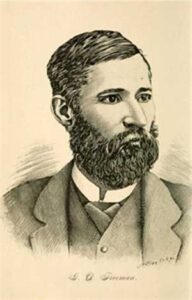
George D. Freeman, from the book Midnight and Noonday
Freeman wrote that at 4 p.m. on June 5, 1872, his brother Milton took George’s team and wagon to get a load of hay they had stacked about two miles from George’s home near Caldwell. About a mile from the haystack, Milton was approached by Smith and Dalton, who inquired where they could find a suitable place to cross a creek. As he was pointing out the place to ford, the two men drew revolvers and demanded the wagon and team.
With Milton driving and one of the thieves seated beside him, they headed west for several hours with the other man leading the way. About midnight, they gave the boy a dollar and told him to go home. At 3 a.m., he walked into Andrew Drum’s ranch, who fed the boy, loaned him a horse, and sent him home; he arrived three hours later. Milton rode on into Caldwell, found George, and related his story to him. With a party of seven men, George Freeman began tracking the thieves who, according to an anonymous letter given to Freeman, were headed 163 miles northwest toward Boyd’s Ranch on Pawnee Creek in Pawnee County, Kansas. [6]
The party continued in a northwesterly direction, finally sighting the Arkansas River, south of which, a mile and a half, they went into camp in a ravine. Crawling to the top of the gully, Freeman saw his wagon and horses in the valley one-quarter of a mile south of the swollen river and four miles south of Boyd’s Ranch on Pawnee Creek. [7] At sunrise, the next morning, the posse surrounded the thieves’ camp, and Freeman commanded the men in the wagon to surrender. Only Dalton was present. He told Freeman that his partner was named Tom Smith and that he had gone to Boyd’s Ranch to get provisions. He also told him that Smith was to receive twenty dollars upon delivery of the two Freeman horses to Boyd’s Ranch. Tom and Charley Smith’s friend and employer, Curly Marshall, was the man behind the theft.
Two of Freemen’s posse took Dalton back to their own camp while the other six remained hidden near the wagon. About ten that morning, Smith crossed the river and cautiously rode toward the stolen wagon and horses. As the rider neared the wagon, Freeman ordered him to surrender. Smith at once put spurs to his horse and headed back for Boyd’s Ranch. Freeman fired both barrels of his shotgun at Smith, wounding him in the arm as he escaped north.
Freeman mounted one of his stolen horses and gave chase, riding the horse bareback. Another of the posse managed to get ahead of Smith and cut off his attempt to reach the hill ahead of him. Smith then turned his horse south, and he and the horse swam across the river. Freeman returned to the wagon, got a saddle, and took another posse member with him in pursuit. They too crossed the river but lost sight of the fleeing Smith in the hills four miles southwest of Larned, Kansas.
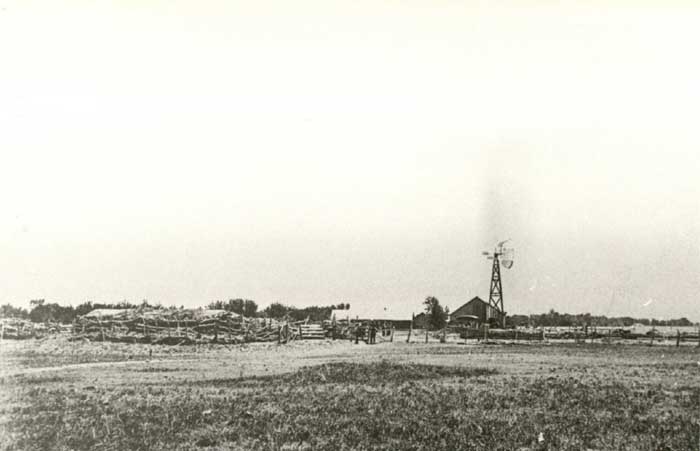
Boyd’s Ranch (Courtesy Fort Larned Historical Society)
Freeman and his posseman rode nine miles to Fort Larned on the south bank of Pawnee Creek, expecting to find Smith there. But the lawman had missed Smith by minutes. While Freeman was having lunch in the quartermaster’s store, a soldier came in and informed the quartermaster that Smith had been wounded in an attack by marauding Indians and that his horse had also been injured. The soldier went on to say that Smith was going to Boyd’s Ranch, three miles east. Post Commander Captain H.B. Bristol ordered a sergeant and six enlisted men to ride with Freeman to Boyd’s Ranch and arrest Tom Smith. A scout from the post volunteered to go with the party.

Jenkin’s Hill.
As the makeshift posse neared Boyd’s sod building, a man fled north up Jenkins Hill. Freeman instructed the sergeant to take three men and pursue him. He took the three remaining soldiers, the scout, and his posseman to Boyd’s. Freeman posted two soldiers to guard the back door and one at the front, and the scout remained in the middle of the building while he searched the premises. The search for the 40-foot-by-20-foot soddie proved futile.
As the men gathered inside to discuss their next move, one of the soldiers guarding the doors said the four others had captured the man who had fled and were taking him back to Fort Larned. Freeman and his posse rode to the fort. With his authority as a deputy United States marshal, Freeman was given possession of Smith and supplied with shackles for both Smith and Dalton. [8] One night on the trail back toward Caldwell, Dalton managed to slip his shackles and escape, the posse continuing with a shackled Smith, who was placed in jail.
After a preliminary hearing in Caldwell at which Smith pleaded guilty, Freeman engaged three citizens to transport Smith to the county jail in Wellington. Smith sent a letter to his brother George in Wichita before leaving for Wellington. In the letter, he enclosed Marshall’s $20, writing that he believed he would not live long enough to spend it himself.
Near the Chikaskia River, they were stopped by a party of about one hundred men who took the prisoner and hung him from a branch of an elm tree. The next day, a coroner’s jury was impaneled and declared that the hanging was done by unknown persons. Smith’s body was taken to a nearby hill and buried with the shackles still on his wrists and ankles. A threat to Freeman’s life, issued by Tom’s brother George, was soon relayed to him.
Tom’s older brother by three years, George Sewall Ford, was adopted by Jonathan K. Cooper of Peoria. Letters of application for appointment to the United States Military Academy at West Point, New York, were sent to President Abraham Lincoln in September 1861. His application was rejected. Eleven months later, he enlisted as a Private in the army, serving with Company C of the 47th Illinois Infantry. He was later transferred to the 47th Illinois Infantry Consolidated, serving until his discharge on July 25, 1865, in Selma, Alabama. A short biography of Governor Thomas Ford, written by J. F. Snyder, says George “lost an arm in the service” [9]

Atchison, Topeka & Santa Fe Railroad in Kansas
Sometime after the war, George drifted west and assumed the name Charles P. (Charley) Smith. [10] In 1871, in northeast Kansas, he worked for “the notorious John E. (Curly) Marshall,” saloon owner, engineer, and most notably, outlaw. [11] Marshall was directing a crew working on an extension of the Atchison, Topeka, and Santa Fe Railroad near Topeka.
On November 12, 1871, during a delay in construction, one of Marshall’s crew found a pistol he mistakenly believed to be unloaded. The man pointed it at Charley, pulled the trigger, and shot him in the wrist. Discussion of amputation arose at once, but within two days, the Topeka, Kansas State Record reported that there was some hope that the hand could be saved. Doctors were unable to save Smith’s hand, and amputation of the arm below the elbow became necessary. Dr. John Homer conducted the procedure on November 19, 1871. George Sewall Ford now became known as “One Arm Charley.”
Charley followed Marshall to Wichita, Kansas, where he began his life of crime working for Marshall’s gang of horse thieves. When he received the letter containing the twenty dollars from Tom, Charley vowed revenge upon George Freeman. Moving from Wichita to Caldwell in the summer of 1872, he claimed he would kill Freeman sight.
During that summer, he loitered in Caldwell and made trips to Wichita and other places in the state and in the adjoining Indian Territory. There were suspicions regarding his source of income, but no proof that it came from illegal activities. In the fall, Charley Smith found, at the bottom of a whisky bottle, the courage to act.
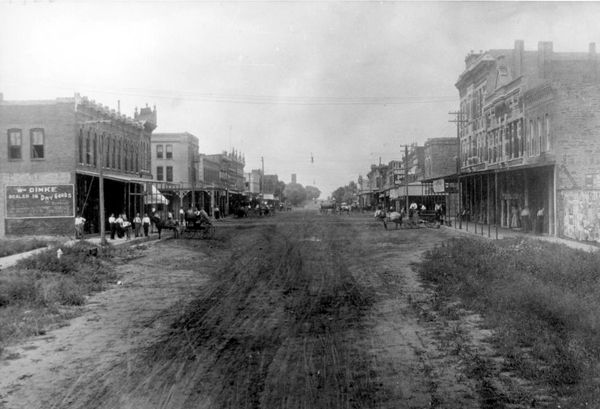
Caldwell, Kansas.
Freeman was in downtown Caldwell when a man named Jones warned Freeman that Smith was walking in his direction with his hand in his pocket. Freeman drew his revolver and held it down by his side in anticipation of Smith’s move. George Freeman noted that, as Smith drew near, the characteristic sound of a derringer being cocked was clearly audible. Smith stopped a few feet from the wary Freeman. After “several moments” that “seem[ed] like hours,” Smith walked into a saloon.
The owner of the saloon had been watching and asked Smith, “Why didn’t you shoot him?” Smith’s reply was that he was afraid that if his derringer’s only shot had misfired or his aim was poor, he would have been a dead man.
Refusing to live with the constant pressure of always being on high alert, Freeman moved with his family to Butler County to be near his father and never again had to contend with Charley Smith. [12]
In the summer of 1874, Charley Smith was part of an organized band of thieves, [13] under the advice and protection of L. B. Hasbrouck, Attorney at Law, which had, for the past two years, stolen horses and mules from farmers and ranchers of Sumner County and surrounding areas. According to the Wellington, Kansas, Sumner County Press of July 30, 1874, despite repeatedly forming vigilance committees that were successful in briefly stopping the thefts, the citizens had to “submit to the depredations of this organized band of thieves” for far too long. Their undoing, and Charley Smith’s death, was prompted by the thefts of mules and horses from Vail and Company, newly named contractors carrying mail between Caldwell, Kansas, and Fort Sill in Indian Territory.
The South Western Stage Company’s mail contract had been terminated by the Postal Service effective July 1, 1874, and awarded to Vail and Company. [14] The thefts were the brainchild of unnamed representatives of the South Western Stage Company, hoping to destroy Vail and regain the mail contract.
On June 29, four mules belonging to Vail and Company and a horse owned by A. E. Fletcher were stolen from Judd Calkins’ livery barn in Caldwell. That same night, three Vail and Co. mules were stolen from their station south of Caldwell. Furthermore, every station along the southern section of the Vail route was targeted for raids. “One-Armed” Charley Smith was sent to steal Vail’s mules at Stinking Creek north of Lawton, I. T. The attempts were “frustrated by the Indians unexpectedly showing their hand.” [15]
William L. (Bill) Brooks, ex-stage driver and ex-marshal of Newton, Kansas, told Burr Mosier, a former employee of the South Western Stage Company, that the gang was paid $600 by that firm, “to prevent Vail and Company from fulfilling their mail contract.” Brooks also stated that Southwestern was to pay the per diem expenses of the gang. B.N. Terrill bragged to Mosier that South Western would again be carrying the mail to Fort Sill. [16]
The downfall of the horse-and-mule thieves’ gang began on July 15, 1874. Sumner County Sheriff John G. Davis was made aware of the hiding place of several members of the gang, where they were holding stolen horses in the Indian Territory, 75 miles southwest of Caldwell, Kansas. Davis formed a small posse and set out on the trail to Caldwell, 25 miles southwest. Spies there informed him that the gang had broken camp and were making their way up the Ellsworth Cattle Trail across Harper County toward Colorado.
Davis and his men started west toward the Ellsworth Trail. On July 16, Davis’s posse was joined by 12 men from ranches on the Chikaskia River, looking for their own stock. [17] The 18 men traveled west until they reached the trail at Devore’s Ranch, twelve miles west of Caldwell. Here, they got information that the thieves had gone up the trail with a wagon and several mules and horses. Knowing now they were on the right track, the posse pushed north, but eight men quit, and the thieves’ trail was lost over the next two days. When the men reached the center of Kingman County, they decided to turn west from the Ellsworth trail and spread out, hoping to find the track of the wagon, horses, and mules. They found a boy from Barber County driving cattle who said he had seen the wagon and livestock and that they had camped the night before on Sand Creek near Sawyer, Kansas. The posse pushed on and found the thieves’ abandoned camp, confirming they were on the right track.
From that point, the posse went in a northwest direction until they came in sight of the Arkansas River twelve miles west of Garfield, Kansas. Here, they found their prey hitching horses to the wagon and then driving away. Davis and two men attacked, but the thieves escaped, leaving their wagon filled with supplies recovered from Pat Hennessey’s plundered supply train when he was killed and burned in Indian Territory, and six mules belonging to Vail and Company. Sheriff Davis and his men arrived back in Wellington on Sunday, July 26, having been gone eleven days and traveling more than three hundred fifty miles.
“Scarcely had Sheriff Davis time to refresh himself after the arduous campaign…before he was ordered to Caldwell, and take into custody several parties who were charged [in connection] with an organized gang of horse thieves and also with being principals and accessories, in the wholesale theft of Vail & Co’s mules.” [18]
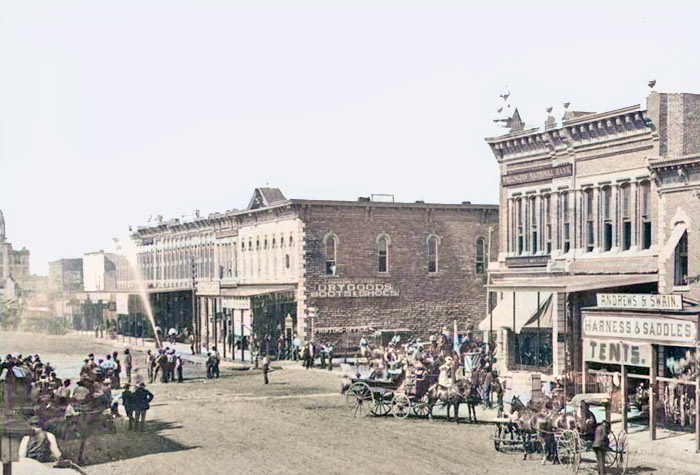
Wellington, Kansas, circa 1885.
On the afternoon of Monday, July 27, Davis left Wellington with a large posse of the most dependable men of the town. His goal this time was the arrest of Attorney L.B. Hasbrouck, Bill Brooks, Charley Smith, A. C. McLean, Dave Terrill, and Judd Calkins.
McLean was arrested at his home one mile south of Caldwell. L.B. Hasbrouck tried to hide in a cornfield near the notorious Last Chance saloon/road Ranch, but was found and taken in. Terrill fled to a dugout three miles from town, where he was captured. Judd Calkins surrendered without a fight, and Bill Brooks barricaded himself inside his home with his wife. He refused to surrender for several hours but was finally convinced to be arrested. Charley Smith had “lit out for the (Indian) Territory.” A posse of 15men rode 25 miles south to a camp where they arrested him while he was gathering wood, and back in Wellington on Tuesday, the 28th.
In Wellington, Terrill was released, McLean was kept under guard, and Calkins was granted $500 bail. Hasbrouck, Brooks, and Charley Smith were locked in the calaboose to await their preliminary examination on Friday morning, July 31, 1874. Given past instances of vigilante justice and the “considerable excitement” that prevailed, the prisoners were closely guarded; however, the night passed uneventfully.
Wednesday morning, warrants were issued for the re-arrest of Terrill and Calkins. The two had fled to Wichita before the warrants could be served, and no further action was taken against them.
When the full moon arose that night, an eerie quiet settled over Wellington. An “ominous tramp, tramp, of marching horsemen broke upon the stillness of the night.” Fifty riders surrounded the jail, dismounted, and disarmed the guards. After obtaining the key to the cells, Hasbrouck, Brooks, and Smith were brought out with their hands tied and ropes around their necks. The vigilante horsemen formed themselves into a hollow square. Men on foot took charge of the prisoners, placed themselves and the three thieves inside the square, and marched to the Slate Creek bridge. The three were hung from the limb of an old elm tree on the bank of the Creek. Thursday morning, the bodies were found dangling from the tree, facing south. From left to right was the lawyer, the ex-marshal, and the son of Governor Thomas Ford. [19] Vigilante justice once again had the desired effect. The Sumner County Press of August 20, 1874, said that “for the first time in three years, the people of Sumner County feel that their property is safe.”
©Roger Myers, for Legends of America, January 2026.
 About the Author: Roger Myers has been writing old west (particularly western Kansas) for the past 27 years. He has had articles published in Wild West (the old), True West, Old West, NOLA, WOLA, WWHA, Journals, Panhandle Plains Historical Review, Oklahombres Journal, and the Kansas Cowboy. I have a book to be published this year (2026) by Arcadia Press, dealing with crime and law enforcement in western Kansas, that is yet untitled. Roger lives with his wife outside Larned, Kansas. Education – Bachelor of Science in Accounting with a minor in History from Northwestern Oklahoma State University. Myers is a retired general manager of an agricultural cooperative.
Also See:
Caldwell, Kansas – The Wicked Border Queen
Sources:
[1] See the Wichita Eagle, June 14 and 21, 1872; Sumner County Press, July 29, 1875, April 6, 1876.
[2] Governor Ford died penniless except for the royalties from a book he wrote on the history of Illinois. Those royalties were divided among his six children.
[3] “United States Census, 1860”, database with images, FamilySearch (https://familysearch.org/ark:/61903/1:1:MX46-RC2 : 13 December 2017), Thos Ford Moore in entry for Thomas C Moore, 1860. He was known as Thomas Ford Moore after his adoption by Thomas C. Moore.
[4] Salina, Kansas, Saline County Journal, January 7, 1875.
[5] As reprinted in the Wellington, Kansas, Sumner County Press, July 29, 1875.
[6] Boyd’s Ranch was a roadhouse for civilians, soldiers, and a rendezvous for horse thieves, providing whiskey, gambling, and prostitutes. The site is on property adjacent to the west of the Larned State Hospital, and three miles west of present Larned, Kansas.
[7] In contrast to the present, at that time, there were virtually no trees, giving Freeman an unobstructed view of the Arkansas River valley.
[8] No record of the capture was reported in the official papers of Fort Larned. Conversation with George Elmore, Chief Ranger and Resource Specialist, Fort Larned National Historic Site, Larned, KS, May 6, 2020. Mr. Elmore has researched this incident, as this author has, and the only detailed source is Freeman’s book.
[9] Journal of the Illinois State Historical Society (1908-1984), July 1910, Vol. 3, No. 2 (July 1910), p. 50. www.archive.org/details/reportofadjutant03illi1/page/412/mode/1up?q=Adjuitant. This is a fabrication and may have been inserted at the behest of the Ford family or their friends to conceal an unflattering family history.
[10] Topeka, Kansas, The Daily Commonwealth, November 21, 1871.
[11] Wellington, Kansas, The Sumner County Press, Feb 26, 1880. Upon Marshall’s death IN 1872, the Leavenworth, Kansas, Daily Commercial headlined the notice of his death, “DEATH OF A DESPERADO,” as well as saying he had been an engineer.
[12] Freeman, George Doud. Midnight and Noonday: The Incidental History of Southern Kansas and the Indian Territory. 1892. https://archive.org/stream/midnightnoondayo00free/midnightnoondayo00free_djvu.txt.
[13] Later writings by T. A. McNeel called the band the “Prairie Riders.” Newspapers of the time never used that phrase.
[14] According to B.N. Terrill, “General Agent” for South Western State Company, Vail and Company had underbid South Western by $15,000.
[15] Sumner County Press, August 6, 1874.
[16] The South Western Stage Company had previously delivered the mail from Wichita and Wellington to Fort Sill on their stagecoaches. Vail and Company were, after July 1874, contracted to deliver the mail in carriages pulled by one horse and make the trip in one day.
[17] The Chikaskia River runs northwest to southeast through Sumner County.
[18] Sumner County Press, July 30, 1874.
[19] Ibid, August 6, 1874.