

Indian Territory Map.
A Battle in the Air
In the country about Tishomingo, Indian Territory (Oklahoma), a battle of unseen men in the air foretells trouble. Whenever the sound of conflict is heard, it indicates that many dead will lie in the fields, for it heralds battle, starvation, or pestilence. The mighty nation that lived here once was annihilated by an opposing tribe, and in the valley, in the western part of the Territory, there are mounds where hundreds of men lie buried. Spirits occupy the valley, and to the eyes of the Indians, they are still seen, at times, continuing the fight.
In May 1892, the last demonstration occurred during the hearing of John Willis, a U.S. Deputy Marshal hunting horse thieves. He was belated one night and entered the vale of mounds, for he had no scruples against sleeping there. He had not, in fact, ever heard that the region was haunted. The snorting of his horse in the middle of the night awoke him, and he sprang to his feet, thinking that savages, outlaws, or at least coyotes had disturbed the animal. Although the moon was good, he saw nothing moving on the plain. Yet the sounds that filled the air were like the noise of an army, only a trifle subdued, as if borne on the passing of wind. The rush of hoofs and feet, the striking of blows, and the fall of bodies could be heard, and for nearly an hour, these fell rumors went across the earth. At last, the horse grew so frantic that Willis saddled him and rode away, and as he reached the edge of the valley, the sounds carried into the distance. Not until he settled did he learn of the spell that rested on the place.
— By Charles M. Skinner in 1896
The Comanche Rider
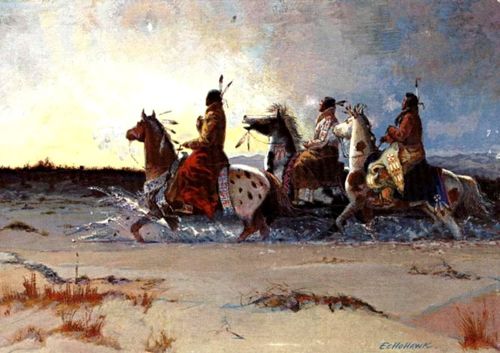
Comanche Indians Painting.
The ways of disposing of the Indian dead are many. In some places, ground sepulture is common; in others, the corpses are placed in trees. South Americans mummified their dead, and cremation was not unknown. Enemies gave no thought to those that they had slain after plucking off their scalps as trophies, though they sometimes added the indignity of mutilation in the killing.
Sachem’s Head, near Guilford, Connecticut, is so named because Uncas cut a Pequot’s head off and placed it in the crotch of an oak that grew there. It remained withering for years. To save Polan’s body from such a fate after the fight on Sebago Lake in 1756, his brothers placed it under the root of a sturdy young beech they had pried out of the ground. They laid him in the hollow in his war dress, with a silver cross on his breast and bow and arrows in his hand; then, with the weight on the trunk released, the sapling sprang back to its place and afterward rose to a commanding height, fittingly marking the Indian’s tomb. Chief Blackbird of the Omaha was buried, per his wish, on the summit of a bluff near the upper Missouri River, on the back of his favorite horse, thoroughly equipped for travel, with the scalps he had taken hung to the bridle.
When a Comanche dies, he is buried on the western side of the camp so that his soul may follow the setting sun into the spirit world the speedier. His bow, arrows, and valuables are interred with him, and his best pony is killed at the grave so that he may appear among his fellows in the happy hunting grounds mounted and equipped. An old Comanche who died near Fort Sill, Oklahoma, had no relatives and was poor, so his tribe thought any horse would do for him to range upon the fields of paradise. They killed a spavined old plug and left him. Two weeks later, the late unlamented galloped into a camp of the Wichita on the back of a lop-eared, bob-tailed, sheep-necked, ring-boned horse with ribs like a grate, and said he wanted his dinner.
Having secured a piece of meat, formally presented to him on the end of a lodge pole, he offered himself to the view of his people, alarming them with his glaring eyes and sunken cheeks, and told them that he had come back to haunt them for a stingy, inconsiderate lot because the gate-keeper of heaven had refused to admit him on so ill-conditioned a mount. The camp broke up in dismay. Wichita and Comanche journeyed, en masse, to Fort Sill for protection. Since then, they have sacrificed the best horses in their possession when an unfriended one journeyed to the spirit world.
— By Charles M. Skinner in 1896
The Legend of the Cherokee Rose (nu na hi du na tlo hi lu i)
“We are now about to take our leave and kind farewell to our native land, the country that the Great Spirit gave our Fathers; we are on the eve of leaving that country that gave us birth…it is with sorrow the white man forces us to quit the scenes of our childhood… we bid farewell to it and all we hold dear.”
— Charles Hicks, Tsalagi (Cherokee) Vice Chief on the Trail of Tears, November 4, 1838
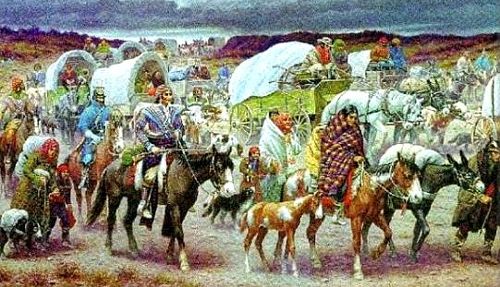
Trail of Tears painting by Robert Lindneux.
More than 175 years ago, gold was discovered in the mountains of North Carolina and Georgia. As thousands of new settlers invaded the area, tensions with the American Indian tribes grew. As a result, President Andrew Jackson established the Indian Removal Policy in 1830, which forced the Cherokee Nation to give up its lands East of the Mississippi River and migrate to Indian Territory.
The forced march, which began in 1838, was called the “Trail of Tears” because over 4,000 of the 15,000 Indians died of hunger, disease, cold, and exhaustion. In the Cherokee language, the event is called Nunna daul Tsuny—”the trail where they cried.”
Along the way, the Cherokee mothers cried, and the elders prayed for a sign to lift their spirits and give them strength. One night along the trail, the old men spent the evening in powerful prayer, asking the Great One to ease their suffering and save the children so they could rebuild the Cherokee Nation.
The Great One responded to the elders by saying, “Yes, I have seen the sorrows of the women, and I can help them keep their strength to help the children. Tell the women in the morning to look back where their tears have fallen to the ground. I will cause a plant to grow quickly, which will grow up and up and fall back down to touch the ground, where another stem will begin to grow.
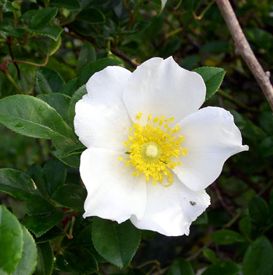
Cherokee Rose.
The next day, when the Cherokee continued their journey, the elders advised the mothers to look behind them. In each place where the mothers’ tears fell, a beautiful white rose began to grow. As the women watched the blossoms form, they stopped crying and felt strong. By the afternoon, they saw many white blossoms as far as they could see.
Its rose-gold center represents the gold taken from Cherokee lands, and its seven leaves on each stem signify the seven Cherokee clans. Today, the wild Cherokee Rose can be found throughout the Trail of Tears from North Carolina to Oklahoma.
©Kathy Alexander/Legends of America, updated September 2026.
Also See:
Native American Legends & Tales
Native American Photo Galleries
Native American Quotes – Great Words From Great Americans
See Sources.