
By Gary Speer.
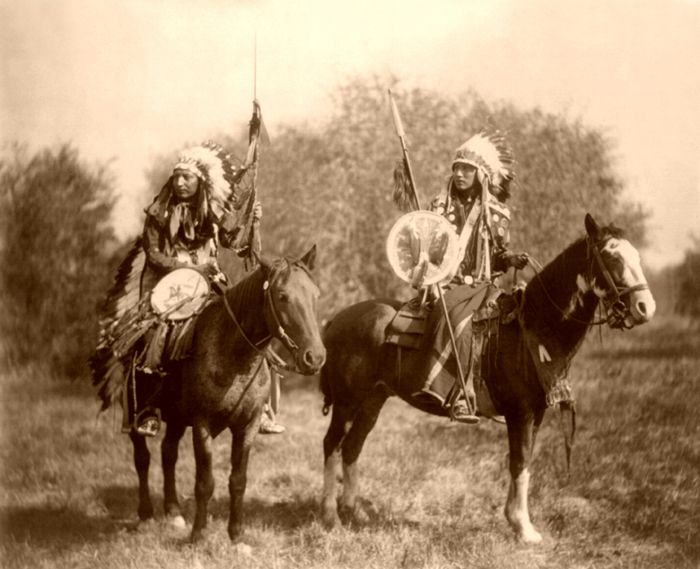
Sioux Indians on Horseback, by Heyn, 1899.
One of the earliest documented disease pandemics in the history of the American West occurred when Anglo-European settlers moving westward during the 1830s and 1840s brought diseases to Native American tribes of the Great Plains.
From the earliest contacts, cultural differences and battles over land use and ownership emerged between European settlers and Native Americans as explorers, pioneers, and settlers expanded westward across the continent. But the first documented evidence of the devastation smallpox would have on tribal groups in this region dates back to the 1830s and 1840s.
Historian Paul H. Carlson, in his textbook The Plains Indians, said this smallpox outbreak was traced to contact between deckhands on an American Fur Company steamboat moving up the Missouri River and members of several tribal groups living along that river, a significant early trade and emigration route into the Plains and Upper Midwest.
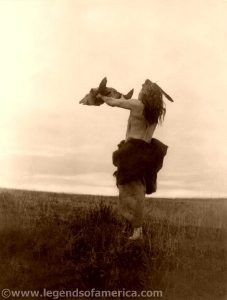
Mandan offering the buffalo skull.
By 1837, Carlson said, thousands of Arikara, Mandan, and Hidatsa people had died. He suggested that as many as half of the Arikara and Hidatsa population of 4,500 died in this 1837 outbreak. In addition, he estimated this smallpox outbreak killed “virtually all” of the 1,600 Mandan living in the Upper Missouri River region.
Diseases that came from Europeans and wiped out villages and large numbers of Native Americans were nothing new elsewhere in America, even as early as the 1830s. Some historians suspect, in fact, that some of the early Puritans’ stories of mysterious, empty villages with full food stores, which they encountered upon landing in New England, reflected smallpox and other disease epidemics that preceded the Puritans. These historians theorize that the villages were probably empty because Native people had been exposed to various European diseases from fishermen and others who came before the recorded visits of English settlers. The villages may have been empty because Native American villagers saw the Europeans coming and fled the risk of disease. (Historians know from fragmentary accounts and sketchy maps that Portuguese explorers and fishermen were in North American waters decades before Plymouth Colony.)
Perhaps the credit more pious Puritan writers gave to God for miraculously providing them with food and shelter was due to far grimmer circumstances, such as sickness and disease that killed or drove away the Indians of New England.
Later on in the history of the settlement of the Old West, during the years known to many historians as “the Indian Wars,” accounts reveal some of the more horrible, dark side of European contact with Native Americans — cases when white people intentionally infected Indian villages with smallpox and other diseases by means of abandoned blankets and clothing. Those were dark times filled with dark deeds by Europeans and Native Americans alike.
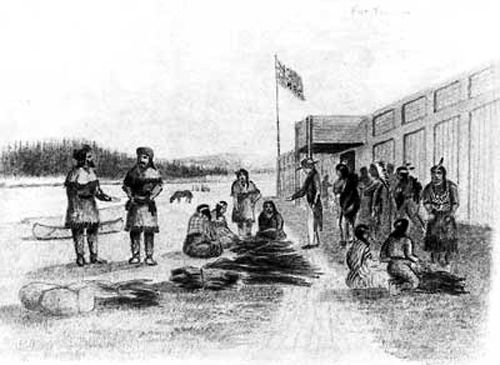
Trading with the American Fur Company.
But one of the earliest traceable outbreaks of smallpox among the Plains Indian tribal groups came from the American Fur Company boat venturing up the Missouri River in the mid-1830s.
©Gary Speer, 2010, updated October 2026.
About the Author: Gary Speer is a longtime writer and former newspaper copy editor who focuses on writing tips, Internet marketing, blogging, and a variety of topics related to outdoor living, collecting, and lots of fun things! Gary offers writing tips on his blog and runs several affiliate marketing websites. You can learn more about the disease of the Great Plains Indian groups’ battles with deadly diseases on Gary’s website, Life in the Old West.
Also See: