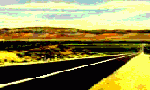
Conway, Texas 1909.
Sixteen miles West of Groom, Texas, is the ghost town of Conway. The last town on the Mother Road before reaching Amarillo, Conway began as a very small sheep and ranching community in the late 1800s. In 1892, the Lone Star School, said to be the first rural school that endured in the Panhandle, was established for the children of area ranchers and homesteaders.
The settlement changed and grew when the Chicago, Rock Island and Gulf Railroad’s Choctaw Route came through in 1903. The same year, a post office was established, and the town was named for former Carson County Commissioner H.B. Conway. Brothers Delzell and P.H. Fisherin platted the town in 1905, and one of its first businesses was a store run by Edward S. Carr, where the post office moved in 1907. A railroad depot, a grocery store, and a blacksmith shop soon followed, and a steam-powered threshing machine served area wheat farmers. The community built an interdenominational church in 1912.
During the 1920s, agriculture in the Texas Panhandle boomed, and the oil industry boosted the local economy. That same decade, Conway formed a community club and began an annual community fair. In 1925, Conway’s population was just 25 residents.

Route 66 West of Conway, Texas, today
In 1926, Route 66 was designated through the Texas Panhandle, but the route remained in dispute in Carson and Potter Counties East of Amarillo. It wasn’t finalized until August 1930, when the Amarillo Daily News declared the “U.S. 66 Highway Tangle Solved.” Federal officials then approved the highway between the town of Conway and the Potter County line along a route North of the Chicago, Rock Island & Pacific Railroad. Residents were jubilant over the announcement, as the dispute over its location had delayed paving a ten-mile section of the roadbed. Before the end of 1930, it had been paved and was opened to Amarillo.
After Route 66 was completed through the area, Conway soon added services for travelers, including tourist courts, restaurants, and service stations. In 1930, the town built a new brick school, and by 1939, Conway had grown to about 125 people.

The old 1930 school in Conway, Texas, is boarded up today, Kathy Alexander.
Just over a decade after the school was built, the district consolidated in 1943, and students were bussed to Panhandle, about 9.5 miles North. The school building then became a community center.
But the small town was doomed when I-40 replaced Route 66 around 1965, bypassing the town by 1.3 miles.
In 1967, the Crutchfield family opened a roadside service station, a curio shop called the Longhorn Ranch, and an attraction called the Rattlesnake Ranch to draw people in from the new highway. It was located just off the interstate, at Exit 96 near Texas Highway 207. The timing must have looked good because Conway’s population peaked in 1969 at 175 people.
But after the town was bypassed, people moved away, and businesses failed. In 1970, the town reported a population of just 50 people. However, it still supported two grain elevators, four service stations, three cafes, and a general store. Conway’s post office closed its doors forever in 1976, and the railroad terminated its operations in 1980. By 2000, Conway’s population had dropped to just 20 people.

Old service station on the original portion of Route 66 in Conway, Texas, by Kathy Alexander, 2018.
In 2002, a Love’s Travel Stop truck stop was established at the same exit on the North side of the highway, drawing people away from Crutchfield’s station. To combat this, the family created another roadside attraction to lure customers: the VW Bug Ranch. As a parody of the Cadillac Ranch on Amarillo’s west side, five Volkswagen Beetles were buried nose down in the ground, and signs announced the “Bug Ranch.” They soon received some publicity and drew in more visitors. But it wouldn’t be enough. In 2003, the Rattlesnake Ranch, the curio shop, and the gas station were closed, and the Crutchfields moved away.

Longhorn Trading Post, Conway, Texas, Kathy Alexander, 2004.

Longhorn Trading Post in Conway, Texas, by Kathy Alexander, 2018.

Conway, Texas Bug Ranch, by Kathy Alexander.
Soon, the brightly painted yellow “bugs” were sprayed with graffiti, like their counterparts at Cadillac Ranch. Twenty years after the Rattlesnake Ranch and curio shop closed, they removed the cars. Still, in 2024, the Big Texan in Amarillo purchased the original VW Beetles to preserve this Route 66 icon, and in June 2024, the Bug Ranch reopened in Amarillo in front of the Big Texan RV Ranch at 1415 Sunrise Dr.
Today, Conway’s old school is boarded up, with no sign that a church ever existed; the Crutchfield’s Longhorn Ranch and service station are vandalized and in ruins, and former buildings now lie on the ground. The tiny town is home to just a handful of people. However, two motels still operate at the Conway exit: the Executive Inn at 9680 Interstate 40 Frontage Road and, just East, the Conway Inn at 9696 Interstate 40. Both have restaurant buildings, but neither appeared to be open during our last time through in 2018.
To continue the Route 66 journey, return South to the intersection of Texas Highway 207 and FM 2161 at the grain elevators in the old part of Conway, South of I-40, and turn West. This stretch of pavement, which runs for 7.2 miles before rejoining I-40, was listed on the National Register of Historic Places in 2007 because it is the longest and best-preserved section of Route 66 in Texas. Though local traffic still uses the road, the abandoned railroad bed, the lack of modern buildings, the open rangeland, and the sheer quiet capture the feel of old Route 66 like few other places. Even the couple of concrete grain elevators along the route date to 1914.
After traversing this old stretch of pavement, continue your Route 66 tour by joining I-40 and heading West to Business I-40, then northwest to Business I-40/US 60 as it turns Southwest and merges with Amarillo Boulevard. On US Highway 60, you’ll pass by the old Amarillo Air Force Base property, now occupied by Amarillo College, through which the old pavement once traversed. You’ll also pass by the old English Field, Amarillo’s first airport.

Conway, Texas Service Station, Kathy Weiser-Alexander, 2004.

Conway, Texas Service Station, Kathy Weiser-Alexander, 2018.
©Kathy Alexander/Legends of America, updated October 2026.

Old car in Conway, Texas, Kathy Alexander.

Old car in Conway, Texas by Dave Alexander, 2018.
Also See:
About Texas Route 66 – Info & History
Sources:
Handbook of Texas
National Register of Historic Places Nomination