
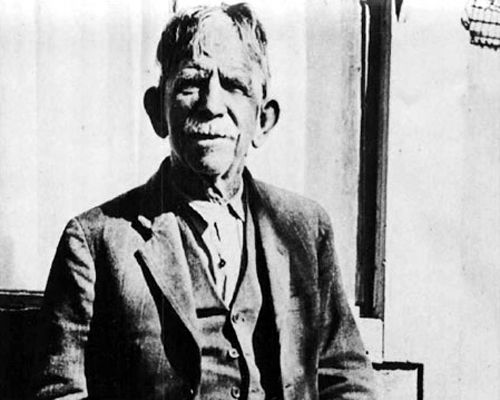
Frank “Shorty” Harris.
After finding free gold on a ledge while making their way to Ballarat, two of Death Valley’s most noted mining personalities—Pete Aguereberry and Shorty Harris —founded Harrisburg, California.
Aguereberry, who had almost died making his way to Death Valley, had been saved by Oscar Denton and recuperated at Furnace Creek Ranch in June 1905. There, he met Shorty Harris, and the two men decided to head into the Panamint Mountains together and do some prospecting. However, Shorty was more interested in getting to the 4th of July celebration at Ballarat. After negotiating the old “dry trail” through Blackwater Wash, they arrived on the open plateau known as Harrisburg Flats, about nine miles northeast of Wildrose Spring.
Shorty, being on horseback and driving his mules harder, was some distance ahead of Aguereberry, who at this point saw a promising-looking ledge on the North side of a long, low hill.
Chipping off a piece, he found it contained free gold and, hurriedly catching up with Harris, Pete showed him the ore sample, and the two excitedly planned to continue to Wildrose Spring to replenish their water, then return and stake out claims. During further prospecting and exploratory work, the two divided up the outcroppings, Aguereberry staking claims on the North side of the hill, which later became known as “Providence Ridge” or “Providence Hill,” including the Eureka Nos. 1-4, while Shorty took claims on the South side, which later became part of the Providence Group. These finds were located at the extreme northeast end of an east-west ridge about 200 feet from the mesa. The camp was initially named Harrisberry, hoping a strong association with Shorty Harris would attract prospective investors.
The pair then split up, both eventually heading for Ballarat, where Shorty spread the word of his new find, and Pete picked up a grubstake. Within a few days of Aguereberry returning to his hill, the rush was on, with gold-seekers from Ballarat swarming the strike area and forcing Aguereberry to reestablish his claim by persuasion and force. Harris’ version of the story differs slightly, suggesting he found the first evidence of riches and was forced to share the discovery with Pete. According to one newspaper, “Pete and Shorty have not flipped coins to determine who is actually responsible for the strike, but the credit is generally given to Shorty, perhaps from previous achievements.” The facts may never be known, but it happened; another Death Valley boom camp had been born.
By August 1905, at least 20 parties were locating claims in the surrounding hills within a three-mile radius of the original discovery. About 50 locations were made almost immediately. The new area was included in the Wild Rose Mining District. Samples from the immense quartz ledge, which, it would turn out, stretched North to the future Skidoo and Emigrant Springs mining areas, assayed from $90 to $200 per ton in free-milling gold, with some rumored to have values as high as $500.
Before long, reports said 300 people were living in the new camp, which was already organizing a townsite company. This was somewhat depopulating Ballarat and Darwin, California, and attracting many from Rhyolite, Nevada. By September, 200 claims had been recorded in the area, and the camp’s population was expected to triple as the weather cooled.
The intense involvement of “outsiders” in the Harrisberry discoveries, and their desire to get in on the ground floor, manifested in the immediate bonding of Shorty Harris’ strikes to several millionaires from Tonopah, Nevada, and of Aguereberry’s claims to Goldfield, Nevada capitalists. A few days earlier, Harris had gone to San Francisco, where he persuaded some investors to visit his property in anticipation of financing development work. This visit led to the formation of the Cashier Mining Company, headed by O.L. Ingalls.
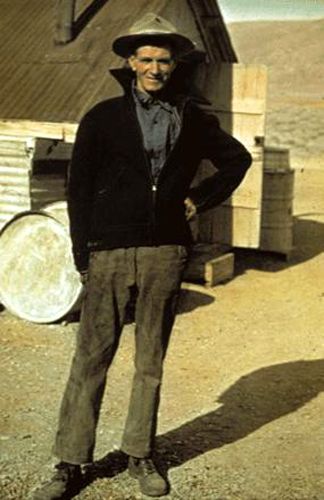
Pete Aguereberry.
Shorty Harris continued to extol the virtues of “his” town in the Panamints whenever he journeyed to Rhyolite or other nearby camps. Along the way, as he told and retold his story, he changed the name from Harrisberry to Harrisburg, and the name stuck.
The survey of the Harrisburg townsite and the Cashier Gold Mining Company’s claims was undertaken by J.H. Wilson of Cripple Creek, Colorado, who had been an engineer in Goldfield, Nevada. He established residence in the area and opened an engineering office (touted as the first such business in the Panamint Range). A William O’Brien of Bullfrog, Nevada, was put in charge of the six men at work, sinking three shafts on the property and a tunnel at the foot of the hill to hit the vein as low as possible.
By late October, the land had been surveyed for a townsite, and tents were constantly springing up in the business section. The Cashier Gold Mining Company now kept 23 men busy at $3.50 a day, around the clock. Twenty-seven tons of high-grade ore had already been mined for shipment to Keeler.
The vast number of prospectors swarming the hills created a shortage of fresh food, which sold for exorbitant prices. Rumors persisted that a deal pending in Goldfield, either for the Eureka or the Cashier Group, would be for $160,000. In February, it was reported that owners of the Eureka Group had sold a half interest in the property to San Francisco investors who paid $15,000 down and intended to build a mill.
In December 1905, a big strike was made on the six claims of the Exjunction Group about two miles northeast of Harris’ Providence claims. Quartz averaging $259 in gold, silver, copper, and lead was being exposed. Stretching for five miles along this same ledge were 40 other claims. By this time, about 40 men were working in and near the camp.
By spring and summer of the following year, discoveries hastening the advent of Skidoo were being made about two miles from Emigrant Springs, attracting miners from throughout the region. The Panamints were rapidly filling up, despite continuing transportation problems.
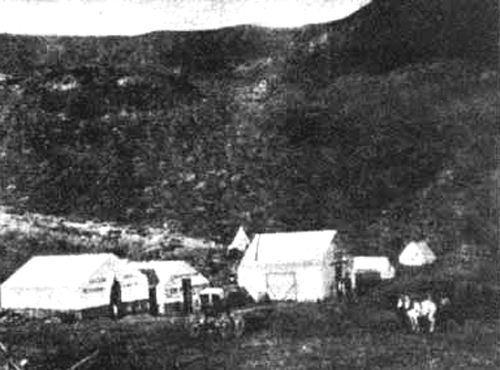
Emigrant Springs, 1907.
By April 1906, the Wild Rose Mining Company had been incorporated, including the Exjunction gold, silver, copper, and lead claim. The following month, Shorty Harris boasted that 20 tents were in residence and that he planned to sink for water soon, negating the need to haul this precious commodity from Emigrant Springs.
Not putting all his marbles in one bag, however, he also located two groups of claims near the Emigrant Springs Gold Eagle strike. The Cashier Mining Company was still thriving with the Providence claim, which seemed to harbor steady reserves. T. E. Crawford of Helena, Montana, purchased the Ingalls’ interest in the company in the fall of 1906, making him co-partner with Shorty Harris. These two planned to employ 15 men to sink a new shaft immediately. Crawford was also planning to install a five-stamp mill on the property to draw water from the Skidoo pipeline to Telescope Peak.
By November, the Emigrant Springs area was fairly bursting with mining activity. Reputedly, 150 miners were in the area, a third of whom were working at the Skidoo Mine and on the projected Telescope Peak pipeline. The new townsite was filling up rapidly. Owners of the Denver and Tramps properties in Rhyolite were still negotiating the purchase of some Harrisburg property for a reputed $160,000.
Meanwhile, the Cashier property was still under active development. The company was planning a mill, and in connection with that project, they were contemplating using the pipeline from Telescope Peak to provide the water supply. The Eureka Mine was still showing rich ledges, and ten tons of high-grade ore were ready for shipment, averaging $150 a ton. A notice appears at this time of some litigation between Shorty Harris and Crawford, owners of the Cashier, and J.P. Aguereberry and F. Flytin, representing the Panamint Midas property, over the Eureka Claim, with two of the properties finally being consolidated. Meanwhile, a man named W.B. Gray was steadily developing the Wild Rose Mining Company’s property two miles from Harrisburg.
Because conditions at the Cashier Mine seemed so promising, entrepreneur George Brown moved his rooming house and restaurant from Emigrant Springs to Harrisburg to accommodate the growing population. The only other storekeeper in the area whose name is known is Sam Adams, who ran a general store and saloon in a large tent with supplies from Ballarat. He supposedly cleared a profit of $6,000 on the saloon in his first six months there.
By March 1909, the Harrisburg Mill was on its way from San Francisco, and over 100 tons of ore were waiting on the dump. Part of the delay in acquiring the mill stemmed from a dispute over Pete Aguereberry’s claim to the adjoining Eureka Mine. Pete and his original grubstakers, Flynn and Kavanagh, had initially divided ownership of this property. When the three decided to sell as soon as possible, Flynn took charge of the sale. As a result of his dealings with dishonest mining promoters, they—a Captain Fleece (appropriately named), his brother, and two other partners—acquired a 1/3 interest in the Eureka property but failed to come through with their promised down payment. When, in November 1906, a bona fide investor from Rhyolite named Sherwood Aldrich examined the claims, he became quite excited and offered to buy them for $180,000 cash if a clear title could be produced.
This proved impossible, for Fleece and his associates blocked the sale by tying up the property in litigation so thoroughly that the future seemed bleak for anyone but Fleece, who had, of course, offered to buy the other two interests at a ridiculously low price. Flynn and Kavanagh became so fed up with the whole situation. Discouraged by their inability to resolve it, they drew up papers relinquishing all their interest in the claims to Aguereberry. As a result, the Eureka property lay idle while the Cashier Mining Company produced rich dividends from Shorty Harris’ original claims. Luckily for Aguereberry, he still had thirty or more properties in the surrounding area that he could sell or lease, so he survived the period. Despite several trips to Los Angeles, during which he tried to reach an agreement with Fleece about starting operations on the Eureka, he made no headway. It was not until the financial panic of 1907 hit that a way out for Pete seemed to offer itself.

Cashier Mill and Pete Aguereberry, 1916.
After having kept up the assessment work on the mine for three years, Aguereberry let it lapse when Fleece and his brother discontinued their mining operations at Skidoo and left that part of the country. Aguereberry arranged with a friend to relocate the claims and then sell them back to him, thus establishing himself as sole owner by the spring of 1909. He immediately commenced driving a tunnel to pursue the gold vein and continued working the mine for the rest of his days.
To pass the time until the Cashier Company mill was finally installed, its employees were kept busy blocking out ore and constructing a seven-mile pipeline for the mill’s operation. Although little more could be done on the Harris property until the mill was done, Aguereberry was by now steadily developing the Eureka Claim and drawing out large quantities of ore for shipment to the Skidoo mill for processing.
The Cashier Mill was almost finished by mid-July, with production expected to begin almost immediately. By early August, the Cashier Mine sent out the first shipment of gold bullion. After about two weeks of operation, the mill had yielded around $2,000. By September, the plant was judged so successful that the company intended to install five additional 1,000-pound stamps within the next month, increasing daily output from the current six tons to about 20.
In February 1911, Sam Godby of Pioche, Nevada, acquired a controlling interest in the Cashier Group and discovered more ore, extending the mine. At that time, a ten-stamp mill was put into operation. Soon after, the mine was sold to W.C. Price, who expanded and developed it further. By December, it was reported that the Cashier Mine was producing so well that a mill was imperative. It is unclear what happened to the earlier one or whether it was just insufficient for the workload.
In the summer of 1913, six leasers were reported to be working at Harrisburg and Skidoo in addition to Aguereberry, who had mined ten carloads of high-grade ore for shipment. By 1916, the Cashier Mine was said to have produced 15,000 tons of ore, averaging $20 per ton.
For the next several years, both the Aguereberry’s Eureka Mine and the Cashier Mine, still owned by the Cashier Mining Company of Los Angeles, were active, but both were idle in 1926. By 1938, Pete Aguereberry owned both mines, which were referred to as the Harrisburg Mine. After he died in 1945, the property passed to his heirs, and by 1960, some of the land was used as a weekend retreat.
Today, Harrisburg is no longer a town, as it was mainly a tent city. However, Aguereberry’s old mining camp still features a few buildings, the ruins of the Cashier Mill still stand, and mining remains dot the area. Harrisburg is located about 1-3/4 miles East of the Emigrant Canyon Road to Aguereberry Point.

Cashier Mill.
Compiled and edited by Kathy Alexander/Legends of America, updated September 2026.
Also See:
Pete Aguereberry – Mining Death Valley for 40 Years
Frank “Shorty” Harris – Single Blanket Jackass Prospector
Source:
Greene, Linda W., and Latschar, John A.; Death Valley Historic Resource Study; National Park Service, 1979