
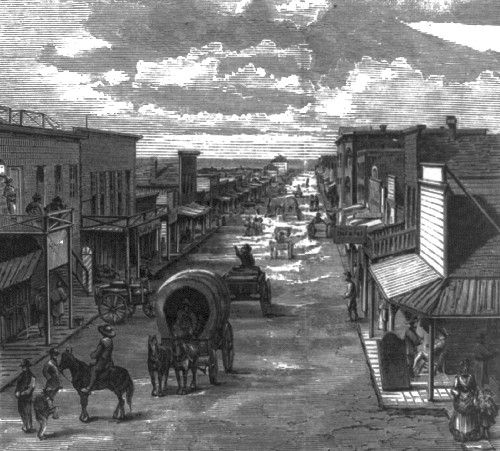
Wichita, Kansas, 1874.
Camp Beecher, Kansas, was established on May 11, 1868, at the junction of the Big and Little Arkansas Rivers, on the site of present-day Wichita, to protect settlers from Indian attacks, particularly those by the Cheyenne, who had been raiding eastern Kansas. The camp was one of many forts built in Kansas to safeguard settlers from Indian raids. Its primary purpose was to serve as headquarters for a border cavalry patrol that extended northward to Marion, Kansas.
This rough frontier outpost stood guard at a crossroads where hunters, traders, settlers, and Native American tribes met.
Its objective was to provide military protection for settlers in the area during a time of increasing tension and conflicts between the Indians and incoming settlers. Using earth and cottonwood logs, the soldiers constructed essential structures, including a kitchen where daily meals were prepared.
The flagpole made from two bound cottonwood trees flew high — a beacon of perseverance against bitter winters and uncertain futures, a steady reminder of the courage of our early pioneers in the face of hardships.
The matter of sending troops had been under consideration, as noted by a letter written by Governor Samuel J. Crawford to General Philip H. Sheridan, previous to April 14, 1868. On that date, General Philip Sheridan posted the following letter to the governor:
“I am in receipt of your letter in reference to the establishment of a military post at the mouth of the Little Arkansas River, to protect the settlers in the county of Sedgwick. I had already ordered an examination of this point, intending to send a small military force there, and the place will be occupied by at least one company by May 1.”
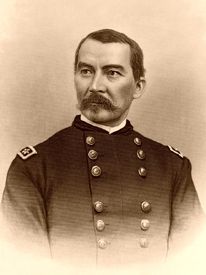
General Philip H. Sheridan.
Though treaties had been made with several Indian tribes, many young men and warriors opposed the agreements and claimed they had been procured by personal bribes offered to the unworthy chiefs who had signed them. Furthermore, some Indian chiefs who sought to confer with General Philip H. Sheridan said they had been deceived into signing the treaty and had never understood its stipulations.
In the meantime, Indians had been collecting about Fort Dodge and Fort Larned, from which it was expected they would proceed during the summer to their reservations in Indian Territory (Oklahoma). Still, as the season advanced, it became evident that they had no intention of complying with the treaty and were only awaiting a favorable opportunity for an outbreak. The Indians to whom General Sheridan was opposed had a force of about 6,000 warriors and had at their disposal a country extending from the Platte River in Nebraska to the Red River in Indian Territory. There were large herds of ponies to mount the warriors and transport the women and children, with their tepees and other property, and, through traders and the bounty of the government, they were well provided with arms and ammunition. General Sheridan determined to confine operations during the grazing and hunting season to protecting the people of the new settlements and those on the overland routes, and to begin an active campaign after winter set in. Then the Indians would be settled in their villages, their horses would be weak and thin from lack of grazing, and there would be little game to be had. Headquarters was established at Fort Hays, then on the extreme western line of settlement and the terminus of the Pacific railroad.
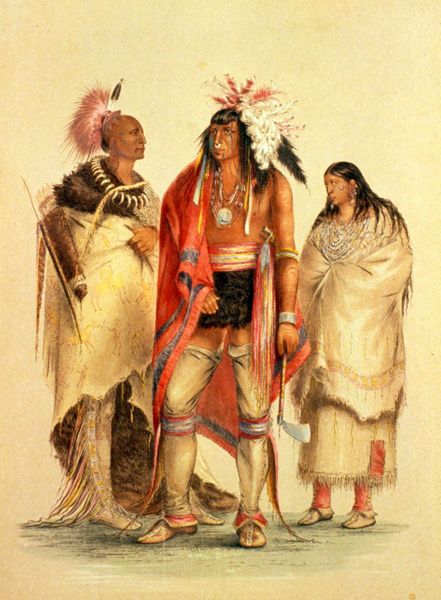
Osage Indians by George Catlin.
The necessity for establishing the camp here at this time became evident after Osage Indians massacred two men in Butler County on the Big Walnut River on the eventing of May 17, 1868. That day, Sam T. Dunn and James Anderson, living on what is known as the Government Strip, were examining a cornerstone near their residence when 14 Indian warriors suddenly surrounded them. Sam Dunn was instantly killed, and James Anderson was first disabled by a tomahawk and then shot. Afterward, their heads were cut off and scalped, and the fingers were also cut off from one of the bodies and taken away.
After the massacre, the warriors let down the fence to an 80-acre field nearby, drove off two mules, and chased a horse to within 150 yards of the house. A party of white men followed them for about 25 miles, far enough to convince them that they were Osage Indians.
The commissioners immediately called the chiefs in council and peremptorily demanded the surrender of the guilty parties. The next morning, after two hours parleying, the moaning of the Indian women, the intense excitement on the part of the warriors and braves, they gave up two young men, who the commissioners brought to Ottawa, Kansas, where they were turned over to U.S. Marshal Whiting to be tried for the crime charged.
The post was initially called Camp Butterfield and was commanded by Captain Samuel L. Barr of the Fifth U.S. Infantry, who served from May 11, 1868, to June 10, 1868.
The soldiers came to the Camp in May 1868 and left in June 1869. General John Schofield ordered them, the commanding officer of the Department of the Missouri, to move northward towards the big bend of the Smoky Hill River, scouring the country between the Arkansas and Smoky Hill Rivers. If no Indians were discovered, they were to go to Fort Harker. Evidently, no Indians were found, as they soon arrived at Fort Harker.
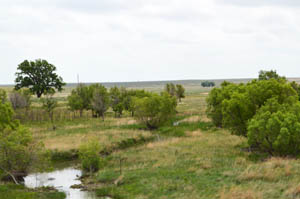
Smoky Hill River in western Kansas by Kathy Alexander.
The post’s name was changed to Camp Davidson in June 1868, with Captain Robert M. West of the Seventh U.S. cavalry taking charge from June 11, 1868, to September 1868.
On October 19, 1868, it was renamed Camp Beecher in honor of First Lieutenant Frederick H. Beecher, a hero of the Battle of the Arickaree. He was followed by First Lieutenant George McDermott, Fifth U.S. Infantry, April 22, 1869, and by Captain Owen Hale, of the Seventh Cavalry, who took charge of the camp on May 20, 1869.
To guard the lines of the Union Pacific Railroad, General Sheridan had only a force of about 1,200 cavalry and 1,400 infantry, he said in his report to the Secretary of War, for 1868-1869. There were in the territory to protect Forts Harker, Hays, Wallace, Larned, Dodge, Lyon, and Reynolds, and the outposts of Cedar Point, Zarah, and Camp Beecher. General Sheridan’s total of 2,600 men was in sharp contrast to the Indians’ 6,000 warriors.
Captain Samuel L. Barr again resumed command from September 1868 to April 1869.
No record has been found of any major engagements that occurred at Camp Beecher.
Camp Beecher was abandoned as a military camp in October 1869.
Also See:
Sources:
Blackmar, Frank W.; Kansas: A Cyclopedia of State History, Vol I; Standard Publishing Company, Chicago, IL 1912.
Kansas State Historical Society
Wichita Old Cowtown Museum