

Battle of Yellow House Canyon, Texas.
The Buffalo Hunters’ War, or the Staked Plains War, occurred in 1877 on the High Plains of Texas, between the United States and Native Americans.
In December 1876, a group of Quahadi Comanche led by Chief Black Horse obtained a permit from the reservation agent at Fort Sill, Oklahoma, to hunt in Texas. Soon, Black Hawk led a group of 170 Comanche warriors and their families, left their reservation, and traveled to the Texas Panhandle. They sought to continue their traditional way of life, including hunting buffalo, which often brought them into conflict with buffalo hunters.

Buffalo Hunters.
Black Horse had been angered by the rapid decimation of the buffalo herds and planned to camp in Yellow House Canyon and attack every buffalo hunter he saw. Earlier in the winter, a buffalo hunter named Marshall Sewell, accompanied by skinners Alexander Gilbert, Louis Keyes, and Joe Jackson, established a camp below the Caprock near the head of the Salt Fork of the Brazos River in western Garza County. On the morning of February 1, 1877, Sewell spotted a buffalo herd, left camp, set up a station, and, with his Sharps rifle, killed the animals one by one until he ran out of ammunition.
Watching the slaughter, Black Horse and his warriors surrounded Sewell on his way to camp. They tortured and double-scalped him before cutting open his stomach and placing pieces of his rifle tripod in the wounds. The action was witnessed by the three skinners who had accompanied Sewell and by another hunter named Billy Devons. They hurried to Rath City, the nearest settlement of any size, to report the murder.
Popular among buffalo hunters, the reaction to Sewell’s death came quickly when a group of 46 American militiamen set out from Rath City on March 4, 1877, with the express purpose of finding Chief Black Horse and his men. Jim White was elected captain, Jim Smith and Hank Campbell lieutenants, and “Smokey” Thompson wagon master. A former Comanchero from New Mexico named José, who had scouted for Colonel Ranald S. Mackenzie, served as guide. Twenty-six of the men rode horses; the others came by wagon.
The band found the site where Sewell had been captured and buried the hunter, after which they picked up the Comanche’s trail. They followed it westward to just northwest of present-day Post, Texas, where the guide predicted that Black Horse and his Comanche would be found in Yellow House Canyon.
The Texans arrived at the canyon fork, now part of the Mackenzie State Recreation Area, in the early hours of March 18. As they moved westward, they discovered a joint camp of Comanche and Apache at what is now marked by Lubbock Lake. By this time, much of the day had passed, but the buffalo hunters decided to launch an attack. They divided into three groups: two mounted and one on foot. The mounted men positioned themselves on the sides of the canyon while the foot soldiers followed the creek in the center.
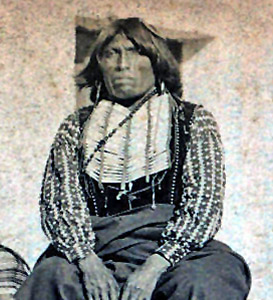
Comanche Chief Black Horse.
When they got within shooting distance, a charge was ordered. Initially, this frightened the natives, prompting them to rush towards their horses. However, upon realizing how small the attacking force was, they regrouped. Women ran toward the horsemen, firing pistols, while the warriors took up defensive positions. Ultimately, the outnumbered Texans had no choice but to withdraw down the canyon.
A man named Joe Jackson was shot in the abdomen and later died, rendering him one of 12 fatalities on the Texans’ side. Several others, including the guide, were wounded, as were a number of natives. Herman Lehmann, a white captive, was shot in the thigh and taken by the Indians. The hunters’ casualties were four wounded and one who later died from wounds.
The Comanche then set a grass fire to use it as a smoke screen. At mid-afternoon, the hunters set out towards Buffalo Springs. The natives trailed them briefly before breaking off. They finally returned to Rath City on March 27.
In the meantime, Chief Black Horse and about 170 warriors continued to plunder hide camps, including those of Pat Garrett and Willis S. Glenn. The affair caused great consternation among buffalo hunters, and they demanded that action be taken.
Although the Battle of Yellow House Canyon was a failure, it marked the beginning of the war’s end. Word of the fight soon reached Fort Griffin, Texas, and Captain P.L. Lee responded by going after the Indians with 72 soldiers of the 10th Cavalry. At Lubbock Lake, they turned north and, on May 4, overtook the natives at Quemado Lake in Cochran County. A brief skirmish erupted, in which two natives were killed. As a result, the remaining natives surrendered and returned to Fort Sill, Oklahoma.
By the winter of 1878–1879, the main herd of buffalo on the South Plains had been destroyed, bringing an end to organized buffalo hunting.
The battle site is located in the Canyon Lake Project in Lubbock. Monuments mark several sites in the area associated with the battle.

Yellow House Canyon near Lubbock, Texas, courtesy of Wikipedia.
©Kathy Alexander/Legends of America, February 2026.
Also See:
Sources:
Facebook
Texas State Historical Association
Wikipedia – Battle of Yellow Horse Canyon
Wikipedia – Buffalo Hunters War