
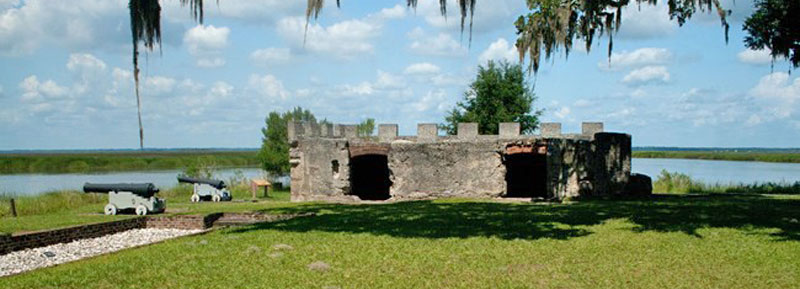
Fort Frederica, Florida Magazine by the National Park Service.
James Oglethorpe built Fort Frederica for the British during the Anglo-Spanish conflict for control of what is now Georgia. Named for Frederick, Prince of Wales (1707-1751), the town housed a civilian community and British troops between 1736 and 1763. Though a 1758 fire destroyed most of the town, it had been a lively commercial center and military post at the edge of British claims to land adjacent to Spanish territory.
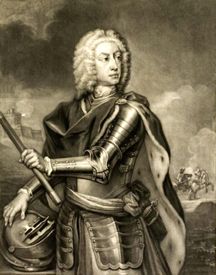
James Oglethorpe
Fort Frederica did more than advance British military interests, however. Under the leadership of founder James Oglethorpe, the settlement furthered a social agenda advocating penal reform and the abolition of slavery. Today, the artifacts and ruins at Fort Frederica National Monument are reminders of this community’s idealism and the Anglo-Spanish struggle for control in the New World.
The settlement at Fort Frederica was one of several in the colony of Georgia, headed by James Oglethorpe. At Fort Frederica, Oglethorpe envisioned a place of employment for people trapped in British debtors’ prisons. Fort Frederica was to be a community of the “worthy poor” who would tend their land, using what they produced to support themselves. The emphasis on enabling the poor to support themselves was in response to the mass of landless poor who were ill-served by the British system of marginalization or imprisonment. Oglethorpe also welcomed religious reformers, accepting Protestants fleeing Germany and the Methodists John and Charles Wesley. Oglethorpe was also careful to ensure that the town had people of diverse occupations. In a small British colonial community, the town at Fort Frederica housed several artisans who practiced specialized crafts to meet the colonists’ needs. In addition to housing skilled laborers and farmers, the fort served as a defensive structure, and an active garrison of British troops was stationed there.
The location of Fort Frederica, in what is today southeastern Georgia, was essential to both the British and the Spanish. Great Britain had established 12 other colonies further north and had made definite claims on land as far north as Maine. To the south, the Spanish sought control over the territory between St. Augustine, Florida, and Charleston, South Carolina. Georgia lay in disputed territory, often referred to as the Debatable Land by Europeans.
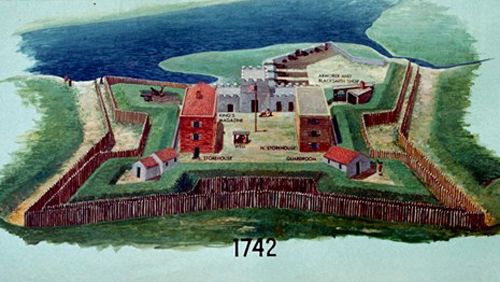
Fort Frederica, Georgia, 1742.
From 1739 to 1742, the British and the Spanish fought numerous battles in what became known as the War of Jenkins’ Ear. Expecting invasions by the Spanish, Oglethorpe built a defensive wall that encircled the entire town, thereby giving it a fort-like appearance. The actual fort itself was a smaller building set partially within this wall. The fort was constructed of tabby, a concrete-like material composed of oyster shells, throughout the southeastern United States. Many of the town’s other buildings were constructed in part of tabby because tabby was less expensive and more readily available than brick. Barracks on the northern edge of town served as quarters for approximately 200 troops and a hospital and prison for captured Spanish soldiers.
Fort Frederica National Monument was the site of frequent battles between the British and the Spanish. Just five miles from the fort town, visitors can see the site commemorating the Battle of Bloody Marsh, fought in July 1742. Under the command of Manual de Montiano, the Spanish governor of Florida, the Spanish launched an attempt to seize British territory from Georgia to South Carolina. They sent two thousand troops to Fort Frederica. Led by Oglethorpe, the British ambushed the Spanish troops, who marched single file through the marsh, and routed them from the island, thereby preventing them from taking Fort Frederica. The name originated from the marsh, supposedly “running red with the blood of Spaniards.” However, official Spanish records indicate that only seven grenadiers died during this battle. The Battle of Bloody Marsh forced the Spanish to abandon attempts to seize territory in the colony of Georgia. It marked the end of their efforts to invade Georgia during the War of Jenkins’ Ear. With the threat from Spain gone, the British had little need to maintain a military presence in Georgia. Oglethorpe returned to England in 1743, and the regiment he commanded disbanded. The withdrawal of British troops from the community in 1749 removed one of the most important sources of income for the village merchants, and the fort and town fell into decline. A disastrous fire in 1758 left Frederica in ruins.
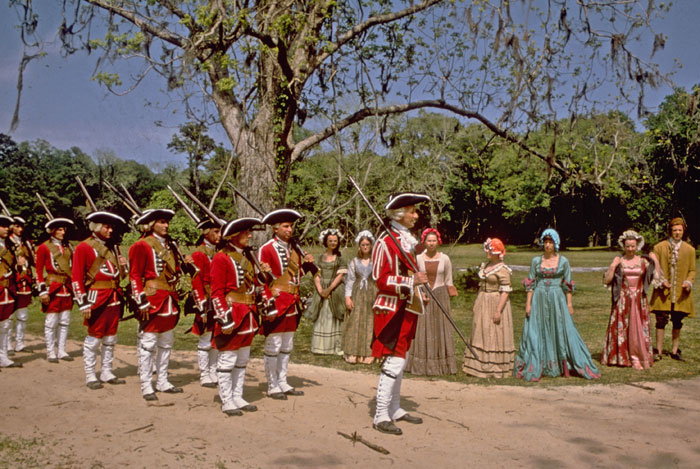
Re-enactors at Fort Frederick, Georgia, courtesy of the National Park Service.
After more than 275 years, the fort community is now an archaeological site with exposed building foundations and other remains, including portions of the King’s Magazine and the entrance to the barracks. The buildings used by city residents included the Calwell House, home of the town’s cobbler and soap maker, and the Hawkins-Davison duplex. The Hawkins-Davison houses belonged to Dr. Thomas Hawkins, a surgeon and apothecary, and Samuel Davison, a tavern owner. The town burial ground has also been partially preserved. During their time at Fort Frederica, John and Charles Wesley preached at services held at the burial ground. Visitors can explore the archaeological site independently or via a digital tour, view artifacts in the museum, and watch a film at the visitor center that explains how this history was uncovered. These provide insight into how the people of the fort lived, fought, and worked during an important period in British and Spanish history.
As a social experiment, the community at the fort demonstrated the need for British penal reform and for the alternative reform systems proposed by contemporary religious and social groups. As a military installation, the Anglo-Spanish clash and ultimate British victory shaped the geography and composition of North America. The artifacts and other objects at the fort tell this unique story.
Fort Frederica National Monument, a unit of the National Park System, is located at 6515 Frederica Rd. on St. Simon’s Island, Georgia. The Bloody Marsh Unit is at 1810 Demere Road.
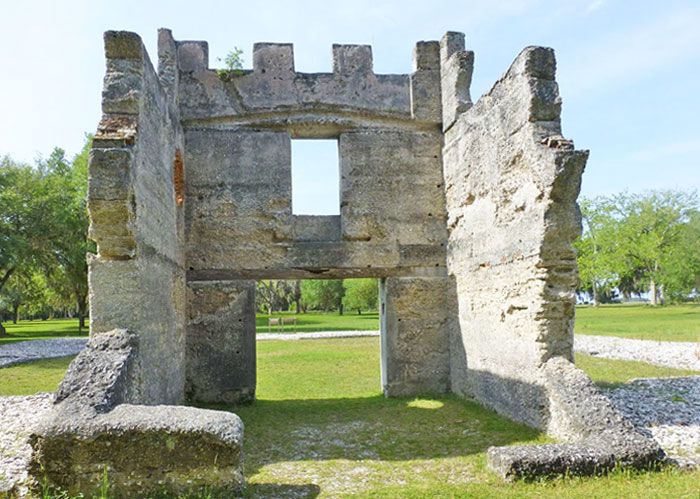
Ruins at Fort Frederica, Georgia, courtesy of the University of South Florida.
Compiled & edited by Kathy Alexander/Legends of America, updated December 2025.
Also See:
Forts & Presidios Across America
Indian Wars of the Frontier West
Soldiers & Officers in Military History
Source: Latino Heritage Sites