
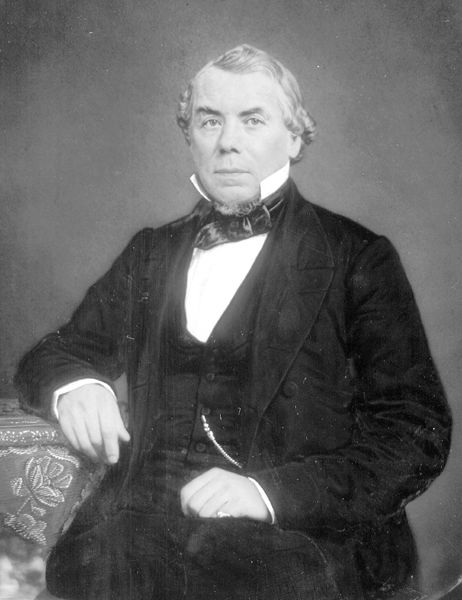
Robert Campbell.
Fur trader, frontiersman, merchant, and Indian Commissioner Robert Campbell was born in Ireland on February 4, 1804. As the youngest son of Hugh Campbell, Sr., and his second wife, Robert stood to inherit little, and at the age of 18 in 1822, he followed his older brother Hugh, Jr. to the United States.
Despite having no formal education, Robert demonstrated a keen sense of business and soon landed a position in the western trade hub of St. Louis, Missouri. He was advised to lead an outdoor life there because he had tuberculosis. In November 1825, he joined Jedediah Smith on an expedition to the Rocky Mountains, backed by William H. Ashley and his Rocky Mountain Fur Company. Also in the group were experienced explorers and traders Hiram Scott, James Beckwourth, Moses Harris, Louis Vasquez, David Jackson, and William Sublette.

Robert Campbell and William Sublette.
In 1832, he joined famed trapper William L. Sublette in a partnership, directly competing with the American Fur Company. That same year, he participated in the Battle of Pierre’s Hole in present-day Idaho. In 1833, they built Fort William near the mouth of the Yellowstone River in present-day North Dakota. Competing with nearby Fort Union, the post dealt in buffalo robes from local Native American tribes, primarily the Assiniboine, Cree, and Gros Ventre.
Both men realized that the fur trade was dying, and from 1835 onwards, the two focused on dry goods and river trading. In September 1836, they purchased a brick building at 7 Main Street in St. Louis, Missouri, and diversified their investments into banking, real estate, and other companies. Robert married Virginia Kyle in February 1841, and the two would eventually have 13 children. Of their many children, only three would survive their parents as diseases like cholera, diphtheria, and measles struck repeatedly.
In 1842, Sublette and Campbell dissolved their partnership but remained good friends. However, Sublette became seriously ill and died in 1845.
He attended the Fort Laramie Treaty gathering in 1851 and, during the Mexican-American War, helped form a regiment that he commanded.
In 1854, the Campbells moved out of the crowded city to the exclusive, elite neighborhood of Lucas Place. While there, Robert and Virginia continued to climb the social ladder. Robert became one of the wealthiest men in Missouri, extending his real estate empire as far as El Paso, Texas, and Kansas City, Missouri while serving as president of two banks and managing the finest hotel in the city, the Southern Hotel.

Campbell House, St. Louis, Missouri.
He continued diversifying his business interests over the years and prospered until he died in St. Louis, Missouri, on October 16, 1879. His wife, Virginia, died in 1882. Both are buried with their children at Bellefontaine Cemetery in St. Louis, Missouri. They left their house to their sons Hugh, Hazlett, and James. The three lived off their parents’ fortune for their entire lives, and none married. The home is now preserved as the Campbell House Museum, complete with the original furnishings and decorations, located at 1508 Locust Street in St. Louis.
©Kathy Alexander/Legends of America, updated November 2025.
Also See:
Trading Posts of the Mountain Men
Trappers, Traders & Pathfinders
Sources: