LEGENDS OF AMERICA

A Travel Site for the Nostalgic & Historic Minded


  Search


Legends Home

Site Map

What's New!!


Recommend this site


American History

Ghost Towns

Ghostly Legends

Historic People

Native Americans

The Old West

Photo Galleries

Roadside Attractions

Rocky Mtn Store

Route 66

Travel Destinations

Treasure Tales

Legends Blog


Free E-Newsletter


Legends of America's Exclusive Custom Products


P.O. Box 19423

Lenexa, KS 66285

913-708-5119


Please report broken links, missing pictures, or other problems online by clicking HERE or send us an email.  Thanks!


Complete List of Old West Vigilantes

More Lists: Explorers | Gunfighters | Lawmen | Native Americans | Outlaws | Outlaw Gangs | Scoundrels | Soldiers | Trail Blazers & Cowboys | Vigilantes | Women


<< Previous  1 2 3  Next >>


Atchinson County Protective Association (1880's) - Operating in Atchinson, Kansas, the group was originally formed in 1883 and called Good Intent. Acting much like other vigilante committees, they quickly took the law into their own hands. Three years later, in 1886, the group was reorganized with another existing group called the Central Protective Association, who was considered much more legitimate. One of their first acts was tracking down a thief who had stolen a team of horses and was finally captured in Nebraska. Three years later, the group, unable to continue to bear the expense of tracking down outlaws, reorganized again, becoming the Atchison County Protective Association in the spring of 1889. With a number of influential members including bankers and county officials, the group grew to some 1,500 members.

Anti Horse Thief Association (1854-Present) - Unlike many vigilante committees, the Anti Horse Thief Association (AHTA,) sometimes referred to as the “Dark Lantern Association,” was well-recognized and much respected throughout the American West. More ...

Missouri BaldknobberThe Bald Knobbers (1883-1889) - Originating in Taney County, Missouri, a group of thirteen men formed under the leadership of Nat Kinney in 1883 in an attempt to stop the flood of invading outlaws that plagued the area since the start of the Reconstruction Period. For the seven years following the close of the Civil War, from 1865-1882, over thirty murders had occurred, none of which had led to a conviction.


Before long, the Bald Knobbers themselves began to be arrested and on August 20, 1888, Nat Kinney was shot and killed. Though the violence continued for a short time, by 1899, the era of the Bald Knobbers had run its course. More ...


Committee of 101 (1898) –  In 1897, Jefferson “Soapy” Smith arrived in Skagway, Alaska. Known in former mining camps throughout the American West as the “King of the Frontier Con Men," Soapy’s reputation for running his illegal rackets and taking over a town were well known.


Having been run out of Denver, Colorado, Soapy saw opportunity in the Klondyke Gold Rush and, bringing in his gang of rogues and thieves, set about to repeat the process in Skagway. Setting up “shop” in his new saloon named Jeff Smith’s Parlor, Soapy's cons began once again in earnest. His saloon soon became known as the “real city hall,” even though Skagway already had an official one. But some of the Skagway citizens were not so impressed with Soapy who’s heavy drinking and black temper had begun to get completely out of hand.


After about nine months of the domination and fleecing of the town, a number of Skagway citizens had had enough of the man and a vigilante group, who called themselves the “Committee of 101,” threatened to drive Smith and his gang out of town. However, Soapy retaliated by forming his own group, that he called the “Committee of 303” to intimidate the first group. Soapy alleged that his group had more than 300 members, hoping to force the vigilantes into submission. It worked.


However, when Soapy's gang took some $2,600 in gold from a Klondike miner in an illegal Three-card Monte game, the vigilantes re-emerged and demanded that Soapy give him back his gold. Soapy, of course, refused, claiming that the miner had lost the gold “fairly” in a sporting game. The next night, on July 8, 1898, the vigilantes organized a meeting in Juneau, Alaska. Hearing of the meeting, Soapy decided to attend himself, arriving with a Winchester rifle draped over his shoulder. When he was barred from entering the meeting, he argued with one of four guards, a man named Frank Reid, who was blocking his way. Before long a gunfight erupted and when the smoke cleared both men lay dead.

Dodge City, Kansas, 1876Dodge City Vigilantes (1873) – Established in 1872, Dodge City was teeming with buffalo hunters, railroad men, soldiers, transients, and desperadoes. In the first year of its existence an estimated 15 men were killed in Dodge City, all winding up in Boot Hill.

By early 1873, local businessmen were concerned about the violence in the town that was not yet organized with city officials or lawmen. They soon hired gunfighter named Billy Brooks as a private lawman. However, when Brooks did not tame the lawlessness of the city, men began to take matters into their own hands by forming a vigilante committee.

The committee effectively rid the town of some of the worst offenders by notifying six of the leading desperadoes that they must leave Dodge immediately. Four went, but two were defiant and remained. When the specified hour had passed, twelve double-barreled shotguns were loaded with buckshot, the men were hunted down, and then killed.

However, the vigilante group, like many others in the west, soon became the main source of violence. With power gone to their heads and attracting violent men, things were quickly out of hand. On March 134, 1873, Tom Sherman, who ran a dancehall, chased a man out of his saloon and shot him. As the man lay dying and writhing in pain, Sherman walked over to him and said, "I'd better shoot him again, hadn't I boys?" He then aimed his gun at the man's head and pulled the trigger point blank.

On June 3, 1873, the violence escalated to the point that two of vigilante members killed a man named William Taylor. However, Taylor was employed by Colonel Richard Dodge, the commanding officer of Fort Dodge. The officer was so outraged that he immediately telegraphed the Kansas Governor and gained special permission to arrest the guilty parties.  His troops entered Dodge City the next day and arrested Bill Hicks who was later convicted. On June 5th, the soldiers arrested five more of the worst vigilantes, including Tom Sherman.


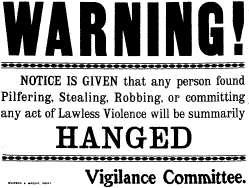
Vigilante NoticeMontana Vigilantes (1863-1864) - During Montana's gold rush days of 1863, the law was sometimes non-existent in the region that was then in the Territory of Idaho. However, that was not the case in Virginia City, when a young miner was found murdered. A posse was quickly formed to track the killers and they soon returned with three suspects, who were tried in a miners' court in Nevada City, a few miles downstream from Virginia City. Tried in December, 1863, one man was convicted and hanged for the crime, but of the other two, one was banished from the territory and the other set free.


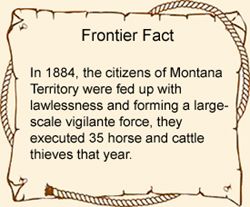
Outraged locals decided that justice in the court was too slow and ineffective and the Montana Vigilantes were born. Five members were originally sworn in as the Montana Vigilance Committee, patterned after the San Francisco Vigilantes of 1856. Almost immediately, orderly arrests and trial courts became obsolete as a reign of lynching began to take place. By the end of February, 1864, 22 men had been lynched.


The most famous victim of the Montana Vigilantes was Henry Plummer, who, after arriving in Montana in 1862 and was elected Sheriff of the Bannack Mining District in May 1863. At the same time, a group of road agents called the Innocents were operating in the area and the vigilantes suspected Plummer of being the leader of the group. On January 10, 1864, Plummer was hanged by a mob at Bannack.


Today, historians disagree as to whether these many men that were hanged during Montana's Vigilante days were truly guilty. In fact, some researchers believe the entire affair was a cover-up for the "so-called" vigilantes who were actually committing the many crimes occurring in the area.


Random lynchings continued in Montana Territory throughout the 1860s until a backlash against extralegal justice finally took hold around 1870.

San Francisco Vigilantes - There were two major vigilante groups that operated in San Francisco, one occurring in 1851 and the other in 1856, both of which arose during the California Gold Rush in response to avid crime, government corruption and prejudice against the immigrants. These two militia style groups lynched 12 people, kidnapped hundreds of others, and forced several elected officials to resign. Each Committee of Vigilance formally relinquished power after it decided the city had been "cleaned up."


1851 Vigilantes - California's Gold Rush transformed the small Spanish settlement of San Francisco into a boom town as thousands of men flocked to California to make their fortunes. The town grew from just about 800 residents in 1848 to nearly 25,00 in 1851, bringing with it murderers, swindlers, thieves, sporting girls and carpetbagger politicians.

San Francisco, California Wharves, 1900

San Francisco Wharves, courtesy Library of Congress.

This image available for photographic prints HERE.

When the young city was incapable of handling the disorder and mahem taking place on what began to be called the "Barbary Coast," San Francisco merchants established the "Committee of Vigilance" in 1851. Meeting in secret, the 700 member group drew up bylaws and soon announced that San Francisco's elected government was incapable of protecting the life and property of the city's citizens and claimed that role for itself.


The committee, believing that Australian immigrants were responsible for much of the city's crime, immediately began to prevent them from landing in San Francisco and deporting more than two dozen others. Their justice was swift and certain, hanging four men accused of murder. Word of their deeds of lynching and excommunicating criminals spread fast and San Francisco's crime rate declined rapidly. Their unprecedented success made them heroes throughout the west, spawning vigilante groups in numerous other locations. Their mission complete, the first organized group of San Francisco was formally disbanded by the end of 1852 and law enforcement returned to the elected authorities, all of which just happened to be former members of the committee.


1856 Vigilantes - In 1856, San Francisco was entirely under the control of its famous Vigilance Committee, a determined band of citizens that held the city under firm rule. At the time that the Vigilance Committee was formed, the conditions of the city's outgrowth had caused caused widespread municipal corruption by a gang of organized political plunderers. Operating in their own individual best interests, the city government held control of San Francisco at the expense of the honest and respectable citizens of the city.


For years, some of the worst elements of San Francisco had held control of the political machine, stuffing ballot boxes, bribing voters, intimidating those that couldn't be paid off, and electing their own judges. Going to any and every extreme to hold their offices, the politicians were raping the city, taking home bucket loads of money and enjoying their power.


However, on May 14, 1856, James King, the editor of the Bulletin newspaper, who had persistently exposed the misdeeds of the political powers, was murdered by a low life politician and known ballot-box stuffer named James Casey. Trusting that the political machine would take care of him, Casey surrendered himself, partly for protection from King's friends.

Word of King's murder spread quickly and determined citizens were ready to end the political corruption at any cost. Soon, a citizens delegate approached William T. Coleman, who had belong to the Vigilance Committee of 1851, asking him to form another vigilante group to take measures against the politicians. At first, Coleman was reluctant but was soon convinced there was no alternative. A call for arms was soon soon made signed by the "Committee of Thirteen," the same title under which the Vigilance Committee of 1851 was disbanded.


Weary of the corruption, response was immediate and organization of a new vigilante group was rapid. Charles Doane, an experienced soldier was given charge of the military details and soon took over a commercial warehouse which he converted as an armory and drill hall. Sacramento Street, it was popularly named Fort Gunnybags, was complete with cannons mounted behind its walls and served as the vigilante group's headquarters.


The politicians were obviously dismayed at the suddenness of the groups preparation. Resisting, they immediately gathered up the police and a number of hoodlum constituents and began to attack the vigilante's headquarters. However, their efforts were faint-hearted in the face of the determined attitude of the vigilantes.


The politicians then appealed to Governor J. Neely Johnson, but when he failed to intervene, they requested help from the federal forces, who also failed to assist.


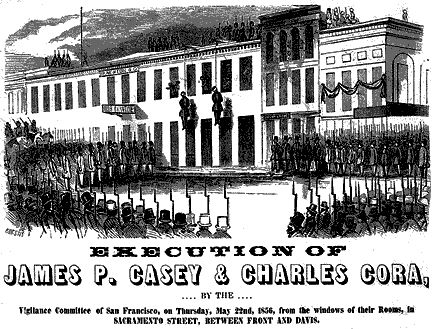
The Sunday following King's murder, the well armed Vigilance Committee overpowered the guards at the jail and removed Casey and another prisoner named Charles Cora, returning them to the warehouse. There, they were given a fair trial, found guilty, and were publicly executed.

James Casey and Charles Cora hanging

James Casey and Charles Cora were hanged by the San Francisco vigilante movement of 1851.

Though the political machine was thoroughly cowed, the Committee continued its efforts to purify the government by exiling politicians, criminals, and taking the reins of government. Once the corrupted officials were replaced and their "messes" cleaned up, the Vigilance Committee disbanded, thus ending one of the most remarkable instances of a revolt by decent citizens against a corrupt city government.

The exiled politicians subsequently sued Coleman for sums amounting to a total of $1,500,000, but the suits were all defeated. Both Coleman and the Vigilance Committee were upheld by every court in both the East and West which considered the cases.


Continued Next Page

<< Previous  1 2 3  Next >>

From the Rocky Mountain General Store

Saloon Style Advertising Prints - What were on the walls of the saloons in the Old West?  Likely, much of the same as those you find today - advertisements for liquor, beer, and tobacco.  Plus the "decadent" women of the time.  In our Photo Print Shop, you'll find dozens of photographs for decorating your "real" saloon or den in a saloon type atmosphere.


                                                              Copyright © 2003-2008, www.Legends of America.com