
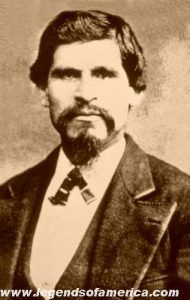
Tiburcio Vasquez.
Born in Monterey on August 11, 1835, Tiburcio Vasquez descended from one of California’s earliest settlers. His great-grandfather arrived there as a young man with the De Anza expedition of 1776. He was educated as a young boy and could speak, read, and write English.
His criminal career began in 1852 when the 17-year-old attended a local fandango with his older cousin, Anastacio Garcia. When a fight broke out, Constable William Hardmount was killed. Though not directly involved in the slaying, Vasquez and Garcia fled the scene. A friend of Vasquez’s who was present at the fight — a man named Jose Higuera– did not flee and was lynched by vigilantes the next day.
Hiding in the hills with Garcia, already a known outlaw, Vasquez soon picked up the “business” from his cousin. He soon joined a gang of other desperados and eventually became the group’s leader.
Excusing his crimes by telling everyone that he was “punishing” the whites for discrimination against those of Mexican and Spanish descent, he ranged up and down central and southern California, stealing horses by the hundreds.
In spring 1857, the law caught up with him after he rustled a herd of horses in Los Angeles. He was sentenced to five years in San Quentin. He briefly escaped in 1859 but was recaptured after stealing horses again and was sent back. Released in 1863, he made a short attempt to abide by the law but quickly returned to a life of crime, adding armed robbery to his list of transgressions.
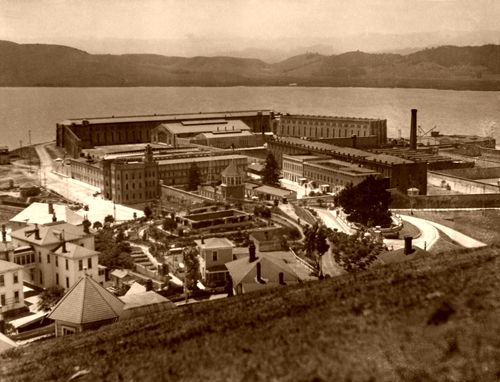
San Quentin Prison, California, 1919.
He was again arrested in 1867 for a failed attempt to rob a store in Mendocino and spent another short stint in San Quentin. After his release, he returned to Monterey and was severely wounded in a fight with Abelardo Salazar over Salazar’s wife. Fleeing to a hideout at Cantua Creek in the Coast Range, Vasquez settled in for a while to recuperate. However, he did not stay long before resuming his life of crime.
On August 17, 1871, Vasquez and two other outlaws robbed the Visalia stagecoach between San Jose and Pacheco Pass. In no time, they were pursued by a posse led by Sheriff Charles Lincoln, who caught up with them, killing one, wounding Vasquez, and capturing the third. Though wounded, Vasquez once again escaped to his Cantua Creek hideout.
After he recovered, he hit the outlaw trail again, and on August 26, 1873, the gang robbed Snyder’s Store in Tres Pinos in San Benito County. Taking some $200 in gold, they also killed three innocent bystanders in the process. Though he was a wanted man before this crime, killing the three innocent people stepped up the pursuit of Vasquez and his outlaw cohorts. Governor Newton Booth immediately offered a $1,000 reward for his capture, an amount that would increase several times as Vasquez continued to elude the authorities.

Vasquez Rocks, California, courtesy of Wikipedia.
Over the next several months, Vasquez continued his life of crime but eluded the posse by hiding in the canyons around Tejon Pass. One of his favorite hiding spots was a steeply sloped rock formation about 40 miles North of Los Angeles, today known as Vasquez Rocks.
By December 1873, Vasquez and his bunch had returned to the San Joaquin Valley in Fresno County, where they sacked the town of Kingston on December 26. Leaving their victims bound, they took from two stores more than $2,500. When the news reached the governor, the reward was increased, first to $3,000, then $6,000, and finally, to $15,000, as the robberies continued. In no time, the sheriffs of Fresno, Tulare, San Joaquin, Santa Clara, and Monterey Counties all organized posses to hunt the Vasquez Gang.
Vasquez’s “womanizing” would become his downfall. While hiding out at the cabin of “Greek George” Caralambo, a former camel driver for General Beale, the outlaw seduced a nearby girl and made her pregnant.
Angered, one of the girl’s family members and a formerly trusted henchman of Vasquez’s, Abdon Leiva, contacted the authorities and agreed to turn State’s evidence against him. With this new information, Los Angeles Sheriff William Roland was quickly on his trail, and the bandit was finally captured in the Arroyo Seco area of Los Angeles on May 13, 1874.
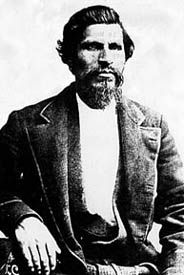
Tiburcio Vasquez.
News of his capture quickly spread, and reporters clamored for interviews. The outlaw told reporters that he was an honorable man who sought only the return of California to Mexico. Vasquez was then moved from Los Angeles to San Benito County, then to San Jose for trial. He became a celebrity and folk hero to fellow Hispanic Californians, with hundreds of people coming to visit him, many of whom were women. The charming Vasquez entertained them all, posing for photographs and giving out autographs. He even sold many of the photographs himself from his cell window to pay for his legal defense.
In January 1875, his trial began, and though he admitted his involvement in many of the crimes attributed to him, he denied that he had ever killed anyone. But it was to no avail, as he was found guilty of two counts of murder in the Tres Pinos incident and sentenced to death. Governor Romualdo Pacheco denied clemency. On March 19, 1875, Vasquez was hanged by Santa Clara Sheriff John H. Adams. “Pronto” was the only word he spoke from the gallows. He was buried in the old Santa Clara Mission Cemetery.
Vasquez’s loyal lieutenant, Clodovio Chavez, fled to Arizona after Vasquez’s capture. On November 25, 1875, Chavez was shot and killed when he resisted arrest by lawmen near Yuma, Arizona.
©Kathy Alexander/Legends of America, updated October 2026.
Also See:
Outlaws & Scoundrels Photo Gallery
See Sources.