
By Theodore Roosevelt in 1893.
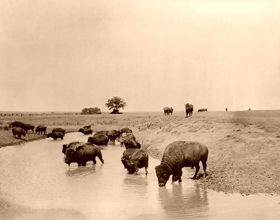
Buffalo at Water, Detroit Publishing Company, 1905.
When we became a nation in 1776, the buffalo, the first animals to vanish when the wilderness is settled, roved to the crests of the mountains that mark the western boundaries of Pennsylvania, Virginia, and the Carolinas. They were plentiful in what are now the States of Ohio, Kentucky, and Tennessee. But by the beginning of the present Century, they had been driven beyond the Mississippi River. For the next 80 years, they formed one of the most distinctive and characteristic features of existence on the great plains. Their numbers were countless — incredible. In vast herds of hundreds of thousands of individuals, they roamed from the Saskatchewan River to the Rio Grande and westward to the Rocky Mountains.
They furnished all the means of livelihood to the tribes of Horse Indians, and to the curious population of French Metis, or Half-breeds, on the Red River, as well as to those dauntless and archetypical wanderers, the white hunters and trappers.
Their numbers slowly diminished, but the decrease was gradual until after the Civil War. Settlers did not destroy them; the railways and skin hunters did.
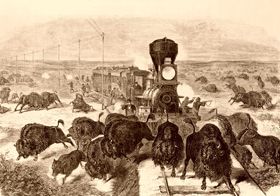
Shooting buffalo from the train.
After the end of the Civil War, the work of constructing transcontinental railway lines was pushed forward with the utmost vigor. These provided cheap and indispensable, but hitherto wholly lacking, transportation for hunters. At the same time, demand for buffalo robes and hides grew greatly, while the enormous numbers of the beasts and the comparative ease with which they were slaughtered attracted throngs of adventurers. The result was such a slaughter of big game as the world had never before seen; never before were so many large animals of one species destroyed in so short a time. Several million buffalo were slain. Within 15 years of the destruction’s beginning, the great herds were exterminated. In all probability, there are not now, all told, 500 head of wild buffalo on the American continent, and no herd of a hundred individuals has existed since 1884.
The first great break followed the building of the Union Pacific Railway. All the buffalo of the middle region were then destroyed, and the others were split into two vast herds: the northern and the southern. The latter were first destroyed in about 1878; the former were destroyed in 1883. My chief experience with buffalo came in the latter year, among small bands and scattered individuals near my ranch on the Little Missouri River. But two of my kinsmen were more fortunate and took part in chasing these lordly beasts when the herds still darkened the prairie as far as the eye could see.
During the first two months of 1877, my brother Elliott, then a lad not 17 years old, made a buffalo hunt toward the edge of the Staked Plains in Northern Texas. He was thus in at the death of the southern herds, for all, save a few scattering bands, were destroyed within two years of this time. He was with my cousin, John Roosevelt, and they went out on the range with six other adventurers.
It was a party of just such young men who frequently drifted to the frontier. All were short of cash and hardy, vigorous fellows eager for excitement and adventure. My brother was the youngest and least experienced of the party, but he was well-grown, strong and healthy, and very fond of boxing, wrestling, running, riding, and shooting; moreover, he had served an apprenticeship in hunting deer and turkeys. They carried their mess kit, ammunition, bedding, and provisions in two prairie wagons, each drawn by four horses. In addition to the teams, they had six saddle animals- all shaggy, unkempt mustangs. Three or four dogs, setters, and half-bred greyhounds trotted behind the wagons. Each man took his turn for two days as teamster and cook, and there were always two with the wagons or camp, as the case might be, while the other six were off hunting, usually in couples. The expedition was undertaken partly for sport and partly for profit; after purchasing the horses and wagons, none of the party had any money left, and they were forced to rely on selling skins and hides and, when near the forts, meat.
They started on January 2 and shaped their course for the Salt Fork of the Brazos headwaters, the center of abundance for the great buffalo herds. During the first few days, they were on the outskirts of the settled country and shot only small game—quail and prairie fowl. Then, they began to kill turkey, deer, and antelope. They traded these for flour and feed at ranches or in squalid, straggling frontier towns.
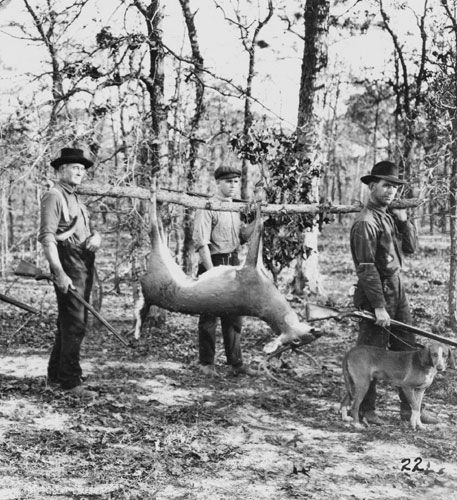
Successful deer hunt.
On several occasions, the hunters were lost, spending the night out in the open or sleeping at a ranch if they found one. Both towns and ranches were filled with rough customers; all of my brother’s companions were muscular, hot-headed fellows, and as a consequence, they were involved in several savage free fights in which, fortunately, nobody was seriously hurt. My brother kept a brief diary, the entries somewhat startling from their conciseness. Several times, the mention of their arrival, either at a halting place, a little village, or a rival buffalo camp, is followed by the laconic remark, “big fight,” or “big row,” but once they evidently concluded discretion to be the better part of valor, the entry for January 20 being, “On the road — passed through Belknap — too lively, so kept on to the Brazos — very late.” The buffalo-camps in particular were very jealous of one another, each party regarding itself as having exclusive right to the range it was the first to find; and on several occasions this feeling came near involving my brother and his companions in serious trouble.
While slowly driving the heavy wagons to the hunting grounds, they suffered the usual hardships of plains travel. As in most Texas winters, the weather alternated between the extremes of heat and cold. There had been little rain; as a result, water was scarce. Twice, they were forced to cross wild, barren wastes, where the pools had dried up, and they suffered terribly from thirst. On the first occasion, the horses were in good condition, and they traveled steadily, with only occasional short halts, for over 36 hours, by which time they were across the waterless country. The journal reads: “January 27 — Big hunt — no water, and we left Quinn’s blockhouse this morning 3 a.m. — on the go all night — hot. January 28 — No water — hot — at seven we struck water and by eight Stinking Creek — grand ‘hurrah.'” On the second occasion, the horses were weak and traveled slowly, so the party went 48 hours without drinking. “February 19 — Pulled on 21 miles — trail bad — freezing night, no water, and wolves after our fresh meat. 20 — Made 19 miles over the prairie; again, only mud, no water, freezing hard — frightful thirst. 21st — 30 miles to Clear Fork, fresh water.”
These entries were hurriedly jotted down by a boy who deemed it unmanly to make any special note of hardship or suffering. Still, every plainsman will understand the real agony implied in working hard for two nights, one day, and portions of two others, without water, even in cool weather. During the last few miles, the staggering horses could only drag the lightly loaded wagon —for they had but one with them at the time —while the men plodded along in sullen silence, their mouths so parched that they could hardly utter a word. I did my own hunting and ranching in the North, where there is more water, so I have never had a similar experience. Once, I took a team in 36 hours across a country where there was no water, but by good luck it rained heavily in the night so the horses had plenty of wet grass, and I caught the rain in my slicker and had enough water for myself. I have but once been as long as 26 hours without water.
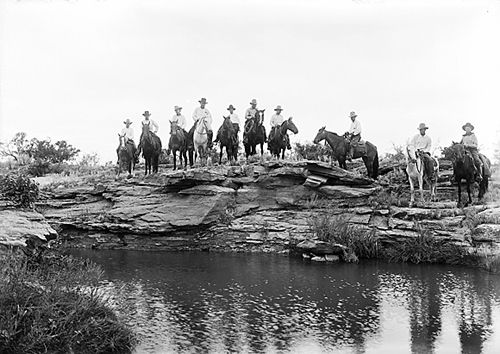
Cowboys at Blanco Canyon, Texas.
The party pitched their permanent camp in a canyon of the Brazos known as Canyon Blanco. In the last few days of their journey, they traveled beside the river through a veritable hunter’s paradise. The drought had forced all the animals to the larger watercourses, and the country was literally swarming with game. Every day, and all day long, the wagons traveled through herds of antelopes that grazed on every side; whenever they approached the canyon brink, bands of deer started from the timber that fringed the river’s course; often, even the deer wandered out on the prairie with the antelope. Nor was the game shy, for the red and white hunters followed only the buffalo until the huge, shaggy herds were destroyed, and the smaller beasts were consequently little molested.
Once, my brother shot five antelopes from a single stand when the party was short of fresh venison; he was out of sight and to leeward, and the antelopes seemed confused rather than alarmed at the rifle reports and the fall of their companions. As was to be expected where the game was so plenty, wolves and coyotes also abounded. At night, they surrounded the camp, wailing and howling in a shrieking chorus throughout the hours of darkness; one night, they came so close that the frightened horses had to be hobbled and guarded. On another occasion, a large wolf crept into camp, where the dogs seized him, and the yelling, writhing knot of combatants rolled over one of the sleepers; finally, the long-toothed prowler shook himself loose and vanished in the gloom. One evening, they were almost as much startled by a visit of a different kind. They were finishing supper when an Indian stalked suddenly and silently out of the surrounding darkness, squatted down in the circle of firelight, remarked gravely, “Me Tonk,” and began helping himself from the stew. He belonged to the friendly tribe of Tonkaways, so his hosts speedily recovered their equanimity; as for him, he had never lost his, and he sat eating by the fire until there was literally nothing left to eat. The panic caused by his appearance was natural, for at that time, the Comanche were a scourge to the buffalo hunters, ambushing them and raiding their camps, and several bloody fights had taken place.
Their camp had been pitched near a deep pool or water hole. On both sides, the bluffs rose like walls, and where they had crumbled and lost their sheerness, the vast buffalo herds, passing and re-passing for countless generations, had worn furrowed trails so deep that the backs of the beasts were but little above the surrounding soil. In the bottom and in places along the crests of the cliffs that hemmed in the canyon-like valley, groves of tangled trees were tenanted by great flocks of wild turkeys. Once, my brother made two remarkable shots at a pair of these great birds. It was at dusk, and they were flying directly overhead from one cliff to the other. He had in his hand a .38-caliber Ballard rifle, and, as the gobblers winged their way heavily by, he brought both down with two successive bullets. This was, of course, mostly luck, but it meant good shooting, too. The Ballard was a very accurate, handy little weapon; it belonged to me and was the first rifle I ever owned or used. With it, I had once killed a deer, the only specimen of the large game I had then shot, and I presented the rifle to my brother when he went to Texas. In our happy ignorance, we deemed it quite good enough for buffalo or anything else, but my brother soon found himself forced to procure a heavier, deadlier weapon out on the plains.
When the camp was pitched, the horses were turned loose to graze and refresh themselves after their trying journey, during which they had lost flesh woefully. The two men who were always left in camp watched and tended them and, save on rare occasions, were only used to haul in the buffalo hides. For the time being, the camp guards acted as cooks, and though coffee and flour ran short and finally gave out, fresh meat of every kind was abundant. The camp was never without buffalo beef, deer and antelope venison, wild turkeys, prairie chickens, quails, ducks, and rabbits. The birds were “potted,” as occasion required; when the quarry was deer or antelope, the hunters took the dogs with them to run down the wounded animals. But the hunters gave almost all their attention to the buffalo. After an evening spent lounging around the campfire and a sound night’s sleep, wrapped in robes and blankets, they would get up before daybreak, snatch a hurried breakfast, and start in couples through the chilly dawn.
The fantastic beasts were plentiful; in the first day’s hunt, 20 were slain, but the herds were restless and ever-moving. Sometimes they would be seen right by the camp, and again it would take an all-day tramp to find them. There was no difficulty in spying them—the chief trouble with forest game; for on the prairie a buffalo makes no effort to hide, and its black, shaggy bulk looms as far as the eye can see.
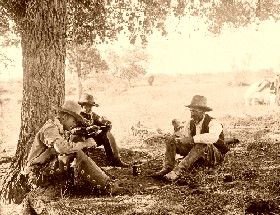
Cowboys Sitting Down to Dinner.
Sometimes, they were found in small parties of three or four individuals, sometimes in bands of about 200, and again in great herds of many thousands, and solitary old bulls, expelled from the herds, were common. On broken land, among the hills and ravines, there was not much difficulty in approaching from the leeward, for, though the sense of smell in the buffalo is very acute, they do not see well at a distance through their overhanging frontlets of coarse, matted hair. If, as was generally the case, they were out in the open, rolling prairie, the stalking was far more difficult. Every hollow, every earth hummock and sagebrush had to be used as cover. The hunter wriggled through the grass flat on his face, pushing himself along for perhaps a quarter of a mile by his toes and fingers, heedless of the spiny cactus. When near enough to the vast, unconscious quarry, the hunter began firing, still keeping himself carefully concealed. If the wind blew the smoke away, and if the buffalo caught no glimpse of the assailant, they would often stand motionless and stupid until many of their numbers had been slain, the hunter being careful not to fire too high, aiming just behind the shoulder, about a third of the way up the body, that his bullet might go through the lungs. Sometimes, even after they saw the man, they would act as if confused and panic-struck, huddling together and staring at the smoke puffs, but generally, they were off at a lumbering gallop as soon as they had an idea of the point of danger. When they started, they ran for many miles before halting, and their pursuit on foot was extremely laborious.
One morning, my cousin and brother had been left in camp as guards. They were idly warming themselves in the first sunbeams when their attention was sharply drawn to four buffalo coming to the pool to drink. The beasts came down a game trail, a deep rut in the bluff, fronting where they sat, and they did not dare stir for fear of being discovered. The buffalo walked into the pool and, after drinking their fill, stood for some time with the water running out of their mouths, idly lashing their sides with their short tails, enjoying the bright warmth of the early sunshine; then, with much splashing and the gurgling of soft mud, they left the pool and clambered up the bluff with unwieldy agility. As soon as they turned, my brother and cousin ran for their rifles, but the buffalo had crossed the bluff crest before they got back. Climbing after them, the two hunters found, when they reached the summit, that their game, instead of halting, had struck straight off across the prairie at a slow lope, doubtless intending to rejoin the herd they had left. After a moment’s consultation, the men went in pursuit, excitement overcoming their knowledge that they ought not, by rights, to leave camp.
They struck a steady trot, following the animals by sight until they passed over a knoll and trailed them. Where the grass was long, as it was for the first four or five miles, this was no difficulty, and they did not break their gait, only glancing now and then at the trail. As the sun rose and the day warmed, their breathing quickened, and sweat rolled down their faces as they ran across the rough prairie sward, up and down the long inclines, now and then shifting their heavy rifles from one shoulder to the other. But they were well trained and did not have to halt. At last, they reached stretches of bare ground, sun-baked and grassless, where the trail grew dim; here they had to go very slowly, carefully examining the faint dents and marks in the soil made by heavy hoofs and unraveling the trail from the mass of old footmarks. It was tedious work, but it let them fully recover their breath by the time they struck the grassland again; and a few hundred yards from the edge, in a slight hollow, they saw the four buffalo just entering a herd of 50 or 60 scattered out grazing. The herd paid no attention to the newcomers, and these immediately began to feed greedily. After a whispered consultation, the two hunters crept back and made a long circle that brought them well to leeward of the herd, in line with a slight rise in the ground. They then crawled up to this rise and, peering through the tall, rank grass tufts, saw the unconscious beasts 125 or 150 yards away. They fired together, each mortally wounding his animal. Then, rushing in as the herd halted in confusion and following them as they ran, impeded by numbers, hurry, and panic, they eventually got three more.
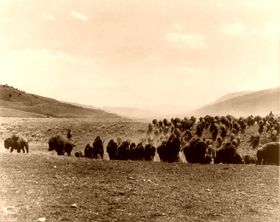
Buffalo Stampede.
On another occasion, the same two hunters nearly met with a frightful death, being overtaken by a vast herd of stampeding buffalo. All the animals that go in herds are subject to these instantaneous attacks of uncontrollable terror, under the influence of which they become perfectly mad and rush headlong in dense masses on any form of death. Horses, especially cattle, often suffer from stampedes; cowboys must remain perpetually on guard against this danger. A band of stampeded horses, sweeping in mad terror up a valley, will dash against a rock or tree with such violence as to leave several dead animals at its base while the survivors race on without halting; they will overturn and destroy tents and wagons, and a man on foot caught in the rush has but a slight chance for his life.
A buffalo stampede is much worse- or rather was much worse, in the old days- because of the great weight and immense numbers of the beasts, which plunged over cliffs and into rivers in a fury of heedless terror and bore down whatever was in their path. My brother and cousin were on their way home when it happened.
They were mounting one of the long, low swells into which the prairie was broken when they heard a low, muttering, rumbling noise, like far-off thunder. It grew steadily louder, and, not knowing what it meant, they hurried forward to the top of the rise. As they reached it, they stopped short in terror and amazement, for before them, the whole prairie was black with madly rushing buffalo.
Afterward, they learned that another couple of hunters, four or five miles off, had fired into and stampeded a large herd. In its rush, this herd gathered others, all thundering together in uncontrollable and increasing panic.
The surprised hunters were far from any broken ground or other place of refuge, while the vast herd of huge, plunging, maddened beasts charged straight down on them, not a quarter of a mile distant. Down they came! — thousands upon thousands, their front extending a mile in breadth, while the earth shook beneath their thunderous gallop, and, as they came closer, their shaggy frontlets loomed dimly through the columns of dust thrown up from the dry soil. The two hunters knew their only hope for life was to split the herd, which, though it had such a broad front, was not very deep. If they failed, they would inevitably be trampled to death.
Waiting until the beasts were in close range, they opened rapid fire from their heavy breech-loading rifles, yelling at the top of their voices. For a moment, the result seemed doubtful. The line thundered steadily down on them; then it swayed violently as two or three of the brutes immediately in front fell beneath the bullets while their neighbors made violent efforts to press off sideways. Then a narrow wedge-shaped rift appeared in the line and widened as it came closer, and the buffalo, shrinking from their foes in front, strove desperately to edge away from the dangerous neighborhood; the shouts and shots were redoubled; the hunters were almost choked by the cloud of dust, through which they could see the stream of dark massive bodies passing within rifle-length on either side. The peril was over in a moment, and the two men were left alone on the plain, unharmed, though their nerves were shaken. The herd careered on toward the horizon, saving five individuals who had been killed or disabled by the shots.
On another occasion, when my brother was out with one of his friends, they fired at a small herd containing an old bull; the bull charged the smoke, and the whole herd followed him. They were probably stampeded and had no hostile intention; at any rate, after the death of their leader, they rushed by without doing any damage.
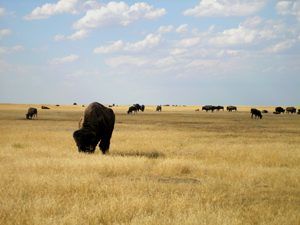
Buffalo in South Dakota, by Kathy Alexander.
But buffalo were sometimes charged with the utmost determination and were then dangerous antagonists. My cousin, a very hardy and relentless hunter, had a narrow escape from a wounded cow, which he had followed up a steep bluff or sand cliff. Just as he reached the summit, the cow charged, and he was saved only by the sudden appearance of his dog, which distracted the cow’s attention. He thus escaped with only a tumble and a few bruises.
My brother also came in for a charge while killing the biggest bull that was slain by any of the party. He was out alone and saw a small herd of cows and calves some distance away, with a massive bull among them, towering above them like a giant. There was no break in the ground, tree, or bush near them, but by making a half-circle, my brother managed to creep up against the wind behind a slight roll in the prairie surface until he was within 75 yards of the grazing and unconscious beasts.
Some cows and calves lay between him and the bull, and he had to wait a few moments for them to shift as the herd grazed onward and gave him a fair shot; in the interval, they had moved so far forward that he was in plain view. His first bullet struck just behind the shoulders; the herd started and looked around, but the bull lifted his head and stepped forward, his tail curling up over his back.
The next bullet likewise struck fair, nearly in the same place, telling with a loud “pack!” against the thick hide and sending dust flying from the matted hair. Instantly, the great bull wheeled and charged in headlong anger while the herd fled in the opposite direction. On the bare prairie, with no spot of refuge, it was useless to try to escape, and the hunter, with a reloaded rifle, waited until the bull was not far off, then drew up his weapon and fired. Either he was nervous, or the bull at the moment bounded over some obstacle, for the bullet went a little wild; nevertheless, by good luck, it broke a foreleg, and the great beast came crashing to the earth and was slain before it could struggle to its feet.
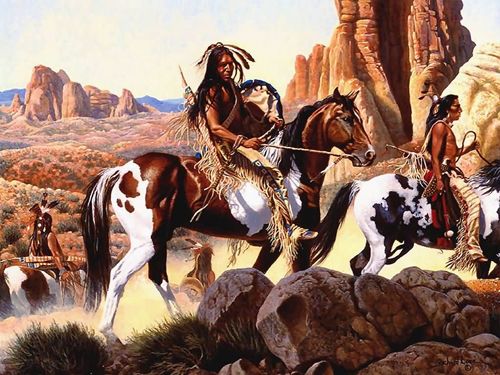
Comanche War Party by Richard Luce, courtesy of First People.
A Comanche war party swept along the river two days after this event. They “jumped” a neighboring camp, killing one man and wounding two more, and at the same time, ran off all but three of the horses belonging to our eight adventurers. With the remaining three horses and one wagon, they set out homeward. The march was hard and tedious; they lost their way and were in jeopardy from quicksands and cloudbursts; they suffered from thirst and cold, their shoes gave out, and cactus spines lamed their feet. At last, they reached Fort Griffin in safety, and their ravenous rejoicing was great when they procured some bread—for during the final fortnight of the hunt, they had been without flour or vegetables of any kind, or even coffee. They had subsisted on fresh meat “straight.” Nevertheless, it was a very healthy, as well as an enjoyable and exciting experience, and I doubt if any of those who took part in it will ever forget their great buffalo hunt on the Brazos River
My friend, General W. H. Walker, of Virginia, had an experience in the early 1850s with buffalo on the upper Arkansas River, which gives some idea of their enormous numbers at that time. He camped with a scouting party on the banks of the river and went out to try to shoot some meat. Many buffalo were in sight, scattered in large bands, as was their custom. When he was a mile or two away from the river, a dull roaring sound in the distance attracted his attention, and he saw that a herd of buffalo far to the South, away from the river, had been stampeded and was running his way. He knew that if he were caught in the open by the stampeded herd, his chance for life would be small, and at once, he ran for the river. By desperate efforts, he reached the breaks in the sheer banks just as the buffalo reached them and got into safety on the pinnacle of a little bluff.
From this vantage point, he could see the entire plain. To the very verge of the horizon, the brown masses of the buffalo bands showed through the dust clouds, coming on with a thunderous roar like that of surf. Camp was a mile away, and the stampede luckily passed to one side. Watching his chance, he finally dodged back to the tent and all that afternoon watched the immense masses of buffalo as band after band tore to the brink of the bluffs on one side, raced down them, rushed through the water, up the bluffs on the other side, and again off over the plain, churning the sandy, shallow stream into a ceaseless tumult. When darkness fell, there was no apparent decrease in the numbers passing, and all through that night the continuous roar showed that the herds were still threshing across the river. Towards dawn, the sound at last ceased, and General Walker arose somewhat irritated, as he had reckoned on killing an ample supply of meat, and he supposed that there would now be no bison left South of the river. To his astonishment, when he strolled up on the bluffs and looked over the plain, it was still covered far and wide with groups of buffalo grazing quietly. There were as many on that side as ever, despite the many scores of thousands that must have crossed over the river during the stampede of the afternoon and night. The barren-ground caribou is the only American animal ever seen in enormous herds.
In 1862, Mr. Clarence King, while riding along the overland trail through western Kansas, passed through a great buffalo herd and was injured in an encounter with a bull. The great herd was then passing North, and Mr. King reckoned that it must have covered an area nearly 70 miles by 30 in extent; these figures represented his rough guess, made after traveling through the herd crosswise and knowing how long it took to pass a given point going northward. This great herd, of course, was not a solid mass of buffalo; it consisted of innumerable bands of every size, dotting the prairie within the limits given. Mr. King rode a somewhat unmanageable horse. On one occasion, following a band, he wounded a large bull and became so wedged in by the maddened animals that he could not avoid the bull’s charge, which was at its last gasp. Coming straight toward him, it leaped into the air and struck the afterpart of the saddle full with its massive forehead. The horse was hurled to the ground with a broken back, and King’s leg was likewise broken, while the bull turned a complete somersault over them and never rose again.
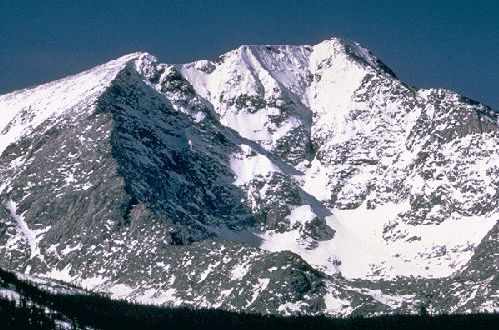
Rocky Mountains.
In the recesses of the Rocky Mountains, from Colorado northward through Alberta, and in the depths of the sub-arctic forest beyond the Saskatchewan, there have always been found small numbers of the bison, locally called the mountain buffalo and wood buffalo; often indeed the old hunters term these animals “bison,” although they never speak of the plains animals save as. They form a slight variety of what was formerly the ordinary plains bison, intergrading with it; on the whole, they are darker in color, with longer, thicker hair, and, in consequence, appear heavier-bodied and shorter-legged.
They have sometimes been spoken of as forming a separate species. Still, judging from my limited experience and comparing the many hides I have seen, I think they are the same animal, many individuals of the two so-called varieties being quite indistinguishable. The only moderate-sized herd of wild bison in existence today, the protected herd in Yellowstone Park, is composed of animals intermediate in habits and coat between the mountain and plains varieties—as were all the herds of the Bighorn, Big Hole, Upper Madison, and Upper Yellowstone valleys.
However, these wood and mountain bison’s habitat sheltered them from hunters in a way the plains never could. Hence, they have always been harder to kill in one place than in the other for precisely the same reasons that have held good with the elk, which have been completely exterminated from the plains while still abundant in many of the forest fastnesses of the Rockies. Moreover, the bison’s dull eyesight is no special harm in the woods. At the same time, it is peculiarly hurtful to the safety of any beast on the plains, where eyesight avails more than any other sense; the true game of the plains being the prong-buck, the keenest-sighted American animals. On the other hand, the bison’s hearing, of little avail on the plains, is of much assistance in the woods, and its excellent nose helps equally in both places.
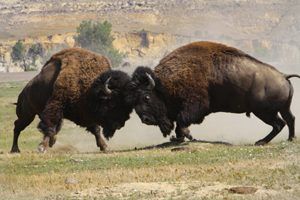
Buffalo at Roosevelt National Park, North Dakota.
Though it was always more difficult to kill the bison of the forests and the mountains than the bison of the prairie, now that the species is, in its wild state, hovering on the brink of extinction, the difficulty has increased immeasurably. A merciless and terrible process of natural selection, in which the agents were rifle-bearing hunters, has left as the last survivors in a hopeless struggle for existence only the wariest of the bison and those gifted with the sharpest senses. Mr. Hornaday’s graphic account of his campaign against the few scattered buffalo living in 1886 between the Missouri and the Yellowstone, along the Big Dry, shows this was true of the last lingering individuals who survived the great slaughter on the plains. The bison of the plains and the prairies have now vanished. So few of their brethren of the mountains and the northern forests are left that they can just barely be reckoned among American game, but whoever is so fortunate as to find any of these animals must work his hardest and show all his skill as a hunter if he wishes to get one.
In the fall of 1889, I heard that very few bison were still left around the head of Wisdom River. I went and hunted faithfully; there was plenty of other game, but of bison, not a trace did we see. Nevertheless, a few days later that same year, I came across these great wild cattle at a time when I had no idea I would see them.
As nearly as we could tell, it was in Idaho, just South of the Montana boundary line and about 25 miles west of the Wyoming line. We were camped high among the mountains with a small pack train. On the day in question, we went out to find moose but saw no sign of them, and then began to climb over the higher peaks with the idea of getting sheep. The old hunter who was with me was, very fortunately, suffering from rheumatism, and he, therefore, carried a long staff instead of his rifle; I say fortunately, for if he had carried his rifle, it would have been impossible to stop his firing at such game as bison, nor would he have spared the cows and calves.
About mid-afternoon, we crossed a low, rocky ridge above the timberline and saw a basin, or round valley, of singular beauty at our feet. Steep mountains formed its walls. At its upper end lay a small lake, bordered on one side by an emerald-green meadow. The lake’s other side marked the edge of the frowning pine forest, which filled the rest of the valley and hung high on the sides of the gorge that formed its outlet. Beyond the lake, the ground rose in a pass evidently much frequented by game in bygone days, their trails lying along it in thick zigzags, each gradually fading after a few hundred yards and then starting again a little farther on, as game trails so often seem to do.
We bent our steps toward these trails, and no sooner had we reached the first than the old hunter bent over it with a sharp exclamation of wonder. The unmistakable hoof marks of a small band of bison were apparently a few hours old in the dust. They were headed towards the lake. Half a dozen animals were in the party; one was a big bull, and two were calves.
We immediately turned and followed the trail. It led down to the little lake, where the beasts had spread and grazed on the tender, green blades and had drunk their fill. The footprints then came together again, showing where the animals had gathered and walked off in single file to the forest. They had come to the pool in the early morning, walking over the game pass from some neighboring valley, and after drinking and feeding, had moved into the pine forest to find some spot for their noontide rest.
It was a very still day, and nearly three hours of daylight left. Without a word, my silent companion, who had been scanning the whole country with hawk-eyed eagerness besides scrutinizing the sign on his hands and knees, took the trail, motioning me to follow. In a moment, we entered the woods, breathing a sigh of relief; for a while in the meadow, we could never tell that the buffalo might not see us if they happened to be lying in some place with a commanding lookout.
The old hunter was thoroughly roused and showed himself a skillful tracker. We were much favored by the character of the forest, which was rather open and, in most places, free from undergrowth and down timber. As in most Rocky Mountain forests, the timber was small compared to the giant trees of the Pacific coast groves and the forests of the northeast. The ground was covered with pine needles and soft moss so that it was not difficult to walk noiselessly. Once or twice, when I trod on a small dry twig or let the nails in my shoes clink slightly against a stone, the hunter turned to me with a frown of angry impatience. Still, as he walked slowly, continually halting to look ahead and stooping over to examine the trail, I did not find it difficult to move silently. I kept a little behind him and to one side, except when he crouched to take advantage of some cover, and I crept in his footsteps. I did not look at the trail at all but kept watching ahead, hoping at any moment to see the game.
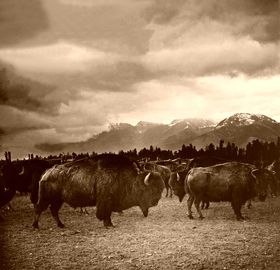
Buffalo Herd in Montana.
Not long before, we struck their day beds, made on a knoll where the forest was open, and there was much down timber. After leaving the day beds, the animals first fed separately around the grassy base and sides of the knoll, then made off in their usual single file, going straight to a small pool in the forest. After drinking, they left this pool and traveled down towards the gorge at the mouth of the basin, the trail leading along the sides of the steep hill, dotted with open meadows, while the roar of cataracts, by which the stream was broken, rose from below. Here, we moved with redoubled caution, for the sign had grown very fresh, and the animals had once more scattered and begun feeding. When the trail led across the glades, we usually skirted them to keep in the timber.
At last, as we neared the edge of one of these meadows, we saw movement among the young trees on the other side, not 50 yards away. Peering through the safe shelter yielded by some thick evergreen bushes, we speedily made out three bison, a cow, a calf, and a yearling, grazing greedily on the other side of the clearing, under the fringing timber, all with their heads uphill. Soon, another cow and calf stepped out after them. I did not wish to shoot, and waited for the big bull I knew was accompanying them to appear.
So, for several minutes, I watched the great, clumsy, hairy beasts, all unconscious, graze in the open meadow. Behind them rose the dark pines. At the left of the clearing, the ground fell away to form the side of a chasm; down in its depths, the cataracts foamed and thundered; beyond, the vast mountains towered, their crests crimsoned by the sinking sun. Mixed with the eager excitement of the hunter was a certain half-melancholy feeling as I gazed on these bison, themselves part of the last remnant of a doomed and nearly vanished race. Few are the men who now have, or evermore shall have, the chance of seeing the mightiest American beasts, in all their wild vigor, surrounded by the tremendous desolation of their far-off mountain home.
At last, when I had begun to grow very anxious lest the others should take alarm, the bull likewise appeared on the meadow’s edge and stood with outstretched head, scratching his throat against a young tree, which shook violently. I aimed low, behind his shoulder, and pulled the trigger. At the crack of the rifle, all the bison, without the momentary halt of terror-struck surprise so common among game, turned and raced off at headlong speed. The fringe of young pines beyond and below the glade cracked and swayed as if a whirlwind were passing, and in another moment, they reached the top of a very steep incline, thickly strewn with boulders and dead timber. Down this, they plunged with reckless speed; their surefootedness was a marvel in such seemingly unwieldy beasts. A column of dust obscured their passage, and under its cover they disappeared into the forest, but splashes of frothy blood marked the bull’s trail, and we followed it at a trot. Fifty yards beyond the forest border, we found the stark black body stretched motionless. He was a splendid old bull, still in his full vigor, with large, sharp horns, a heavy mane, and a glossy coat, and I felt the most exulting pride as I handled and examined him, for I had procured a trophy such as can fall henceforth to few hunters indeed.
It was too late to dress the beast that evening, so after taking out the tongue and cutting off enough meat for supper and breakfast, we scrambled down to near the torrent and, after some search, found a good spot for camping. Hot and dusty from the day’s hard tramp, I undressed and plunged into the stream, the icy water making me gasp. Then, after building a slight lean-to of brush and dragging together enough dead timber to burn all night, we cut long alder twigs, sat down before some embers raked apart, and grilled and ate our buffalo meat with the utmost relish. Night had fallen; a cold wind blew up the valley; the torrent roared as it leaped past us and drowned our words as we strove to talk over our adventures and success, while the fire flickered and danced, lighting the gloom of the forest round about with continual vivid flashes.
By Theodore Roosevelt, 1893. Compiled by Kathy Alexander/Legends of America, updated October 2026.
See our Bison Photo Gallery HERE
Also See: