

Mining ruins at Silver Reef, UT. Photo by Kathy Alexander.
Alas, the homes that sprang so quickly
Soon were vacant, empty rooms.
But the pioneers who viewed them
Could not see them just decay,
And they brought their teams and wagons,
Hastily hauling them away.
Now, a scarred and lonely landscape
Greets the trav’lers wondering gaze,
As he comes to view the remnants
Of this camp of by-gone days.
And, so, we love your memory,
Sad old Silver Reef!
And your bright, new promise too,
Of a newer flow of metals,
Lately come to light,
That can even help our Nation in defending
What is right.
— Marietta M. Mariger, 1951
Located about 15 miles northeast of St. George, Utah, the “ghost town” of Silver Reef got its start when silver was discovered in the limestone cliffs of the eastern slope of the Pine Valley Mountains. Silver in sandstone?? It was unbelievable and has spawned numerous tales of exactly how the ore was discovered.
The most often told tale is of a prospector named John Kemple, who had been roaming the sandstone reefs in search of any metallic color back in 1866; he took shelter with a family in the Mormon settlement of Leeds. Welcoming the tired and chilled man into their home, they got the fire roaring to warm him up, and as Kemple sat staring into the fire, he allegedly saw a small shining stream ooze from an overheated rock. The next day, he began searching for the source of what he believed was silver. Though he did find a small sample, it wasn’t enough to keep him in the area, and he soon moved on to Nevada.
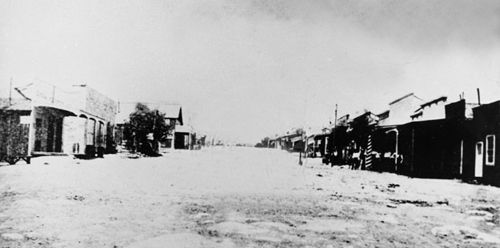
Silver Reef, Utah, 1880s.
A later story tells of an assayer in the notorious mining town of Pioche, Nevada, just across the state line, who was infamous for his overstated ore values. Referred to by area prospectors as “Metalliferous” Murphy, two miners decided to pull a prank on him and submitted pieces of a broken grindstone for assay. When Murphy predictably reported that the fragments contained silver valued at 200 ounces per ton, the miners revolted, threatening to hang Murphy if he didn’t immediately leave town. Murphy complied, but not before he tracked the source of the fragments of the grindstone back to the area that would soon be called Silver Reef. Murphy then headed to Utah in search of the “sandstone silver.” Though there is no record of the assayer ever filing a claim, he quickly drew the attention of other prospectors, and silver was soon confirmed to be hidden within the sandstone rock formations, much to the surprise of many skeptical miners. It was the first and only time silver has been found in North American sandstone.
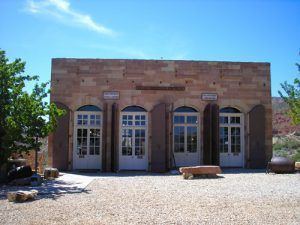
Silver Reef – Wells Fargo office.
In 1874, John Kemple returned to the area and established the Harrisburg Mining District. Though he filed several claims for unknown reasons, he never developed them. Soon, word got out, and the hills were crawling with prospectors. The area drew the attention of two Salt Lake City bankers, who backed a well-known prospector, William T. Barbee, in 1875. The miner staked more than 20 claims and established a town he called Bonanza City. Though the settlement offered very little in its early days, the lot prices were so high that most miners couldn’t afford them. Instead, they established a tent city nearby that they called “Rockpile.”
After the mines closed in Pioche, Nevada, in November of 1875, several businesses moved into the area, setting up their establishments in “Rockpile,” rather than Bonanza City.
The rapidly growing community then changed its name to Silver Reef, and by February 1877, the camp was filled with more than 1,000 men seeking their fortunes.
Within no time, the town boasted more than 100 businesses stretched out along a mile-long main street, including nine grocery stores, six saloons, a newspaper called the Silver Echo, eight dry goods stores, a bank, a Wells Fargo office, a hospital, hotels and boarding houses, and five restaurants.
Though surrounded by Mormon settlements, Silver Reef never had a Mormon Church. Rather, the Catholic Church was the only one in town, and they allowed the Presbyterians to use its building for services. A school was also built that other denominations used for services and where the community held public meetings and celebrations. The building was moved to nearby Leeds in the early 1900s.
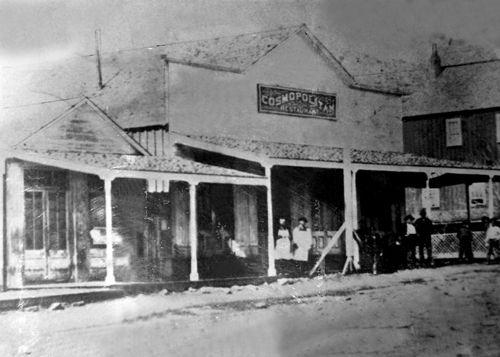
Silver Reef-Cosmopolitan Restaurant North of Wells Fargo
By 1879, the town was home to some 2,000 people and included a horse racetrack, a brewery, and a brass band. But it was a bad year for the settlement, as a major fire swept through the town, the price of silver dropped, labor disputes erupted in the mines, and flooding occurred in many of the low-level mine shafts.
However, Silver Reef endured, centered within a six-mile area of active mines that produced more than a million dollars in ore each year. But its demise was imminent. In late 1881, silver prices dropped worldwide, the mines were filling with water faster than the workers could pump it out, and mine owners began lowering wages.
Most miners could no longer afford to stay and began to move. By 1884, most of the area mines had closed, and Silver Reef quickly became a ghost town. By 1890, less than 200 people had remained in the area, and the following year, the last mine shut down, though ore continued to be brought out of the area for the next decade. Over the years, Silver Reef produced about 25 million dollars worth of ore.
In the early 1900s, many of the remaining buildings were demolished, and in 1908, a fire destroyed most of what was left.
Several historic buildings remain in Silver Reef, including a collapsed mine, numerous foundations and ruins, and two cemeteries.
The 1877 Wells Fargo Office was utilized as a residence until the late 1940s. Listed on the National Register of Historic Places, today, it serves as a museum and art gallery.
The 1876 Rice Bank Building was completely taken apart and rebuilt to serve as a jail during a major mining dispute in the late 1800s, and it continues to stand. During the conflict, one mine foreman was run out of town, and another was tarred and feathered. The authorities then arrested the union leaders, but because of the limited space in the old bank building, a line was drawn around the building to “hold” the men. Anyone crossing the line was threatened with being shot. In 1991, the building was fully restored.
Behind the Wells Fargo building is a restored powder house that serves as an information center.
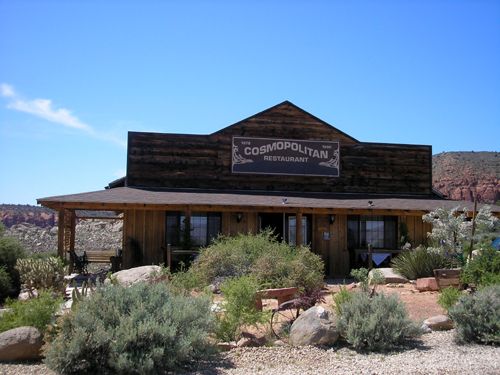
Silver Reef, UT – Cosmopolitan Restaurant.
The Cosmopolitan Restaurant appears to have been rebuilt to appear as it did more than a century ago. Though it looks rustic on the outside, the gourmet restaurant serves European Cuisine in a fine dining atmosphere.
Scattered throughout the town are numerous ruins and foundations, especially in the gully behind the old town site, where crumbling mine buildings still stand. The formerly mile-long main street has been reduced to several hundred yards and is surrounded by an upscale community of private homes on a private drive restricting public access. Nearby are the remains of both Catholic and Protestant cemeteries.
Silver Reef is about 15 miles northeast of St. George, Utah, just off Highway 15. Take the Leeds Exit (#22) and travel 1.5 miles West.
©Kathy Alexander/Legends of America, updated August 2026.
Also See:
Ghost Towns of Utah Photo Gallery
See Sources.