
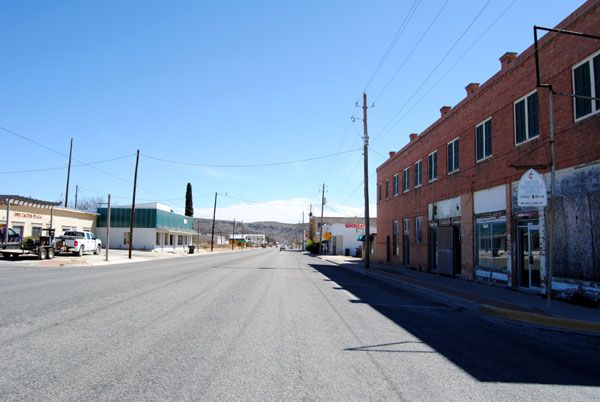
Even though Sanderson remains the county seat of Terrell County, it looks a little bit ghost-towny. Kathy Alexander.
Sanderson, Texas, the county seat of Terrell County, is located on a picturesque portion of the Pecos Trail and along Historic U.S. Highway 90. Known as the Cactus Capital of Texas and the East gate to the Big Bend Wilderness Area, Sanderson is home to most Terrell County residents. Situated on U.S. Highway 90 about midway between San Antonio and El Paso, it has a rich and colorful past that can be seen in many of its historic buildings.
Along with the many other railroad towns of the area, Sanderson began with the construction of the Galveston, Harrisburg, & San Antonio Railroad. In 1881, railroad surveyors reached the site of present-day Sanderson. The area had very few residents at that time, except a few early sheep ranchers.
The site was first called Strobridge after James H. Strobridge, president of the transcontinental railroad construction company. It was originally planned to be the midway point where the rail-building efforts from San Antonio and El Paso would join. However, work fell behind in the canyon country east of present-day Sanderson, and the silver spike was driven far to the east near Shumla, Texas.
One of the first to settle in the area was a man named Charlie Wilson, who established a saloon near the site of the proposed railroad terminal. Calling it the Cottage Bar Saloon, Wilson also bought all of the lands that would later become the Sanderson townsite. In these earliest days, he also had a competitor – no other than Roy Bean, who hoped to capitalize on the incoming railroad crews. However, when Bean opened another saloon, Wilson spiked his whiskey with “coal oil,” Bean soon moved eastward to Vinegarroon and Langtry. Wilson’s riddance of his competitor would later earn Sanderson the name “Town Too Mean for Bean.”
As the sole landowner other than the railroad, Wilson, affectionately called “Uncle Charlie,” quickly worked on developing the town. Not only did he initially own the only saloon, but he also became the first real estate developer, selling lots to prospective businesses and homeowners. He would also become known as a community philanthropist, giving money and land to many good causes.
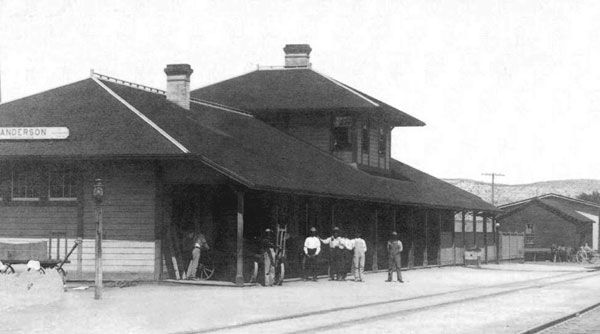
Sanderson Depot about 1910.
In 1882, when a roundhouse was built, the site’s name was changed to Sanderson after Joseph P. Sanderson, the engineer in charge of construction. After the Southern Pacific Railroad acquired an interest in the Galveston, Harrisburg, & San Antonio Railroad, the depot was constructed in the fall of 1882. Built to the Southern Pacific Railroad standards, it was similar to other depots in many western states. It was initially about 130 feet long, with equal extensions on either side of the central 2-story depot master’s residence. The east end contained a lunchroom, locally known as the “Beanery” and the west end contained a freight warehouse. The railroad would eventually employ hundreds of workers and include 13 tracks in Sanderson.
Along with the railroad, the local cattle and sheep ranchers grew as Sanderson became a prominent shipping point. In 1883, the fledgling community gained a post office. In its earliest days, it was like many other frontier towns – unruly with its many railroad workers and cowboys.
Terrell County was created by the Texas Legislature in 1905 by carving about 1,500,000 acres out of Pecos County. As a result of a county election, Sanderson became the County Seat, and business began to grow. Before long, it boasted a number of hotels, a drug store, a doctor, a vaudeville theater, and the three-story brick Kerr Mercantile building.
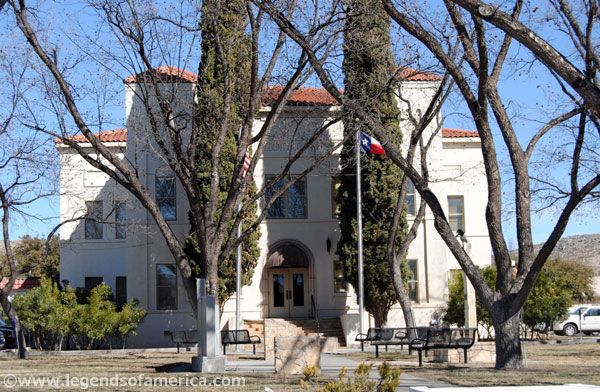
Sanderson became the Terrell County Seat in 1905 by Kathy Alexander.
The Terrell County Courthouse was also constructed in 1905. It was later remodeled in a Spanish colonial style in 1930. Continuing to be used today, it is located between 1st and 2nd Streets and Hackberry and Mansfield Streets.
In 1910, the railroad was thriving, and a 50-foot extension was added to the west end, creating a new passenger ticketing and waiting room area, a baggage handling facility, a Railway Express Agency office, a Western Union telegraph office, and a bump-out bay window for the station operators to see oncoming trains.
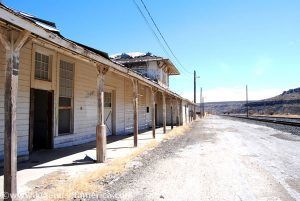
The Sanderson depot was instrumental to the town’s growth. On October 15, 2011, it was threatened with demolition. An organization was formed to save the depot; however, adequate funds could not be raised. It was demolished in October 2012. Photo by Kathy Alexander, February 2011.
A much larger freight house was also constructed east of the depot to handle the massive shipments of wool and mohair, which dominated the Sanderson economy for years. In later years, as locomotives grew more powerful, bigger, and longer, the roundhouse was extended to the front to accommodate the larger engines. Most repairs could be done at this facility, except for major overhauls.
Once automobiles became popular, the old San Antonio-El Paso Road, long used by soldiers, wagons, and westward-bound emigrants, was transformed into an “auto highway.” In 1922, it became Texas State Highway #3 and, later, U.S. Highway 90, the main “coast-to-coast” route through the area. Before long, all services, including gas stations, restaurants, and lodging facilities, sprang up in Sanderson for the many travelers headed east or west.
Over the years, Terrell County became one of the biggest sheep and wool producers in the U.S. By 1926, 11,000 lambs, averaging $6 per head, were sold in one of the most significant lamb sales in history. Additionally, the Sanderson Wool Commission sold thousands of pounds of wool and mohair annually.
The community continued to thrive until reaching its peak of about 3,000 people in the 1950s. Afterward, the population began to decline, encouraged by several events. On June 11, 1965, Sanderson was devastated by a flash flood as a wall of water roared down Sanderson Canyon into town, destroying numerous homes and businesses, taking out highway bridges and railroad tracks, and killing 27 people. As a result, 11 flood-control dams were built to protect the city against another such catastrophe. The town slowly recovered after the tragic loss, but the population did not.
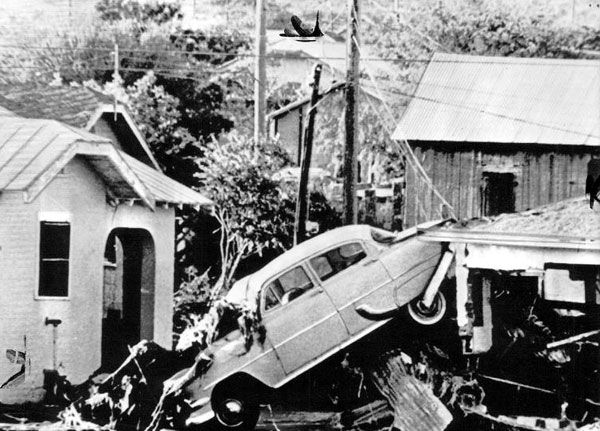
Sanderson, Texas Flood Destruction 1965.
In 1970, the depot continued to thrive until the Southern Pacific Railroad turned passenger operations over to the newly formed Amtrak. By this time, the Southern Pacific had reduced its operations to a minimum and focused only on freight operations.
Another blow came to the community after Interstate Highway 10 was completed through Texas in the 1970s. Before that time, U.S. Highway 90, barreling right through Sanderson, was the main route to points east and west.
Making matters worse was when the Southern Pacific Railroad moved its crew base from the Sanderson terminal to Alpine in 1995, taking numerous families out of the community. The following year, the Southern Pacific Railroad was bought by the Union Pacific Railroad, and all operations were moved to Alpine. The depot was closed, and all maintenance stopped. With the depot abandoned, the historic building became the target of vandalism and theft. Before long, almost all of the fixtures and furnishings, up to and including lighting and plumbing, were stolen. Though Amtrak still makes stops in Sanderson, no passenger facilities are provided.
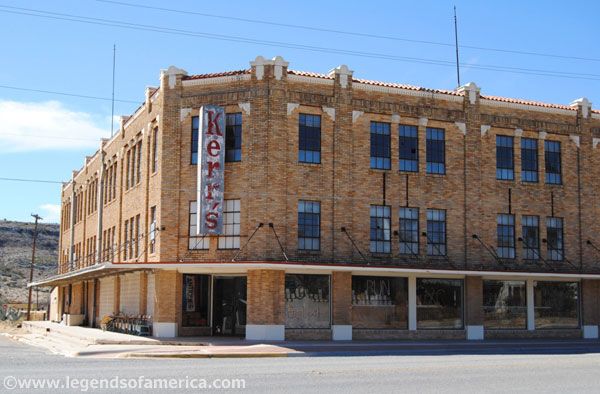
Constructed in 1927 of solid concrete and brick, the Kerr Mercantile building in Sanderson is for sale at the time of this writing. Photo by Kathy Alexander.
The depot, located on Downie Street, was scheduled to be demolished in 2011. An organization was formed to save it; however, adequate funds could not be raised. It was demolished in October 2012.
Today, Sanderson continues to be the county seat of Terrell County and has worked hard to preserve its heritage while providing modern amenities and services to locals and visitors alike. Although it is home to only about 900 people today, it lies between beautiful canyons and enjoys a wonderful climate year-round.
Progress includes promotion through preservation, rural technology, increased recreational facilities, and infrastructure improvements. The small town is also known for its quality public schools, low crime rates, and low cost of living. While visiting Sanderson, the Terrell County Memorial Museum is a good stop, which features railroad memorabilia, cowboy and ranching relics, tools, and pioneer furnishings, and mementos of Terrell County History. The Terrell County Visitor Center provides information about Sanderson, Terrell County, and the Big Bend National Park and Wilderness Area. A Walking or Windshield Tour begins and ends at the Visitor Center.
©Kathy Alexander/Legends of America, updated May 2025.
Also See:
Del Rio to Sanderson on the Pecos Trail
See Sources.