
Welcome to McLean, Texas, by Kathy Alexander.
McLean, Texas, located on Route 66 in southeastern Gray County, is a time capsule into simpler times.
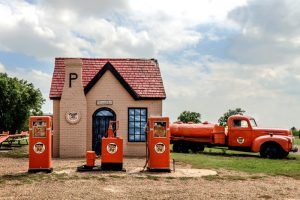
Restored Phillips 66 Station in McLean, Texas, by Carol Highsmith.
McLean started as nothing more than a cattle-loading site along the Chicago, Rock Island, and Gulf Railway when, in 1901, a water well was dug, and a switch and a section house were built. But among the railroaders, a large rancher had a vision. Alfred Row, an Englishman, saw a greater opportunity for the area and donated land near the switching station to lay out a townsite.
Naming the town for W.P. McLean of the Texas Legislature and Railroad Commission, the town quickly grew, gaining a post office by 1902. Just one year later, the town was incorporated and boasted two banks, two livery stables, two wagon yards, two cafes, a post office, a lumber yard, a newspaper called the McLean News, and a furniture store. A windmill pumped water from a well drilled in the middle of Main Street, and residents hauled their water from the mill home in barrels and buckets.
By 1909, McLean had become a center for area agriculture, with several hundred carloads of hogs and watermelons shipped annually from the rail station. In fact, it became so busy that four telegraph operators were required to handle the messages of the railroad business.
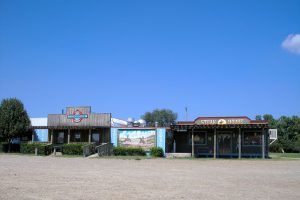
Red River Steakhouse in McLean, Texas, by Kathy Alexander.
In 1912, Alfred Rowe, the town’s founder, left McLean to visit his native England. Tragically, he would never see McLean again, as, upon his return to the United States, he met his death on the Titanic when the grand ship sank in the Atlantic in the early morning hours of April 15, 1912. Legend has it that rescuers found him hugging his briefcase, frozen to death atop an ice floe, with his gold watch still ticking.
In 1927, the town profited from the oil boom, becoming a major shipping point for livestock, gas, and oil. In the very same year, the Mother Road arrived in McLean, further ensuring the town’s growth for the next several decades. During the Golden Age of Route 66, McLean boasted 16 service stations, six motels, and numerous cafes. Oklahoma-based Phillips Petroleum Company built one of its first Texas service stations in McLean in 1929; its first was in Turkey, Texas, in 1928. By 1940, McLean had six churches, a newspaper, 59 businesses, and a population of more than 1,500.
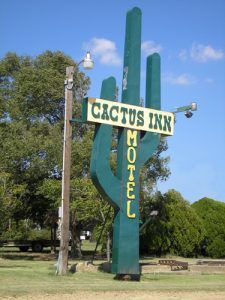
Cactus Inn Motel in McLean, Texas, by Kathy Alexander.
In September of 1942, an area northeast of McLean was designated as the McLean Permanent Alien Internment Camp during World War II. During its operation, the camp boasted 20 to 30 buildings and housed 3,000 prisoners of war. The first prisoners were German troops captured in North Africa, who arrived in early 1943. A second group of Germans captured in their Homeland were also retained at the camp. During its time, there were several escape attempts from the camp, but there was nowhere to go on the bare plains of the Texas Panhandle. All were recaptured and seemed glad to return to prison. The camp continued to operate until July 1, 1945.
With nearby Amarillo’s growth and Pampa’s emergence as the county’s industrial center, McLean’s population began to fall. In the late 1970s, Interstate 40 began to bypass many small towns in the Texas Panhandle. McLean business owners fought hard to keep McLean alive, knowing that a bypass would divert the tourist trade on which many service stations, motels, and cafes thrived. Doing their best, the town fought to stop, or at least slow, the eventual building of the Interstate to no avail. Construction of the bypass started in March 1982 and was completed in the summer of 1984. Though McLean was the last Texas Route 66 town bypassed by Interstate 40, the move further reduced its population. Today, McLean is home to just over 800 citizens.
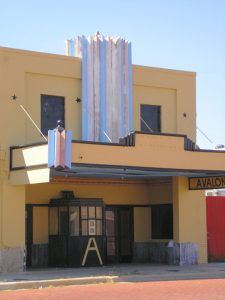
The Avalon Theater in McLean, Texas, was razed in 2017 due to safety issues.
However, McLean’s lack of growth is undoubtedly why the town today feels like a nostalgic step back in time. Watch for great murals on the buildings as you pass through town!
The McLean Commercial Historic District was placed on the National Register of Historic Places in 2004. Unfortunately, the town lost one of its historic district buildings in 2017. The old Avalon Theater on Main Street was built in the late 1920s and contained 450 seats. After years of showing movies, it was closed in January 1997. The Route 66 Association of Texas restored its art deco facade. However, the building had become dilapidated over the years, and one of its back walls collapsed. It was torn down for safety reasons in August 2017.
McLean is now the headquarters of the Texas Historic Route 66 Association, located in the Devil’s Rope Museum. A Texas Route 66 Newsletter is published quarterly, and brochures and other information are available at the first 66 museum on the route.
McLean is 75 miles east of Amarillo, on I-40 and Old Route 66, and can be reached via Exits 141, 142, and 143.
From McLean, follow the south side frontage road to Alanreed.
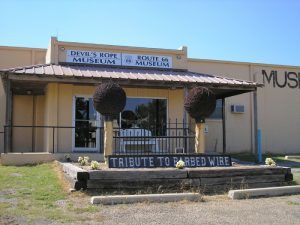
Devil’s Rope Museum in McLean, Texas, by Kathy Alexander.
©Kathy Alexander/Legends of America, updated April 2026.
Also See:
See Sources.