

Hecla Mines atop Lion Mountain, Montana.
In the 1870s, four mining camps started in the Hecla Mining District on the side of Lion Mountain. Also referred to as the Glendale or Bryant Mining District, which was strung out along ten miles of gulches, the four towns included Trapper City, Lion City, Glendale, and Hecla. One of the last districts to be established in the Pioneer Mountains, it was also one of the richest, producing silver, lead, copper, and zinc ore valued at nearly $20 million over the years.
The first claim in the area was made in 1872 by two men, William “Billy” Spurr and James Bryant, who named it the Forest Queen. However, Spurr recorded the claim in his name but never worked it. The following year, James Bryant returned to the area with several other men and began looking for other potential claims.
During this excursion, a silver outcropping called the Trapper Lode was found. After staking their claim in Bannack, Montana, the men began to work the mine, taking silver and lead out by pack train and wagons to be loaded at the railroad at Corinne, Utah, and sent to Denver, Colorado, for smelting.
Word quickly spread, and before long, the area was filled with many prospectors from Bannack. More lodes were soon discovered, and the Cleve and Avon Mines were soon being worked. The first mining camp was Trapper City, which established a post office in 1873. Soon, the camp also boasted a hotel, several saloons, a brothel, a general store, a butcher shop, a livery stable, and numerous cabins lining Trapper Creek. The settlement reached a population of nearly 200 but was short-lived as mining began to move up onto Lion Mountain.
In 1875, a 40-ton smelter was built farther down Trapper Creek by Noah Armstrong and Charles Dahler. The mill workers’ camp that grew up around it was named Glendale, and a post office was opened the same year. Numerous employees and their families soon made their homes in Glendale, the tamest and most civilized of the four mining camps in the district. The new town also sported “The Montana Brewery,” owned by John Mannheim, who had formerly operated the brewery at Bannack. Noah Armstrong owned a general merchandise store.
Two years after building the smelter, Noah Armstrong and investors from the east formed the Hecla Consolidated Mining Company, buying out the Trapper Lode’s original claimants and aggressively developing the organization. The mining company was named after a painting hanging in its payroll office, depicting Mt. Hecla, a volcano on the Icelandic Continent. Soon, the new mining organization began buying up most of the workings on Lion Mountain, including the Cleopatra, Trapper, Franklin, Cleve-Avon, Mark Anthony, Ariadne, True Fissure, and Atlantus lodes. By 1878, Glendale had grown to almost 1000 residents.
Also growing was the new camp of Lion City, at the base of Lion Mountain, and by 1878, almost everyone had abandoned Trapper City and moved to Lion City or Glendale. Trapper City’s businesses also moved, and Lion City soon boasted three saloons, two brothels, two hotels, several businesses, a school, mining buildings, numerous cabins, and about 600 people.
In the meantime, the Glendale smelter was busy producing about one million ounces of silver and thousands of tons of lead and copper annually until it burned down in July 1879. That same year, Noah Armstrong was replaced by Elias C. Atkins as the Hecla Consolidated Mining Company’s General Manager. However, the company was not faring as well as its investors would like, and he, too, was replaced in April 1881 by Henry Knippenberg. The new general manager quickly reorganized the company, splitting it into three divisions and appointing a superintendent for each. By the end of the year, the company was profitable once again. In the meantime, the Glendale Smelter was rebuilt, enlarged, and returned to operation.

Glendale, Montana Smelter.
New manager Henry Knippenberg also made his home in Glendale, building a mansion that looked over the townsite for his family. Glendale continued to grow, boasting numerous businesses, hotels, four saloons, a newspaper called The Atlantis, restaurants, a school, an opera house, a church, a hospital, and one of the largest skating rinks in the state. The town peaked at about 2000 people during the early 1880s.
At the same time, Knippenberg also created the company town of Hecla, about a mile from Lion City, primarily to remove miners from the many bawdy opportunities in Lion City. Building boarding houses for miners and relocating the company’s mine offices to the new site provided easier access to the mines and improved miners’ morale.
In 1882, Knippenberg added the Greenwood Concentrator halfway down the mountain and laid four miles of narrow-gauge tramway to move the ore from Hecla to the mill. The mine operations continued to expand, and by 1885, the plant consisted of three blast furnaces, two crushers, a large roaster, two powder houses, warehouses, and numerous other mine buildings.
Unfortunately, like many others, the Hecla Mining District was hard hit when the Sherman Silver Purchase Act was repealed in 1893. Though operations continued on a smaller scale, the ore was played out dramatically by the turn of the century. The company’s significant producing mine, the Cleopatra, shut down in 1895, and in 1900, the Glendale Smelter was torn down. Only the Atlantis and Cleve Mines continued to operate, but by 1904, all Hecla Consolidated Mining Company operations ceased.

Glendale, Montana, today.
But Henry Knippenberg was not convinced that the district’s heydays were entirely over, and that same year, he bought the operations at a sheriff’s sale. Knippenberg then leased the properties to the Penobscot Mining Company, which continued to mine the area for several years. Finally, in 1915, the mines closed forever, but still more ore was to be worked in the old slag piles, which continued until 1922.
For the next several decades, the property changed hands numerous times as new developers attempted to work the old mines and tailings. Though small amounts of ores were recovered, these ventures were unprofitable.
Though its prosperous times were finally over and its mining camps abandoned, the Hecla Consolidated Mining Company was one of the more successful, paying dividends to its investors for over two decades.
Today, all signs of Trapper City are long gone, but Glendale still displays the smelter stack, the remains of the old stone office building, and a few old buildings. Lion City and Hecla also sport just a few remaining buildings and mining remains. The old charcoal kilns are about five miles beyond Glendale on Canyon Creek Road.
The district can be reached from I-15, near Melrose, at Exit 93, on Trapper Creek Road. Glendale is about five miles, and Lion City and Hecla are another seven miles. A four-wheel drive or ATV is recommended.
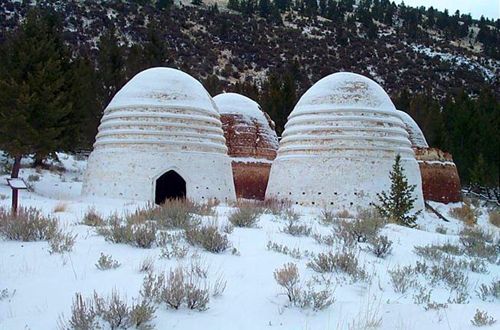
Charcoal kilns on Canyon Creek, Montana.
More Information:
©Kathy Alexander/Legends of America, updated November 2025.
Also See:
See Sources.