
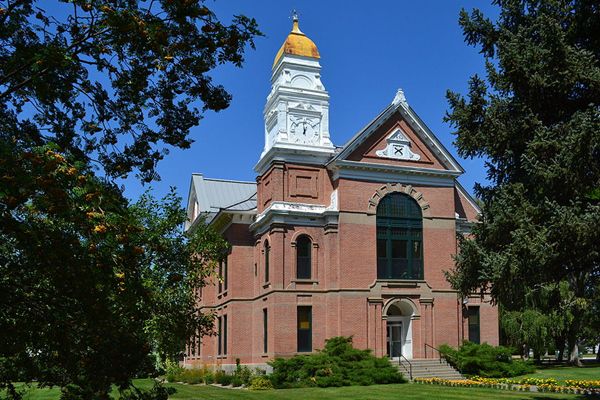
Chouteau County Courthouse in Fort Benton, Montana, courtesy of Wikipedia.
Fort Benton is a city and the county seat of Chouteau County, Montana, established in 1846, making it the oldest settlement in the state. The city’s waterfront along the Upper Missouri River was the most critical factor in its growth in the 19th Century.
In 1845, Alexander Culbertson, an agent for the American Fur Company, established Fort Lewis about 18 miles upstream from present-day Fort Benton to trade with the Blackfeet Indians. However, the tribe did not like the location, so a year later, Culbertson moved the post to a more accessible spot on the Missouri River. The log buildings were then dismantled and floated downstream to the new site, situated on a broad, grassy riverbank on the North side of the Missouri River. The post was reassembled and kept the name Fort Lewis, which was named for Meriwether Lewis of the Lewis and Clark Expedition.
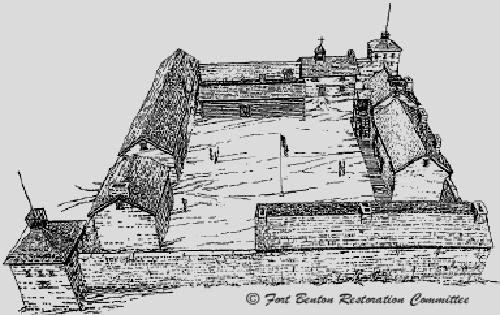
Fort Benton, Montana.
In its early years, many traders sent whiskey into Canada to lure Indians away from trade with the Hudson’s Bay Company. As the Canadian Mounties worked to curtail the whiskey trade, they also created additional trading opportunities for Fort Benton by bringing back supplies for the Canadian posts. While this was profitable for Fort Lewis, selling liquor to the Indians nearly cost the American Fur Company its license; however, Missouri Senator Thomas Hart Benton stepped in, saving them from losing the opportunity to trade.
Meanwhile, Albert Culbertson visited Fort Laramie, Wyoming, and was impressed by the adobe buildings there. Knowing these buildings would provide more protection against extreme weather and any forthcoming attacks, he began construction of new buildings at Fort Lewis in the fall of 1848. During this time, as many clay bricks were being made for the new structures, the post was often referred to as Fort Clay.
Culbertson’s two-story dwelling was the first building completed, and more buildings followed, including a new trade store, trader’s quarters, a warehouse, a blacksmith and carpenter shop, and a barn. Two 20-foot blockhouses sat opposite corners, with their second story strong enough to support the movement of brass-barreled cannons. One blockhouse served as both a powder magazine and an armory. A 14-foot-high adobe wall connected the blockhouses and surrounded the post. When the new post was completed in 1850, it was renamed Fort Benton in honor of Senator Thomas H. Benton, who had helped the company retain its trading license earlier.
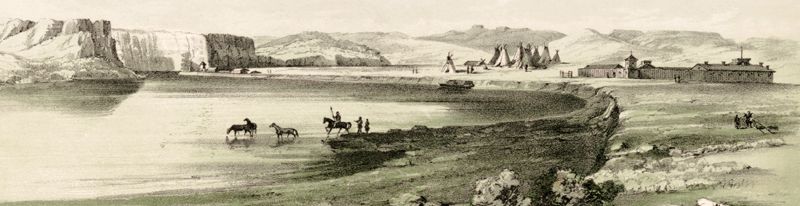
Fort Benton, Montana.
For two decades, the trading post thrived as a center of commerce and served as the American Fur Company’s base of operations. Serving Indians and white fur traders alike, the trading post flourished as pelts and hides were exchanged for clothing, arms, liquor, and other supplies. The post also served as a center for peace talks between local Indian tribes and white settlers, which concluded with a successful peace treaty in 1855. The treaty allowed the U.S. Government to build roads and navigate the Missouri River in exchange for annual annuity payments to the Blackfeet tribe. It granted the Crow Indians buffalo-hunting rights.
The fur trade era marked the first extensive use of the Missouri River as a transportation route. Keelboats, Mackinaws, bullboats, and canoes were first used to transport traders, supplies, and furs. Soon, however, the vast profits encouraged steamboat captains to brave the Missouri River’s treacherous waters. Although steamboat navigation on the Missouri River began in 1831 with the arrival of the steamer Yellowstone at Pierre, South Dakota, it took several years for steamboats to reach the area, as the waters upstream were far more treacherous.
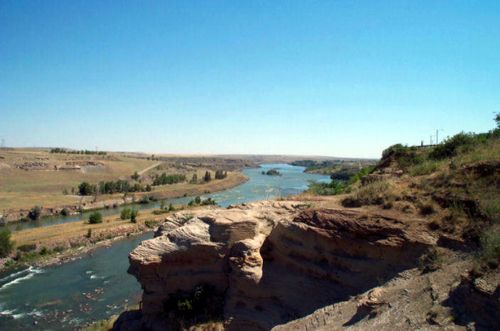
The Missouri River in Montana today.
In Montana, the Missouri River was filled with submerged trees, snags, and sandbars, and its shifting currents made navigation impossible. However, years later, a new broad-bottom steamboat was designed, which first appeared in the 1850s. In 1859, Captain John LaBarge, accompanied by Charles Chouteau of the American Fur Company, attempted to reach Fort Benton on the Chippewa. However, just 12.5 miles short of their goal, they were forced to unload at the former site of Fort McKenzie. They tried again, and the following year succeeded. More steamboats followed, and another, the Key West, reached Fort Benton in July 1860, proving the Missouri River was navigable to that point.
Albert Culbertson managed the upriver trade from Fort Benton until his retirement in the late 1850s. At that time, Andrew Dawson took his place and oversaw the operation until his retirement in 1864. Isaac G. Baker was appointed to supervise the post until the following spring, when the American Fur Company withdrew from the upriver trade. By that time, the northern fur trade had fallen off. However, a thriving settlement had developed around the trading post, and Isaac Baker opened a mercantile store with his brother. The American Fur Company sold the post to the U.S. Army in 1865, which wanted it because Fort Benton sat at the eastern anchor of the Mullan Wagon Road, a road built from Washington Territory in 1859-1860. However, it would be several years before military troops occupied the site.
As the northwestern point of disembarkment on the Missouri River and the eastern terminus of the Mullan Wagon Road, the town, which also took the name of the post, continued to thrive as steamboats carrying goods, merchants, and settlers arrived in significant numbers, mainly after gold was found in Idaho and Bannack and Virginia City, Montana, in the early 1860s. Soon, stage lines, bull trains, and mule trains carried incoming supplies to points beyond Fort Benton. “All trails lead out of Fort Benton” was a familiar statement. In addition to the Mullan Road to Washington, the town also sat along the Fisk Wagon Road to St. Paul, Minnesota, and the Whoop-Up Trail, which led to Canada.
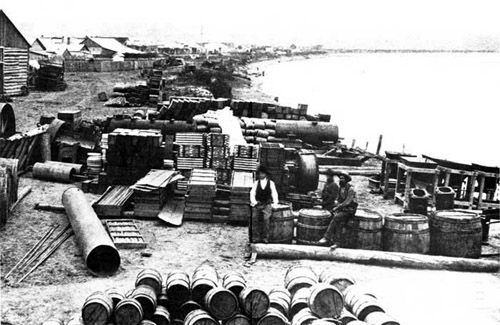
Fort Benton Boom
As the town grew in importance, people built numerous buildings along the levee, extending a mile upriver to the fort. Fort Benton became the world’s innermost port and earned a reputation as one of the toughest towns in the West. In 1865, Fort Benton became the county seat of the newly formed Chouteau County. Around the same time, the area was inundated with even more people as the Civil War drew to a close, and thousands flooded to the West in search of their fortunes. During this time, riverboat traffic was heavy as steamboats transported men and supplies to the goldfields and returned downriver with their cargo. Most made the trip by steamboat from St. Louis, Missouri, because it was faster and safer than the overland route.
The trip typically took 60-65 days, with passengers paying an average of $150. On the return trip, heading downriver, one of the steamboats’ main cargoes was Montana’s rich gold finds. In 1866, one steamboat left Fort Benton with a cargo of 2 ½ tons of gold dust from Confederate Gulch. It was valued at $1.25 million and was the wealthiest cargo to travel down the Missouri River. During the busy year of 1867, about 1,500 people made the journey to Fort Benton by steamboat.
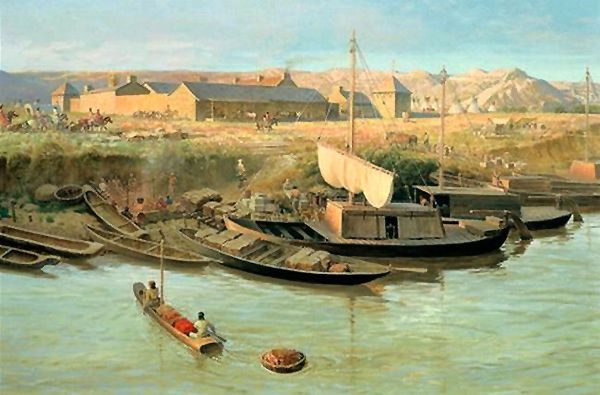
Old Fort Benton, Montana by John Ford Clymer, 1967.
By this time, Fort Benton had become prosperous, and new buildings lined the levee. However, it had also developed a reputation for rowdiness. On Front Street, between the cross streets of 15th and 16th Streets, was what was known as the “bloodiest block in the West.” Containing more than a dozen saloons, dance halls, gambling parlors, and brothels, violence was often the order of the day. Amid this wicked block, the infamous Eleanor Dumont, better known as “Madame Mustache,” had set up her blackjack table in a gambling den called “The Jungle.”
In June 1867, as she sat at her table dealing cards, she spied an incoming steamboat, the Walter B. Dance, coming into the dock. Having heard a report that the boat was carrying smallpox, she jumped up from her table, ran down the stairs, and across the street to the levee, where she brandished two pistols, warning the captain not to stop. Though the infamous madame is far better known for her other capers across the West, she may have saved the flourishing town from suffering several deaths.
Just a month later, another event would occur and become the town’s talk. In the summer of 1867, General Thomas Francis Meagher, then acting governor of Montana Territory, traveled to Fort Benton to receive a shipment of guns and ammunition sent by General William T. Sherman for use by the Montana Militia. On the evening of July 1, Meagher, who had been ill, fell overboard from the steamboat G.A. Thompson into the rushing waters of the Missouri River. His body was never recovered. Many believed his death was suspicious, and he may have been murdered, but this was never determined.
Meanwhile, the old trading post of Fort Benton, though owned by the U.S. Army, had sat abandoned for four years. When troops finally occupied it in 1869 to utilize the post as a supply base for Forts Shaw and Ellis, it had already begun to deteriorate. Though the fort would be occupied for the next six years, little was done to improve it. One soldier, Lieutenant James H. Bradley, who served at the post during this time, wrote in his journal: “Gradually the wild country became too tame for the great fur traders. The forts passed into the hands of the federal troops, and the heroic role the trapper and trader had played. He had found the trails that the settlers followed. He had explored and named the lakes and the streams. He had learned how to deal with the tribes, so their full fury was never unleashed upon the settlers. He released a primitive source of wealth that built nations.” In 1875, the military abandoned the fort, and private families occupied its buildings for the next few years. However, it was empty by 1881 and left to deteriorate.
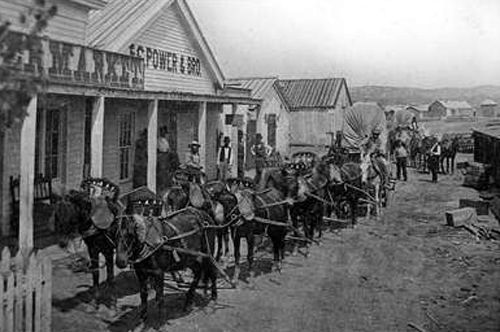
Fort Benton Heydays.
The peak of the riverboat trade to Fort Benton was in 1879, when 47 boats carried 9,444 tons of cargo up the river. The next decade saw Fort Benton take on an air of respectability. Numerous brick buildings replaced shoddily built saloons and brothels, and the levee finally grew more peaceful, having outlived its rowdy reputation. In 1882, the Grand Union Hotel opened. Said to have the finest accommodations between Minneapolis, Minnesota, and Seattle, Washington, it hosted the rich and the famous, but its excellent reputation would be short-lived. A year later, the Northern Pacific Railroad to Helena was completed in June 1883, ending the Benton Road’s long supremacy as the Territory’s most important highway. Two months later, in August, the Canadian Pacific Railroad reached Calgary, abruptly ending the importance of the Northern roads into Alberta and Saskatchewan. Dealing a mortal blow to Fort Benton, the Grand Union Hotel failed in early 1884. Over the next century, the once-luxurious hotel went through a series of owners, declining along the way. However, it has been restored to its former luxury and continues to stand in Fort Benton, operating as a bed-and-breakfast inn. It is listed on the National Register of Historic Places.
The last silver spike to reach Fort Benton came in 1887, signaling the end of the steamboat era. The last commercial boat unloaded its cargo at Fort Benton in 1890. From 1860 to 1890, 600 steamboats reached the head of navigation. Though it had declined much from its previous heyday, Fort Benton continued and fared well during an agricultural boom created by the Homestead Act.
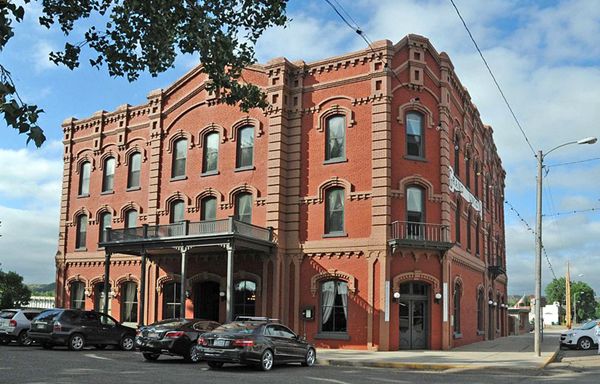
Grand Union Hotel in Fort Benton, Montana’s Historic District, courtesy of Wikipedia.
Meanwhile, the old Fort Benton post had fallen into ruins by 1900. Only the fort’s crumbling northeast blockhouse and part of the adobe wall remained. However, in 1908, the Daughters of the American Revolution rescued the remnants with donated funds, including $1,500 from the Montana Legislature. Their efforts kept the oldest building in Montana standing today. Over the years, several other historic buildings have been reconstructed, including the Trade Store, the Warehouse, the Blacksmith and Carpenter’s Shop, and the main “Sally Port” Gate.
Today, Fort Benton is recognized as the “Birthplace of Montana” and is home to approximately 1,600 residents. It proudly features several sites that showcase its rich heritage, including museums and a walking tour of the historic district, which boasts numerous historic buildings. Fort Benton’s waterfront area was designated a National Historic Landmark in 1961.
The town is a haven for history buffs and recreation enthusiasts seeking solitude and the unique beauty found along the Upper Missouri National Wild and Scenic River. It is along several trails, including the Lewis & Clark National Historic Trail, the Nez Perce National Historic Trail, the Mullen Road, the Whoop-up Trail in Alberta, Canada, and the Fort Walsh Trail in Saskatchewan.
More Information:
Fort Benton, Montana
P.O. Box 262
Fort Benton, Montana 59442
©Kathy Alexander/Legends of America, updated October 2026.
Also See:
Forts & Presidios Across America
See Sources.