
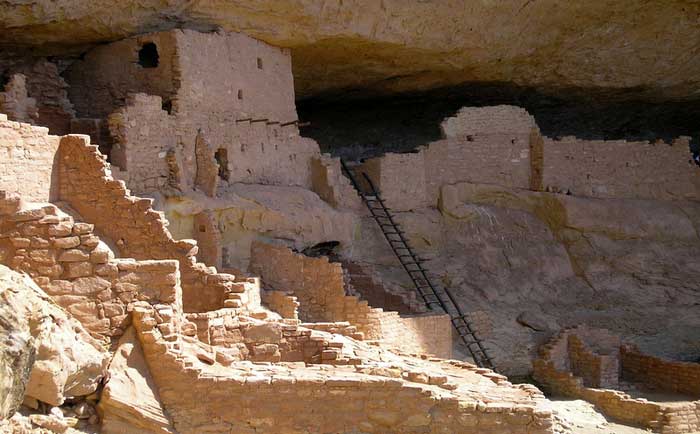
Mesa Verde National Park, Colorado, by Kathy Alexander.
Mesa Verde, Spanish for “green table,” rises high above the surrounding country of southwest Colorado, providing a spectacular look into the lives of the Ancient Puebloan people who made it their home for over 700 years, from 600 A.D. to 1300 A.D. The National Park, encompassing 52,073 acres, protects over 600 cliff dwellings and approximately 4,000 known archaeological sites, only a few of which have been excavated.
The Mesa Verde area was inhabited for approximately 800 years by agricultural peoples who settled there shortly after the beginning of the Christian Era (the period beginning with the year of Christ’s birth). The first farming people in the Mesa Verde area were called Basketmakers (1,400 A.D.) because weaving excellent baskets was their outstanding craft.
At this early date, the people did not make pottery, build houses, or use the bow and arrow. No sites dating from the early Basketmakers have been found within the boundaries of Mesa Verde National Park.
Around the year 400 A.D., people began to make pottery and build roofed dwellings. About 250 years later, around 750 A.D., they started using the bow and arrow. Their culture was gradually changing, and during this “growth” period, archeologists refer to these people as the Modified Basketmakers (400-750 A.D.). Pithouses were built in alcoves and on the mesa tops, and dozens of these have been found on the mesas, two of which have been reconstructed.

Mesa Verde, Colorado, by Kathy Alexander.
Starting about 750 A.D., the people grouped their houses to form compact villages, which were given the name of “pueblo”, a Spanish term meaning village. Many types of house walls were used, including adobe-and-pole, stone slabs topped with adobe, adobe-and-stone, and layered masonry. The houses were joined together to form compact clusters around open courts. In these courts were pithouses, which grew deeper and finally developed into ceremonial rooms now referred to as kivas.
During the last century, some Ancient Puebloan Indians of Mesa Verde left the mesa tops and built their homes in the many alcoves that abound along the canyon walls. This final period marks the apex of Pueblo culture in Mesa Verde and is known as the Classic Pueblo Period (1100-1300 A.D.).
Beginning in A.D. 1276, drought struck the region, and for 23 years, precipitation was scarce. The springs dried up one by one, and the people were in serious trouble. Their only escape was to seek regions with a more reliable water supply. People left village after village. Before the drought ended, these people had left the Mesa Verde area.
The first known mention of Mesa Verde was made in 1859 when Captain J.N. Macomb explored specific territory in what is now the State of Utah. Along with him was Professor J.S. Newberry, who made a geological report of the expedition and described climbing to one of the highest points of Mesa Verde, possibly Park Point, but evidently didn’t make an in-depth exploration, as he made no mention of the cliff dwellings.
The first cliff dwelling known to have been entered by white men was Two-Story Cliff House in Ute Mountain Tribal Park, discovered by William H. Jackson in September 1874. Jackson was a photographer for the U.S. Geological and Geographical Survey, who had heard of the ruins from miners and prospectors. One of these prospectors, John Moss, led Jackson into Mancos Canyon, where the cliff dwelling was discovered. Jackson found other small cliff dwellings in the canyon, but the Two-Story Cliff House was the only one he named.
The following year, the second cliff dwelling was discovered by W.H. Holmes, leader of another government survey party that passed through Mancos Canyon. Holmes named it Sixteen Window House. Over the next several decades, more explorers identified sites named Balcony House, Cliff Palace, Square Tower House, and others.
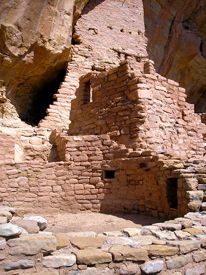
Mesa Verde National Park, Colorado, by Kathy Alexander.
Unoccupied for many centuries, the pueblos were weakened by natural forces, and later some were severely damaged by looters before the area was designated a National Park.
Though the first known suggestion that the area should be set aside as a National Park appeared in an editorial in the Denver Tribune Republican on December 12, 1886, it would be years before any action was taken. A bill was finally introduced in Congress in February 1901 to establish Mesa Verde National Park, but it was never referred to the Public Lands Committee. From 1901 to 1905, more bills were introduced, but it would not be until June 29, 1906, that President Theodore Roosevelt established Mesa Verde National Park to “preserve the works of man,” the first National Park of its kind.
Today, the continued preservation of both cultural and natural resources is the focus of the park’s research and resource management staff.
Archeological sites of many types are accessible to visitors, ranging from pithouses built in the 500s to cliff dwellings of the 1200s.
The cliff dwellings are the most spectacular, but the mesa top pit houses and pueblos are equally important.
Maximum protection must be afforded to the dwellings to preserve them. One regulation is strictly enforced: visitors may enter cliff dwellings ONLY when accompanied by a Park Ranger. However, there are more than 20 mesa-top sites and viewpoints that may be visited independently. Some sites are closed during the winter.
Mesa Verde National Park is in Southwestern Colorado. The Mesa Verde Headquarters is a one-hour drive from Cortez, Colorado, via Highway 160 to the park turnoff, and a 1.5-hour drive from Durango, Colorado, via Highway 160 to the park turnoff.
The park, which is open daily throughout the year, also features a Visitor Center, a museum, guided and self-guided tours, hiking trails, and a campground.
Plan ahead. Check alerts here.
Mesa Verde National Park
PO Box 8
Mesa Verde, Colorado 81330-0008
Headquarters – 970-529-4465
Visitor Information – 970-529-4465
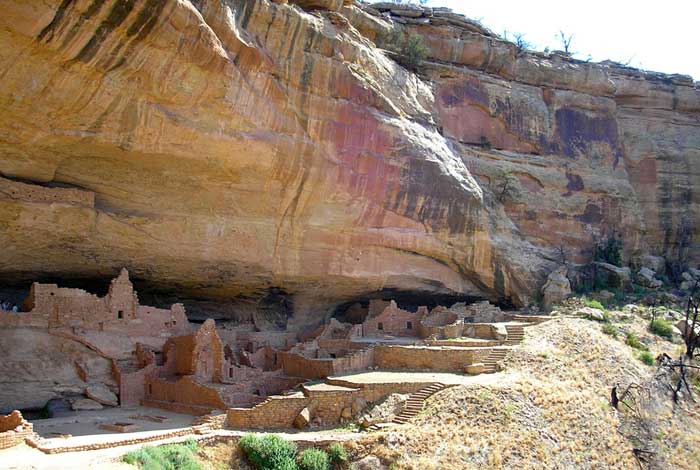
Mesa Verde National Park, Colorado. Photo by Kathy Alexander
©Kathy Alexander/Legends of America, updated December 2025.
See our Puebloan Photo Galleries HERE
Also See:
Colorado – The Centennial State
Ancient Cities of Native Americans
Source: National Park Service