

Navajo County Courthouse in Holbrook, Arizona, by Kathy Alexander.
Before Navajo County, Arizona was formed, it was first made part of Yavapai County on November 8, 1864. But Yavapai County was so large; it was subsequently divided into six different counties on February 24, 1879, from which Apache County was created. Encompassing almost 21,000 square miles, the newly created Apache County was mainly unknown and uninhabited. As Texas cattlemen began to move in, Apache and Navajo Indians raided the settlements. To further complicate matters on this large section of the Old West frontier, Apache County was soon torn by range wars between the newly settled Texas cattlemen and the already established Mexican and Indian sheepmen.
Then again, on March 21, 1895, Apache County was split to create Navajo County. Will C. Barnes’s bill to create the new county caused a two-month fight within the territorial Legislature. Held up by a filibuster, it finally passed within a few moments of adjournment on the last day of the session.
The newly created Navajo County made Holbrook, founded in 1881, its county seat. At first, the county was supported by lumbering, farming, railroading, ranching, and trade with the Indians. It was also a rugged stretch of land, mostly home to a crusty bunch of men. At its center, Holbrook had taken on all the vices of a typical Wild West town, complete with a saloon called the Bucket of Blood. Law and order were non-existent, gambling was popular, and painted ladies far outnumbered “proper women.”
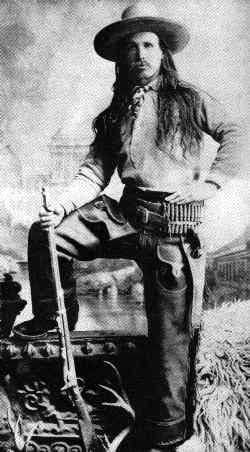
Perry Owens.
Navajo County clearly needed law enforcement, and Holbrook soon brought in Sheriff Commodore Perry Owens to settle the lawless elements. Owens, already the Sheriff of Apache County, had gained a reputation for cleaning up the territory, so much so that he was called “Saint George with a six-shooter.” Owens was appointed its first sheriff, a position he held until Frank Wattron was elected in 1896.
In 1898, the county erected a new courthouse that would become the scene of several notorious trials over the years. The courthouse basement housed the jail cells, manufactured as complete units in St. Louis, Missouri, and shipped to Holbrook on railroad flatcars. The small, dark cells proved effective over the years, as no one ever escaped.
Though the court would continue to dispense justice at this location for the next seventy-eight years, the most famous would always continue to be the first and only man ever hanged in Navajo County.
In November 1899, the new courthouse jail was holding one of its most notable prisoners, a murderer named George Smiley. Convicted of having killed a railroad section foreman named McSweeney, Smiley was scheduled to hang on December 8, 1899. At this time, Arizona law required that the county sheriff send “invitations” of executions to the other Arizona sheriffs, as well as certain territorial officials. However, the Legislature did not provide a form for the required invitation nor any guidelines on the format.
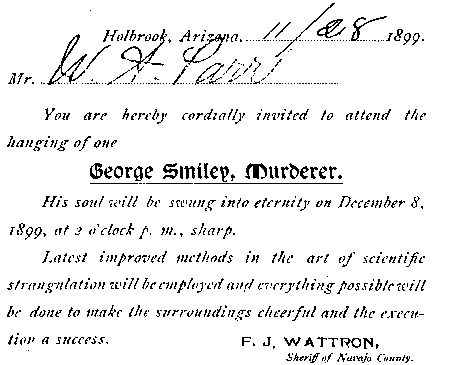
First George Smiley “invitation,” courtesy Arizona Journal
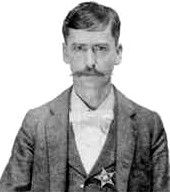
Sheriff Frank Wattron.
Goaded by his friends, Wattron decided to issue a “novel” invitation and have it professionally printed on gilt-bordered paper. However, when a reporter got hold of the invitation, he wired it to the Associated Press.
Before long, newspapers across the nation printed the invitation, and it even appeared in the London Times, the Berlin Tageblatt, and Paris Fiarge. President McKinley then wired Arizona Governor Nathan Oakes Murphy, who stayed the execution for 30 days and reprimanded Wattron.
Though Sheriff Wattron seemed unfazed, telling a friend, “Well, I got a hell of a lot of notoriety anyway,” the incident rankled him. Determined to make his point and have the last word, he prepared a second printed invitation, this time more “mournful” than the first and slightly sarcastic. It too was professionally printed, though this time the invitation was edged in black. He then waited to mail out the second invitation until he was sure the governor and other officials would not receive it until after the execution had been performed.
It read:
The Revised Statutes of Arizona, Penal Code, Title X, Section 1849, Page 807, makes it obligatory for the sheriff to issue invitations to executions, but the form is (unfortunately) not prescribed.
Holbrook, Arizona
January 7, 1900.
With feelings of profound sorrow and regret, I hereby invite you to attend and witness the private, decent, and humane execution of a human being; name, George Smiley, crime, murder.
It is said that George Smiley will be executed on January 8, 1900, at 2 p.m.
You are expected to deport yourself respectfully, and any “flippant” or “unseemly” language or conduct will not be allowed. Conduct by anyone bordering on ribaldry and tending to mar the solemnity of the occasion will not be tolerated.
F.J. Wattron,
Sheriff of Navajo County
I would suggest that a committee consisting of Governor Murphy and Editors Dunbar, Randolph, and Hull wait for our next Legislature and have a form of invitation to executions embodied in our laws.”
In any event, George Smiley was finally hanged on January 8, 1900.
The historic building continued to serve the Navajo County public until 1976, when a new governmental center was established South of Holbrook. In 1978, the Richardsonian Romanesque courthouse was added to the National Register of Historic Places. Today, the historic building houses the Holbrook Chamber of Commerce, a Visitor’s Center, and the Navajo County Historical Museum.
It is also home to a couple of resident ghosts! The most prominent spirit lurking about this historic building is none other than George Smiley, the one and only man ever hanged at the courthouse. After keeping his date with the noose in 1900, he has been seen wandering about the building and pacing up and down the stairs. Historical Society staff also blame this old ghost for doors that seemingly close on their own, strange noises heard throughout the building, and objects that are mysteriously moved.
Another entity seen looking out of the windows is a woman whom staff identifies as a former prisoner named “Mary.” According to the legend, Mary died inside one of the old jail cells while looking out a window and longing for her freedom.
Today, this historic courthouse should be the first stop for Holbrook visitors, as friendly staff will gladly provide maps, directions, and information about the area. The museum offers information on Navajo County’s past, including ancient pottery, Native American art displays, artifacts from Holbrook’s early pioneers and businesses, and a tour of the old county jail. During the summer months, Native American dancers offer free performances on weekday evenings at the courthouse.
Contact Information:
Navajo County Historic Courthouse
100 East Arizona Street
Holbrook, Arizona 86025
928-524-6558 or 800-524-2459
©Kathy Alexander/Legends of America, updated October 2026.
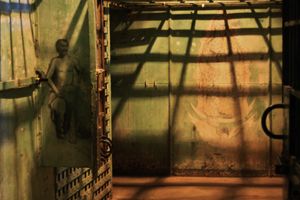
Inside the 1898 Navajo County Jail in Holbrook. Photo by Jim Hinckley.
Also See:
Arizona – The Grand Canyon State
Holbrook – Too Tough For Women or Churches
See Sources.