
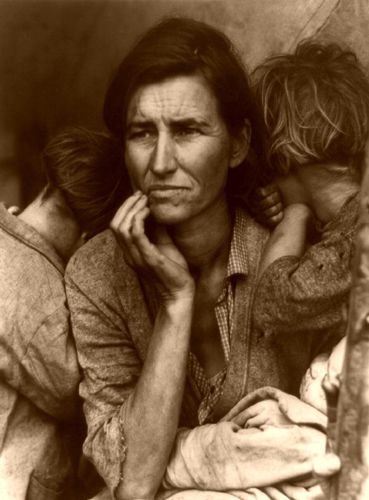
Migrant Mother during the Depression era.
The Great Depression, a worldwide economic downturn, began in 1929 with the U.S. stock market crash, known as Black Tuesday, on October 29th. It was the most severe economic depression of the 20th century.
Affecting virtually every country and both the rich and the poor, the depression had devastating effects on international trade, personal income, prices, and profits. People of all walks of life were affected, especially those employed in heavy industry, construction, farming, and mining.
The causes of the Great Depression were many and varied, beginning with rapid economic growth and financial excess of the “Roaring Twenties.” Excess applied not only to spending, but also to a change of values with women smoking, drinking, and wearing short skirts.
During this period, many Americans rapidly purchased automobiles and appliances and speculated in the stock market. Unfortunately, much of this excessive spending was financed on credit, and while businesses were making substantial gains, the average worker’s wages were not increasing at anywhere near the same rate.
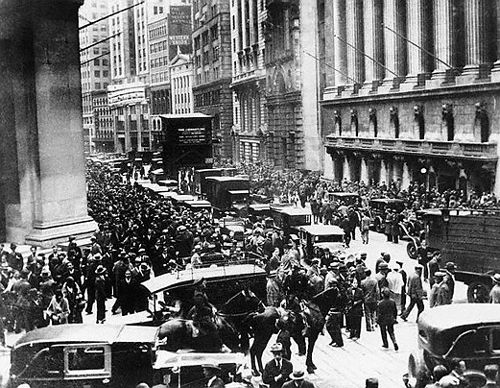
Black Tuesday on Wall Street, New York City.
But, like other “booms” throughout history, the cycle soon led to a “bust.” As manufacturing output continued and farmers overproduced, circumstances changed, leading to falling prices and rising debt. At the same time, there was a major banking crisis, including “Black Tuesday” and serious policy mistakes by the Federal Reserve Board, which led to a decline in the money supply. Making matters worse for farmers, the “Dust Bowl Days” of the 1930s were caused by severe drought and decades of intensive farming without crop rotation. Facing plummeting demand for products, bank failures, and global overinvestment, businesses began laying off thousands of employees. However, the optimism of some major politicians and businessmen remained. Early on, John D. Rockefeller, an American industrialist, said, “These are days when many are discouraged. In the 93 years of my life, depressions have come and gone. Prosperity has always returned and will again.” President Herbert Hoover, underestimating the seriousness of the crisis, called it “a passing incident in our national lives,” and assured Americans that it would be over in 60 days. He was wrong.
The decline in the United States economy triggered a downturn in other countries, before their own internal weaknesses or strengths determined whether their fate would be better or worse than that of the Americans.
The initial U.S. Government response to the crisis exacerbated the crisis and led to Americans’ loss of confidence in the nation’s economic future. Protectionist policies such as the 1930 Smoot-Hawley Tariff Act, which raised U.S. tariffs on more than 20,000 imported goods to record levels, led to retaliation against U.S. industries and strangled global trade. Industries that suffered the most included agriculture, mining, logging, durable goods, construction, and automobiles.
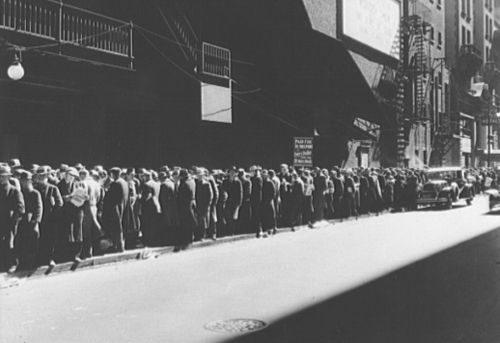
Food Line during the Great Depression.
The Great Depression caused significant political changes, including President Herbert Hoover’s loss in the 1932 presidential election to Franklin D. Roosevelt. The lowest point of the depression was during the winter of 1932-33, but Roosevelt’s economic recovery plan, called the “New Deal,” began to turn the nation around.
From 1933 to 1936, Roosevelt implemented several new programs, such as the National Recovery Administration, which sought to stimulate demand and provide work and relief for people experiencing poverty through increased government spending. Other relief and recovery measures included the Civil Works Administration and the Public Works Administration, as well as the use of prior agencies such as the Reconstruction Finance Corporation, to regulate and stimulate the economy in 1935. Afterward, additional programs were implemented, including the Works Progress Administration and a national relief agency administered through the National Labor Relations Board, which provided a strong stimulus to the growth of labor unions.
During Roosevelt’s first term, unemployment fell by two-thirds and remained low for five years, until the Recession of 1937 temporarily returned it to 1934 levels.
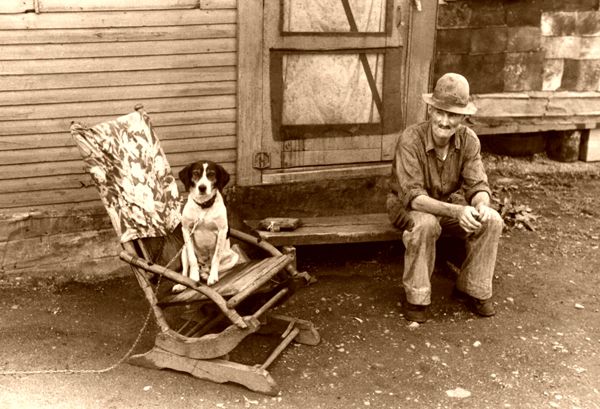
Unemployed Farmer, 1938.
Finally, by May 1938, retail sales began to increase, employment improved, and industrial production rose. Following the recovery from the 1937 Recession, conservative politicians halted further expansion of the New Deal and abolished many of its programs.
The Great Depression ended at different times across countries; the United States did not end until 1941, with its entry into World War II.
During the peak years of the Depression, some 13 million people were unemployed in the United States; industrial production had fallen by nearly 45%; homebuilding by 80%; 5,000 banks had failed; the stock market had lost almost 90% of its value; and over a million families had lost their farms.
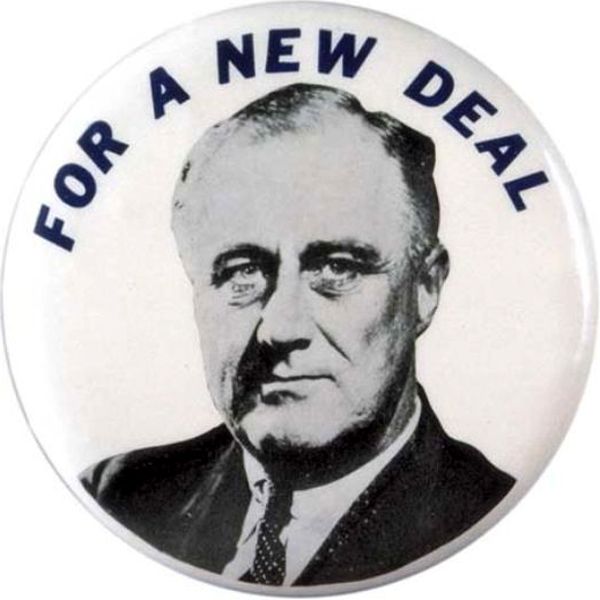
President Roosevelt’s New Deal.
During these turbulent times, individuals were affected not only financially but also psychologically as unemployment caused self-blame and self-doubt. Men were harder hit than women, as they were expected to provide for their families, and it wasn’t very comfortable for them to ask for help. Ironically, while millions of men were out of work, the percentage of women employed during the Depression increased, particularly under New Deal programs. Due to extremely low wages, children sometimes found work when their parents could not. African Americans and other minorities suffered more than whites, as their jobs were often taken away and given to white people. In 1930, 50% percent of African Americans were unemployed.
The Great Depression and the New Deal transformed Americans’ relationship with their government, with the public now expecting government involvement and responsibility for caring for the needy and regulating the economy.
It also created a liberal political alliance of labor unions, an acceptance of women working, African-American rights, and, unfortunately, a new generation of outlaws and gangsters who profited during a time when others were starving.
These, including notorious figures such as Bonnie and Clyde, John Dillinger, and dozens of others, operated during what is sometimes referred to as the “public enemy era” between 1931 and 1935. It also spawned in much of the American public strong habits of careful saving and frugality.
The Great Depression has been the subject of extensive literature, as writers have sought to evaluate an era that caused profound emotional and financial trauma. The most noteworthy novel of the period was John Steinbeck’s The Grapes of Wrath, published in 1939. Awarded both the Nobel Prize for Literature and the Pulitzer Prize, the novel focuses on a poor sharecropper family who travel from Oklahoma to California during the Dust Bowl of the 1930s, seeking a better life.

Former Coal Miners put to work by the WPA in Zeigler, Illinois, by Arthur Rothstein, 1939
©Kathy Alexander/Legends of America, updated February 2026.
Also See:
The Bum Blockade – Stopping the Invasion of Depression Refugees
Dust Bowl Days or the “Dirty Thirties”
Hoovervilles of the Great Depression
See Sources.