
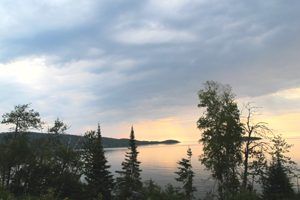
Grand Portage National Monument, MN – Bay. Photo National Park Service.
When the French ceded Canada to Great Britain in 1763, traders immediately began moving across the Canadian frontier to exploit the region’s abundant resources, thereby forming trading companies throughout the Canadian Northwest. Among these was Simon McTavish’s North West Company, which, from 1784 to 1803, was the most profitable fur-trading corporation on the Great Lakes. Although based in Montreal, Canada, the company’s inland headquarters was on the Grand Portage, an 8.5-mile footpath that allowed travelers to bypass the Pigeon River Rapids. Known by the Ojibwe as the Kitchi Onigaming, or “Great Carrying Place,” by voyagers who hauled their canoes over the portage trail, this historic gateway into Canada’s fur country is part of the Grand Portage National Monument, which tells the stories of the American Indians and voyageurs of Minnesota’s Grand Portage.
Although the Cree, Sioux, Blackfeet, Beaver, and Chipewyan Indians are commonly associated with the fur trade in the Canadian Northwest, Grand Portage was and remains the home of the Ojibwe. Also known as the Anishinabe, the Ojibwe people reached the Grand Portage during their migration to Lake Superior in the 1600s. They were resourceful people who, in preparation for winter, began hunting, fishing, and gathering wild rice and other plants as early as the last days of the previous winter. These resources, used for food, medicine, and clothing, enabled the Ojibwe to survive the long winter months they endured while living in peaked, birch-bark-covered lodges.
Approximately 20 feet long, 10 feet wide, and 7 feet high, these winter lodges differed from the traditionally cone-shaped lodges used by the Ojibwe in the warmer months. The winter lodges were warmer, had different designs, and were larger, accommodating up to three or more generations of the Ojibwes’ extended family. Both the warm weather lodges and winter lodges were made of birch bark. The Ojibwe also used water-resistant birch bark to build their canoes, which were 25 to 35 feet long and could carry up to 12 people. The Ojibwe used canoes for fishing, hunting, and other purposes, and voyageurs and traders later adopted them for their own commercial needs.
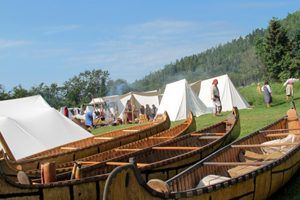
Grand Portage National Monument, MN – Historic Encampment. Photo National Park Service.
Once the Ojibwe taught French explorers how to build birch-bark canoes, these lightweight, swift vessels gave voyageurs greater access to Canada’s fur-bearing animals and wilderness. The North West Company hired skillful voyageurs to transport furs and other goods between Montreal and the Canadian Northwest. These voyageurs separated into two groups to meet the demand for furs and cover the territory between the Great Lakes and Canada’s vast fur country. The North men, or “winterers,” covered the Northwestern territory in Canada. Their counterparts were the Montreal men, or “pork eaters,” who navigated the Ottawa River and the Great Lakes. Once the northern men completed their trade in the fur country, they returned to Lake Superior, where they met the Montreal men at the company’s inland depot at the Grand Portage.
Established in 1784, Grand Portage Depot was the largest fur trading post, where the “winterers” and “pork eaters” voyageurs brought trade goods and gathered supplies. The depot structures did not survive after the post’s abandonment, but historical accounts offer insights into the Grand Portage Depot’s daily life and overall design. These accounts and archeological excavations provided a basis for reconstructing the depot. Among the reconstructed structures at Grand Portage National Monument today are the Great Hall, where company partners dined and conducted business with Indians and clerks; the Kitchen, located behind the hall; the Cedar-Picket Palisade and Warehouse, which served as a secure storage facility; a fur press; and a lookout tower.
The North West Company’s Grand Portage Depot was the site of the annual gathering that allowed partners, clerks, traders, voyageurs, Indians, and anyone connected with the company to wait out the long winter months. Known as the Rendezvous, which in French means “a meeting or assembly,” this winter gathering was both commercial and celebratory. The Rendezvous was a great opportunity for trappers, traders, voyageurs, and Indians to display and trade furs, liquor, supplies, and other goods while dancing and feasting through the night. The partners and their guests usually ate and drank inside the Great Hall. The Ojibwe dressed in ceremonial garb, and the voyageurs in their best attire hosted their celebration outside the palisade.
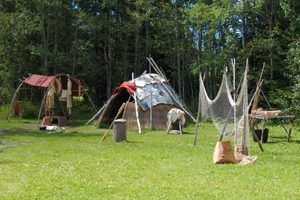
Grand Portage National Monument, MN – Ojibwe Village. Photo National Park Service.
Once the Rendezvous ended, a new trading season began, and voyageur canoes would once again ply the Great Lakes until the next Rendezvous. Although the Rendezvous at Grand Portage ended when the North West Company abandoned the post in 1803, Grand Portage National Monument continues to celebrate this tradition with its annual Rendezvous during the second week of August. Held in conjunction with the Pow Wow Rendezvous Days of the Grand Portage Band of Lake Superior Chippewa, this event commemorates the rich heritage of the Grand Portage.
Visitors are encouraged to begin their tour at the Grand Portage National Monument Heritage Center. This new 16,600-square-foot facility overlooks the reconstructed fur-trading post and honors the history of the Grand Portage people. The Heritage Center houses exhibit galleries that interpret Ojibwe culture and fur trade history, a bookstore, multimedia programs, archives, and a classroom.
Beyond the Grand Portage National Monument Heritage Center, visitors can tour the reconstructed depot on Lake Superior, historic gardens, the Ojibwe village, the voyageur encampment, the dock, and the site’s three log buildings–the great hall, canoe warehouse, and kitchen. Other popular activities at Grand Portage National Monument include hiking the Mount Rose Trail, picnicking beside Lake Superior at the historic pork eater’s camp, participating in ranger walks, and becoming a Grand Portage Junior Ranger Voyageur.
Grand Portage National Monument, a unit of the National Park System, is located within the Grand Portage Indian Reservation in Minnesota’s northeastern “Tip of the Arrowhead,” ½ to 1 mile south of the west and east exits from Minnesota State Highway 61 in the village of Grand Portage, Cook County, Minnesota.
Contact Information:
Grand Portage National Monument
P.O. Box 426
Grand Portage, MN 55605
(218) 475-0123
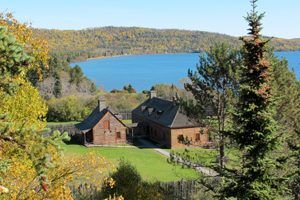
Grand Portage National Monument, MN – Historic Depot. Photo by the National Park Service.
Compiled & edited by Kathy Alexander/Legends of America, updated December 2025.
Also See:
Chippewa – People of the Great Lakes (Ojibwe)
North West Fur Company Trading Post
See Sources.